
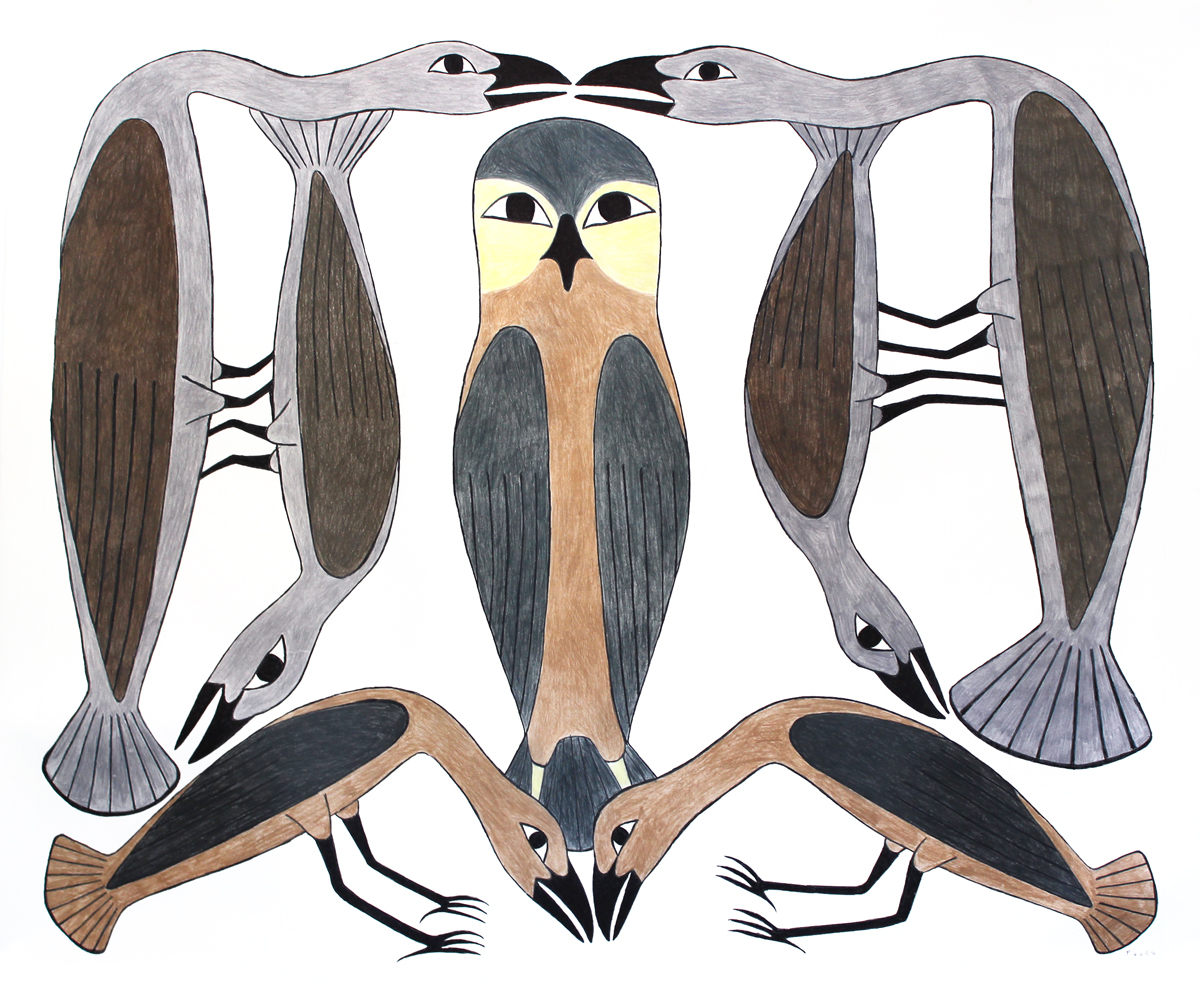
Kenojuak Ashevak, OWL WITH BIRDS, 2011, Coloured pencil & ink, 48 x 57 3/4 in.
First Generation
Drawing on paper was initially introduced in Cape Dorset in the late 1950s, to produce images that could later be used for prints. However, approaching the twenty-first century, a number of elders embraced the idea of drawing as a finished art form, rather than as a step in the printmaking process. Among these artists were Kananginak Pootoogook, Kenojuak Ashevak, Ohotaq Mikkigak, Papiara Tukiki, and many others who had been part of the drawing programme throughout.
Early on, most artists picked up paper from the Studios and drew at home, but renovations around the turn of the century allowed for a drawing space where groups of artists could work together, creating an influx of creativity and styles. Looking at the drawings of the older generation in the early 2000s, it is apparent that individual styles were changing and becoming more diverse. Kenojuak Ashevak left behind her signature balanced compositions to introduce bolder approaches to her drawings with confident experimentations. Kananginak Pootoogook shifted from depicting traditional life and to documenting his daily life, as can be seen in the drawing of rollers and scrapers used for lithography. Ohotaq Mikkigak similarly evolved from his traditional narratives and often humorous imagery to focus on abstract landscapes and local imagery. Eventually, each of the artists began to work in larger scale as the paper became available at Kinngait Studios.
Second Generation
Four artists, two of them new to the drawing programme, were responsible for very new approaches to drawing from 2000-2010. Together, their works embraced a more contemporary and individual style that resonated strongly with southern art collectors.
Arnaqu Ashevak, adopted son of Kenojuak Ashevak, has always had a very distinctive style. He once remarked that his favourite artist was Alexander Calder, and he has made many inventive mobiles using found materials. According to the manager of Kinngait Studios William Ritchie, Arnaqu was the first artist to work in large scale, using a canvas. Before the Studios brought in large scale paper, he would use three sheets of paper together to create triptychs; two of such are included in this exhibition. It was his style, however, that set him aside; he was always searching for innovative compositions, combining negative and positive space, and varying colours from strong to almost pastel.
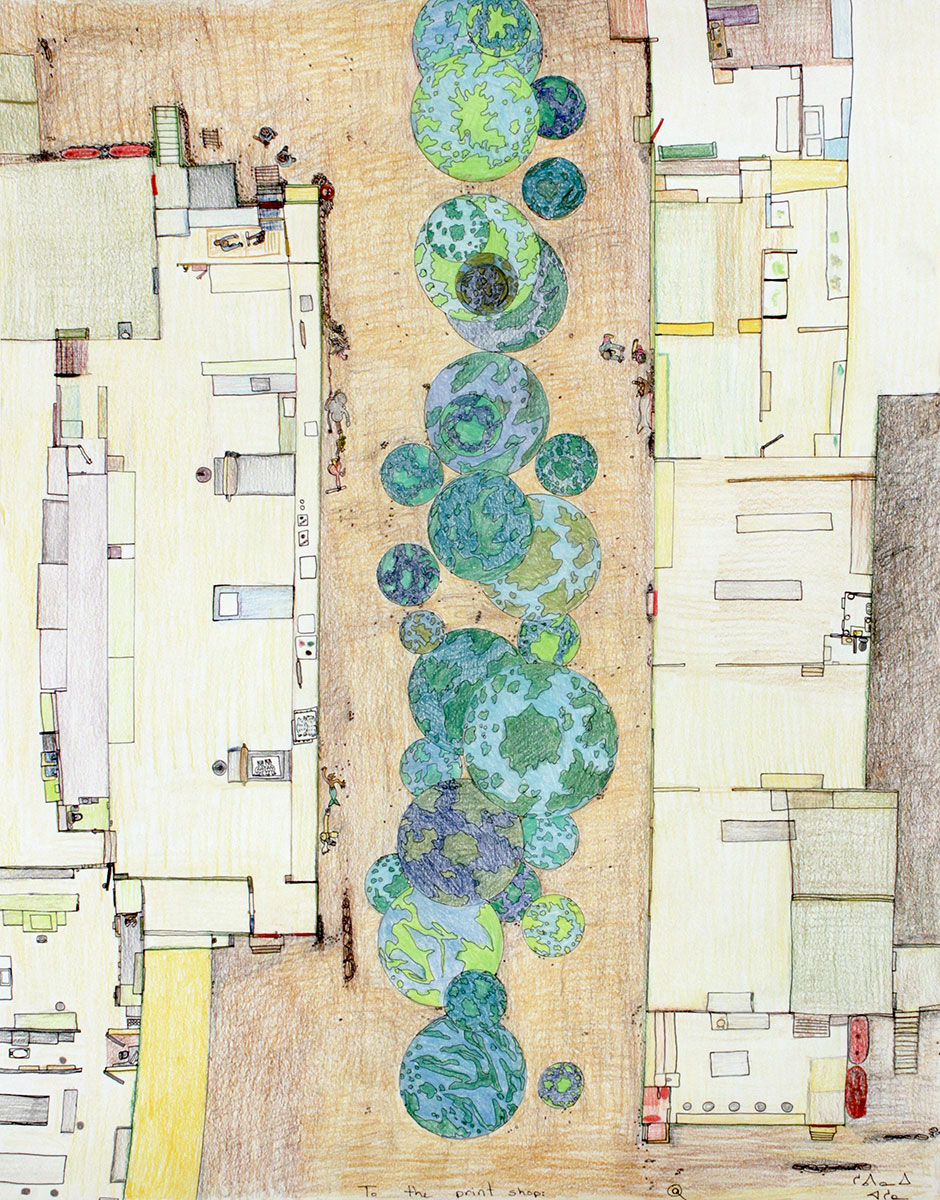
Shuvinai Ashoona, TO THE PRINT SHOP, 2013, Coloured pencil & ink, 28 1/2 x 22 1/2 in.
Annie Pootoogook began drawing in the late 1990s. Her imagery was radically different from any other Cape Dorset artist. Like her grandmother and mother, she chronicled Inuit life but only as she saw it in her lifetime. Annie’s artwork included childhood memories at outpost camps, rather than traditional life for earlier generations. Her simple compositions gained great success nationally and internationally, attracting a whole new audience. Her achievements, in spite of breaking with the traditional drawing style of Cape Dorset, encouraged other artists to draw what they wanted rather than repeating conventional subject matter.
Itee Pootoogook based his drawings on photographic images. At first, he used his own photographs to dictate his subject matter, primarily consisting of people and buildings in Cape Dorset. Itee gradually began using photographs taken by William Ritchie and fellow artist, Tim Pitsiulak. While his drawings were based compositionally on photographs, he transcended the subject matter with his subtle pencil strokes and use of colour.
Throughout this fifteen year period, Shuvinai Ashoona worked with imagery as unusual and radical as that of Annie; however, her drawings were largely based on fantasy and her own world view. Among the works in this exhibition, World Plants depicts a huge kudlik placed in a landscape that echoes the detail of her earlier drawings but adds a fantastic component; the kudlik becomes a campsite created by the artist whose hand appears, while among the rocks of the landscape there are images of the world bunched like balloons.
New Media
Traditionally, drawing materials consisted of pencil, pencil crayon, ink, and wax crayon. Over this fifteen year period however, Cape Dorset artists began working with a broad range of media.
In 2004, Kenojuak Ashevak accepted a commission to design a stained glass window for a chapel in southern Ontario. The combination of the deep colours of the glass combined brilliantly with the lyrical lines of Kenojuak’s composition. Subsequently, images by Kenojuak, Kanaginak Pootoogook, and Ohotaq Mikkigak were developed into limited edition stained glass windows. Each of their drawings was enhanced by the rich colour of the hand made glass. Kenojuak, always willing to experiment, was also the first artist to work with Paul Machnik to create sugar lift prints in collaboration with southern artists who hand coloured the prints.
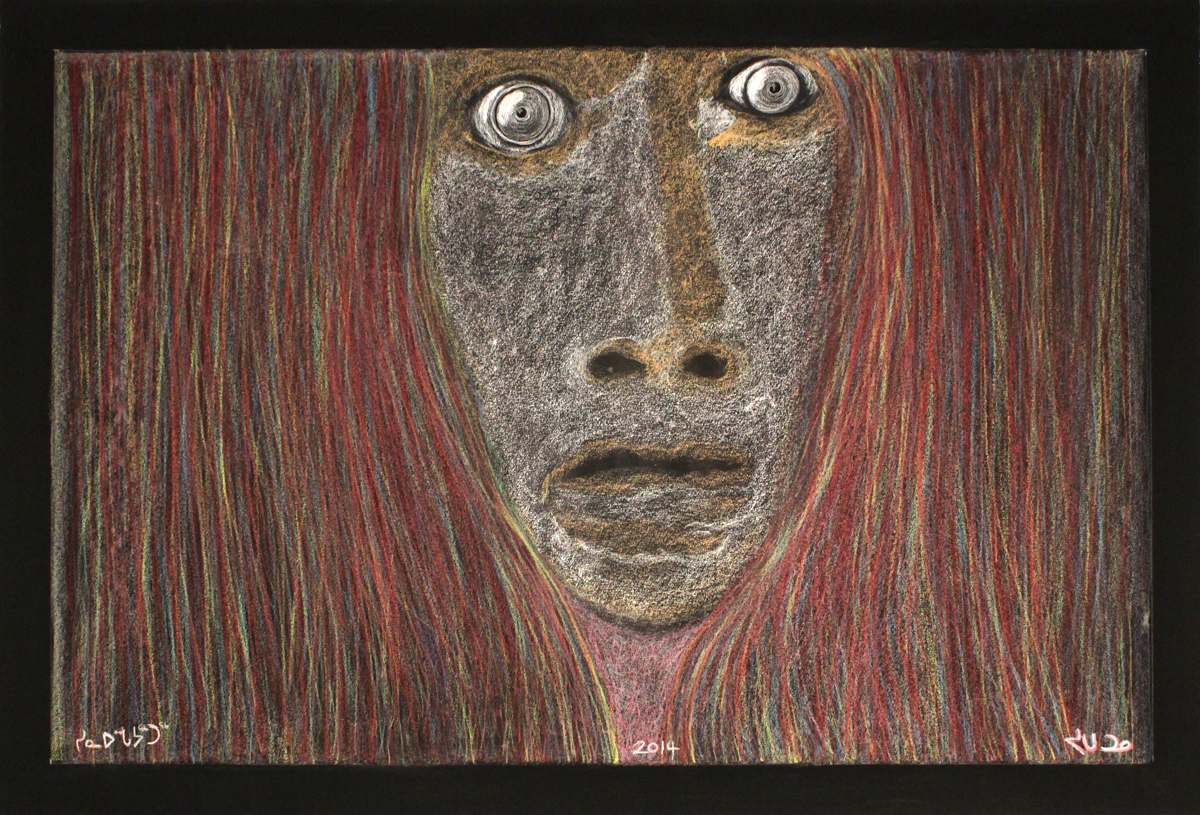
Jutai Toonoo, WOMAN WITH LONG HAIR, 2015, Oil pastel, 30 x 44 in.
Oil stick or oil pastel had been introduced in workshops in the 1990s, but did not become commonly used until after 2005. Although many of the artists experimented with this medium, only a few truly mastered it. Annie Pootoogook used this medium to create a large work on paper that echoes the imagery and style found in her pencil crayon drawings. Others, such as Siassie Kenneally, left behind their usual drawing style and to create monumental and colourful images.
Jutai Toonoo is the one Cape Dorset artist who truly embraced oil pastel. Better known as a sculptor and printer, Jutai began drawing in this period when it became evident that experimentation and innovation was possible. Jutai’s images in this section show his mastery of oil pastel and mixed media; he manipulates the medium by applying heavier or lighter layers, and then scraping away sections or combining it with other materials.
More recently, several artists have been experimenting with watercolour and adapting their personal style to this medium. Considering Tim Pitsiulak’s typical pencil crayon drawings, his watercolour whale shows how he has been able to leave behind the precision of his line and yet still capture the power of the whale.
The New Wave
Thanks to all of the recent developments in imagery, style, scale, and media, Kinngait Studios is one of the most energized, creative and happening art spaces in Canada today. Some artists choose to work in the Studios, while others come to pick up materials and chat. Visiting artists from the south come and go, bringing their own energy and often undertaking workshops.
Sadly, a number of the elder artists have passed, including Kenojuak Ashevak, Kananginak Pootoogook, Itee Pootoogook, Arnaqu Ashevak, and Ohotaq Mikkigak. Each of them played an important role in creating the energy and the magic that is Kinngait Studios today. Their creative legacy lives on through the younger and emerging artists who are now adding to the energy.
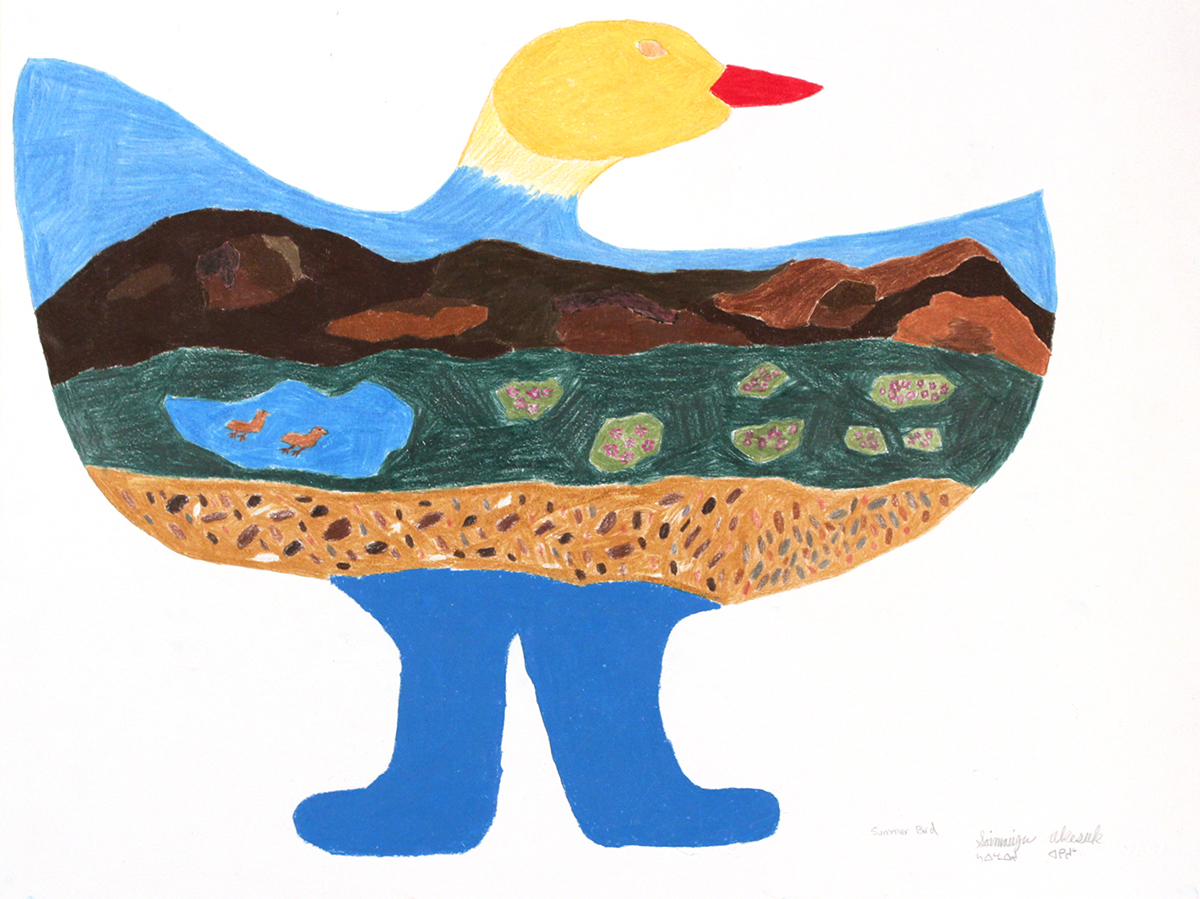
Saimaiyu Akesuk, SUMMER BIRD, 2014, Coloured pencil, 20 x 26 in.
Shuvinai continues to dazzle with her unique drawings. They do not always involve fantasy but her unique style is evident when she depicts day to day life, such as the old community hall or figures holding up drawings that are recognizable as the work of Papiara Tukiki, who created a colourful series of drawings of bugs. Qavavau Manumie, a master printer in the stonecut shop, continues to create his fanciful drawings of figures and birds in his characteristically lighter colour palette. He, like several of the others, has enthusiastically embraced creating artwork on custom made guitars; both a drawing for a guitar and the surface of a guitar are completed. Jutai Toonoo, Shuvinai Ashoona, Tim Pitsiulak, and Ningeokuluk Teevee have also painted the bodies of guitars.
Ningeokuluk Teevee continues to use mythology as her starting point for her beautifully balanced compositions. Humour is often evident; in one of her drawings in this exhibition, a Sedna/Bird transformation sports a high heel on one talon. Her use of negative and positive space harks back to some of the earlier works by Arnaqu. Newly emerging artist Kudluajuk Ashoona freely uses photographs as her starting point; she carefully selects images from her community in the 1970s and 1980s, as well as personal family photos.
Finally, we have included works by the younger generation, Saimaiyu Akesuk, and sisters Nicotye Samayualie and Pudlo Samayualie. All are newcomers to the drawing programme and, like the earlier generations, all have unique styles and imagery. They, and many more to come, are the future of Kinngait Studios. With great enthusiasm, we look forward to the next fifteen years.
To view available drawings for sale from Kinngait (Cape Dorset), click here.
- Annie Pootoogook/
- Arnaqu Ashevak/
- Contemporary Art/
- Gallery Exhibition/
- Group Exhibition/
- Historical Art/
- Itee Pootoogook/
- Jutai Toonoo/
- Kananginak Pootoogook/
- Kenojuak Ashevak/
- Kinngait (Cape Dorset)/
- Nicotye Samayualie/
- Ohotaq Mikkigak/
- Papiara Tukiki/
- Pudlo Samayualie/
- Saimaiyu Akesuk/
- Shuvinai Ashoona/
- Tim Pitsiulak/
Article Tags: