
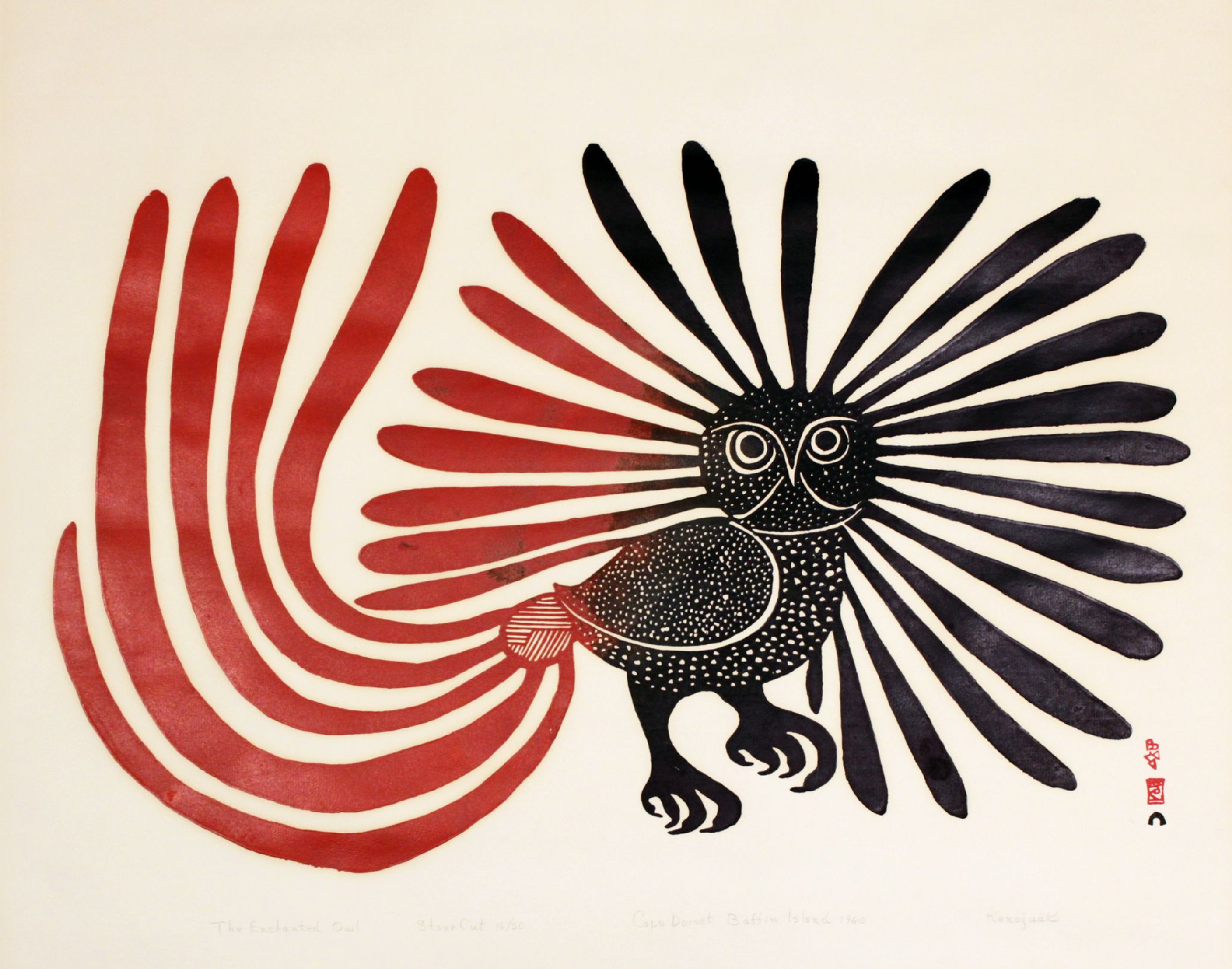
Kenojuak Ashevak, ENCHANTED OWL, 1960, Stonecut, 23 1/2 x 26 in.
Kinngait Printmaking: A Legacy
Many are familiar with the world-famous Inuit printmaking tradition based in Kinngait (Cape Dorset), Nunavut, but the details of its unique history and the inner workings of the studio and co-operative remain a curiosity to those both new to and familiar with Inuit art. This article provides an introduction to Kinngait printmaking and the Cape Dorset Annual Print Collection – from its very beginnings, to the people who helped establish it – to how the prints continue to reach large audiences today, ensuring a lasting legacy.
How did the studio start?
Kinngait printmaking began in the 1950s in a modest 512-square-foot studio. [1] Established with the help of James Houston, a Toronto-based artist and arts advisor, and the Canadian government, the studio was part of a new initiative intended to encourage Inuit artists to produce and sell art and handicrafts. Houston had been appointed to guide this initiative, and the little print shop marked the beginning of a soon-to-be world-renowned centre for printmaking. Uniquely, Houston brought with him knowledge of Japanese printmaking and introduced Kinngait artists to washi paper, and encouraged the use of carved stone printing blocks, inspired by Japanese woodblock printing. The first Cape Dorset Print Collection was released in 1959, consisting primarily of stonecut and stencil prints.
The success of the early print program depended largely on the Inuit artists and printers who skillfully adapted these new techniques to depict their own traditions and interests in pictorial form. Kenojuak Ashevak, Pudlo Pudlat, and Parr, to name a few, became important figures in the development of Kinngait’s graphic art, each developing a distinctive style despite being entirely new to drawing and graphic arts. Notably, art advisor Terry Ryan joined the print studio in 1960 and became its general manager, a position he held for decades. Ryan encouraged artistic experimentation and helped establish the studio as an important centre for printmaking.
How are prints made and selected?
Prints are made at Kinngait Studios through a collaborative process between artists and printmakers. Artists create original drawings that are considered for inclusion in print collections. Once a drawing is selected, a skilled printmaker, trained in techniques such as carving a printing block out of stone or working in lithography, works with the artist to determine how best to translate the image into a print. Less widely noticed is the printer’s unique chop, or “signature,” a unique mark found in the corner of a printed image. Prints are also signed by the artists, acknowledging the contributions of both individuals.
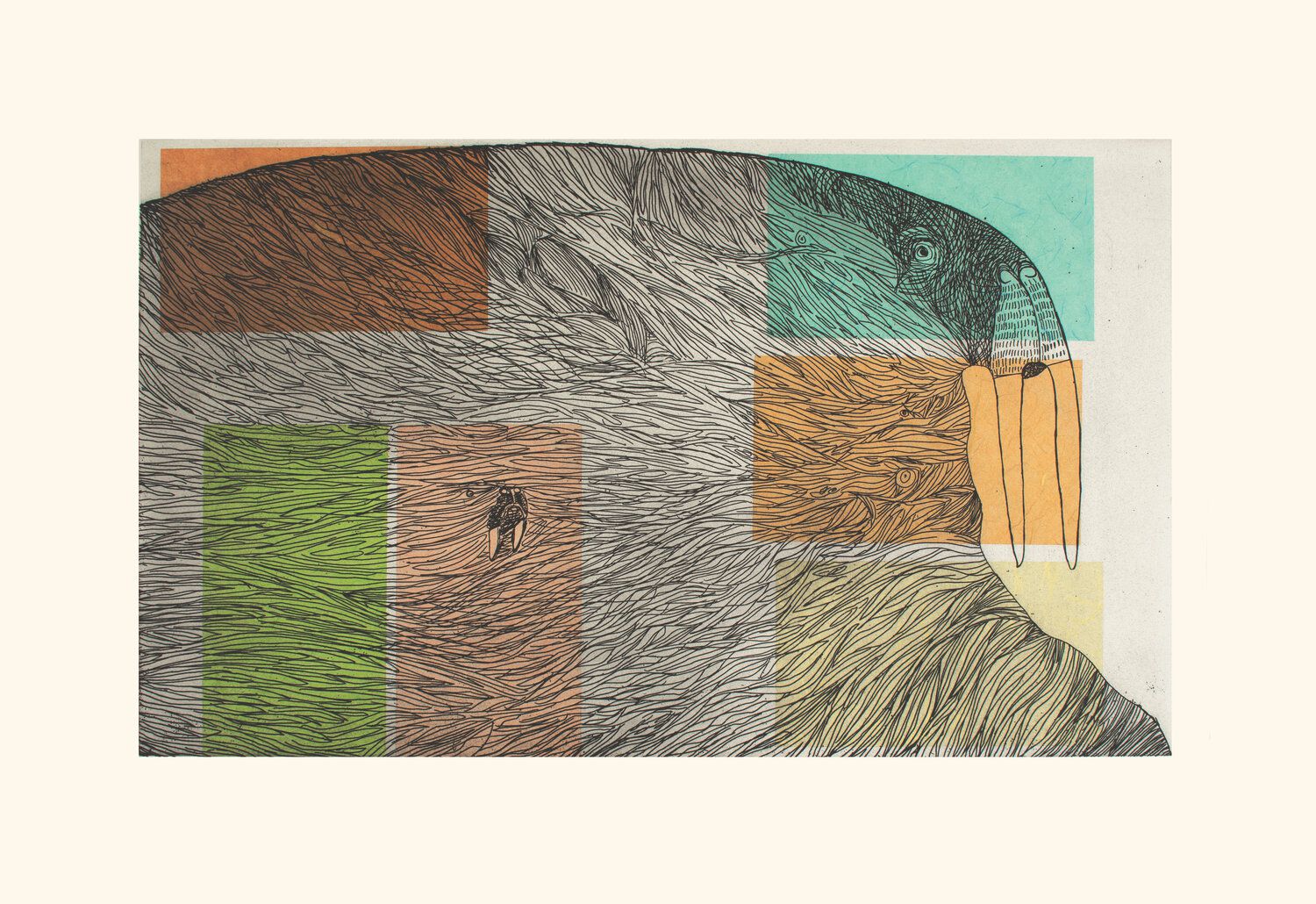
Ningiukulu Teevee, 2021, Etching & chine collé, 23 1/4 x 34 in.
The studio has experimented with numerous techniques over the decades. In the early days, artists first worked with small linocuts before developing the distinctive stonecut technique. Terry Ryan introduced engraving and etching in the 1960s, while lithography was introduced in the 1970s. Later experiments included aquatint, silkscreen, and more recently, chine collé. Throughout it all, stonecut prints have remained among the most coveted works in the collections, harking back to the earliest prints that remain highly coveted today, like Tudlik’s minimalist Division of Meat (1959), and Kenojuak Ashevak’s iconic The Enchanted Owl (1960).
How are prints distributed from the Arctic?
Many wonder how prints from the small community of Kinngait in the Canadian Arctic become internationally renowned and find their way into the collections of major museums like the Met, MoMA, and the AGO. Dorset Fine Arts plays a central role in bringing these works to audiences outside Kinngait, established in Toronto in 1978 as the wholesale marketing division of the West Baffin Eskimo Co-operative. Once prints and other artworks are purchased from the artists by the co-op, the works are sent to Dorset Fine Arts in Toronto to be catalogued, then distributed to selected galleries, such as Feheley Fine Arts, who proceed to exhibit, promote, and sell the work – exposing the artists and their work to diverse audiences.
The annual print collection is one of the most important aspects of this system. Each October, Kinngait Studios releases the Annual Print Collection containing 20–40 different images, with individual prints commonly produced in editions of 50. The annual release has become an important event for Inuit art collectors, museums, galleries, and institutions around the world. Importantly, it also ensures the continuity of Kinngait printmaking, notably offering opportunities for young and upcoming artists to make their debut in the annual collection and find success.
This year marks 67 years of Kinngait printmaking, demonstrating the remarkable longevity and lasting legacy of printmaking in the community. Here’s to another 67 years!
Sources:
[1] Ryan, Leslie Boyd. Cape Dorset Prints, A Retrospective: Fifty Years of Printmaking at the Kinngait Studios. San Francisco: Pomegranate, 2007.
To view available artworks for sale from the Cape Dorset Annual Print Collection, click here.