
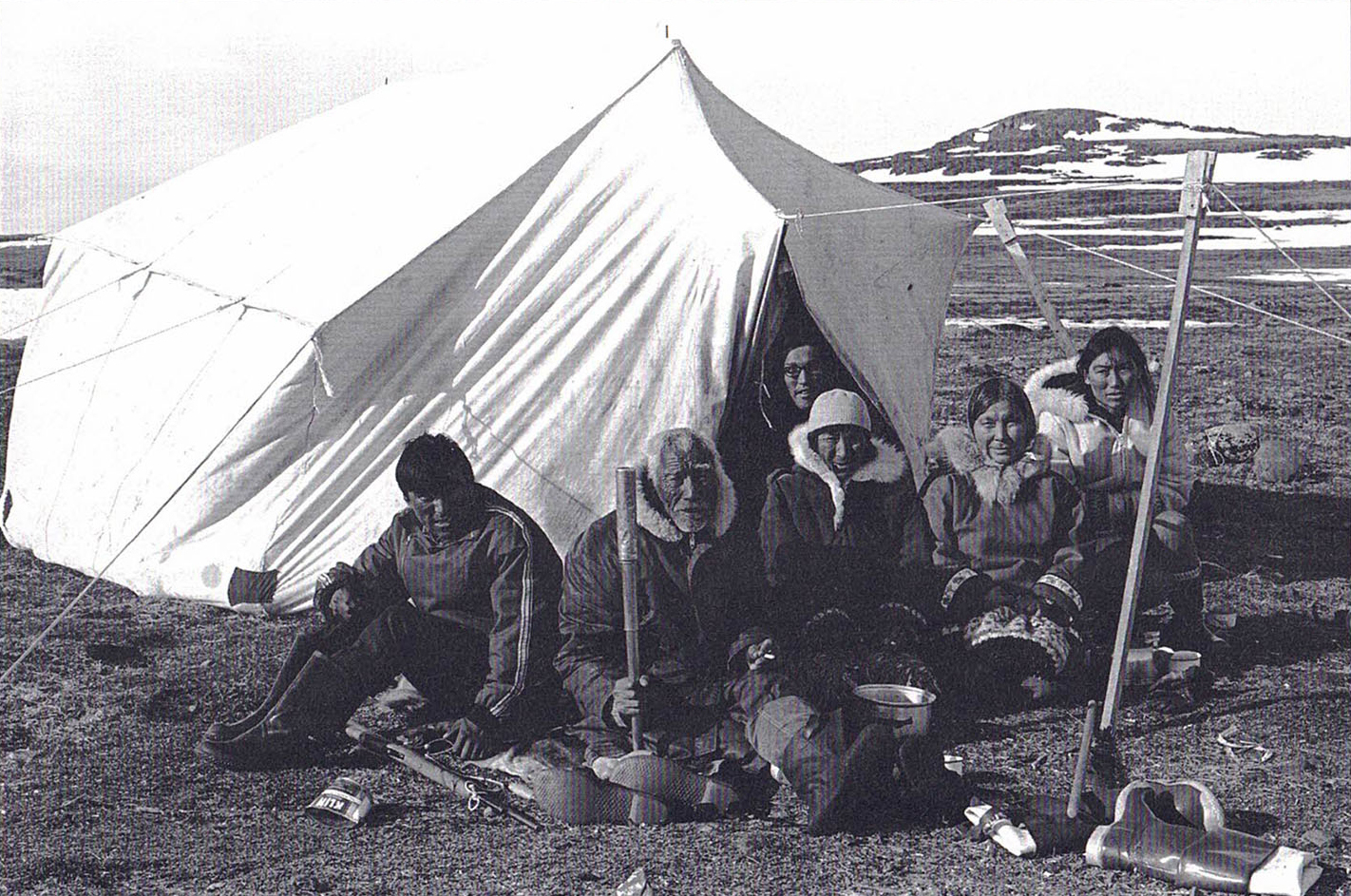
Anguhadluq and Oonark’s camp at the Prince River.
(Digitized catalogue below)
Foreword
Patricia Feheley
The Formation of the new Canadian territory of Nunavut on April 1, 1999 marks the most significant event in a year filled with celebrations for the Inuit and for Inuit art. Feheley Fine Arts is pleased to join in the celebrations and to pay tribute to the artists of Baker Lake in presenting The Butler Collection of early Baker Lake drawings.
Fifty years ago, in 1949, the Canadian Handicrafts Guild in Montreal hosted the first commercial exhibition of Inuit art. This exhibition provided an exciting and overdue glimpse of an art form which was in reality centuries old. The evolution of contemporary Inuit art has continued over the ensuing years. Forty years ago, in 1959, the first collection of prints by Inuit artists was released in Cape Dorset, marking the beginning of one of the most innovative and successful developments in contemporary Inuit art.
Thirty years ago, in the summer of 1969, Jack Butler and Sheila Butler arrived in Baker Lake. Commissioned to assess the potential for arts and crafts production, particularly printmaking, the Butlers intended to stay in Baker Lake for only a few months. Their enthusiasm and admiration for the people they encountered soon ensured an extended commitment. Within a year of their arrival, the successful collaborative process they encouraged resulted in the release of the first of many wonderful Baker Lake Print Collections. Over three years of residence, and subsequent involvement as advisers, the Butlers developed a strong bond with the artists and printers. They wove into the fabric of the group as advisers, fellow artists, colleagues and friends.
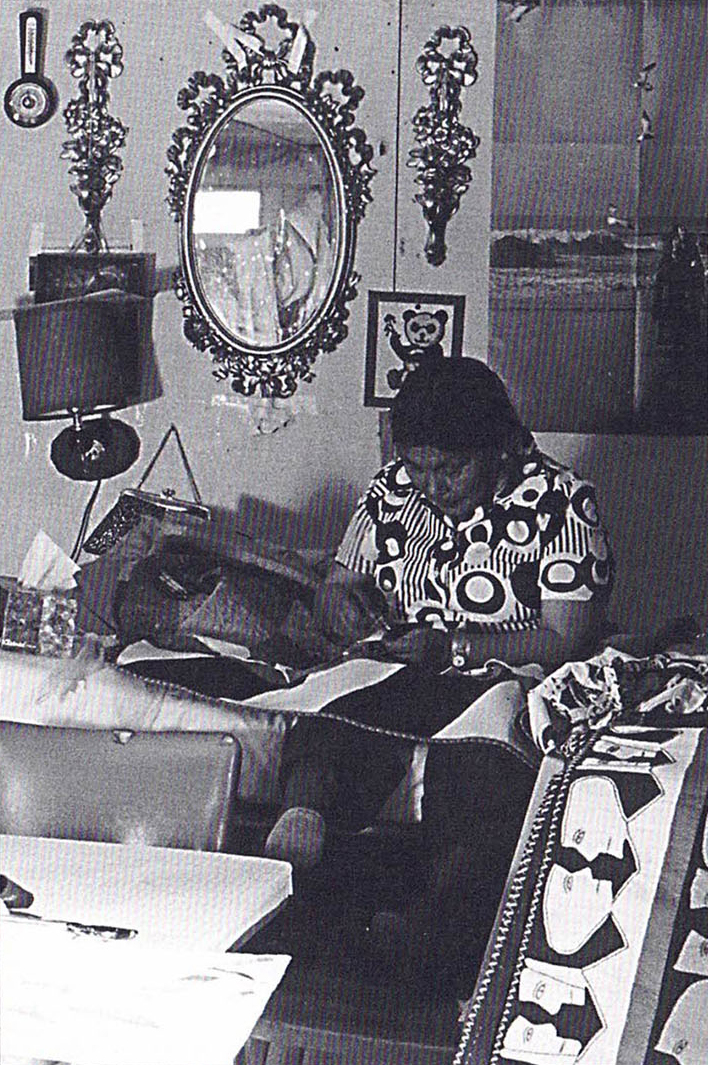
Oonark sewing at home.
This catalogue and exhibition present a selection of images which provide a rare insight into the early explorations of the drawing medium by individuals who are now recognized as among the finest of Canada’s graphic artists. Accumulated over a period of fifteen years, the collection reflects the Butlers’ admiration and respect for the artists of Baker Lake. These drawings confirm that even the older artists, adjusting to the recent loss of the ‘old ways’ of life, embraced with assurance and enthusiasm the new two-dimensional graphic medium. The extraordinary vision and skill brought by these individuals combined brilliantly with the encouragement and technical and artistic expertise offered by Jack Butler and Sheila Butler.
For me, one of the highlights of preparing for this exhibition was a review of the drawings with Jack Butler to record the comments which accompany them throughout this catalogue. His enthusiasm for the artists and their drawings was as immediate and infectious as it must have been thirty years ago when he first encountered them in the Sanavik Co-op. Similarly, a genuine passion is evident in Sheila Butler’s essay in this catalogue, in which she calls for the positioning of Inuit art within broader artistic, cultural and philosophical context.
I would like to thank Jack Butler and Sheila Butler for entrusting this treasure-trove of works to Feheley Fine Arts and sharing so generously their expertise and experience. I would also like to thank Marie Bouchard, art historian and curator, for her collaboration in preparing this exhibition and catalogue. Like the Butlers, Marie worked closely with many of the Baker Lake artists during her eleven years of residence in the settlement. Her work on the artist biographies and her editorial assistance have been invaluable. Further thanks go to Ruby Arngna’naaq who provided translations of the Inuktitut annotations on many of the drawings. I am particularly grateful for the tireless dedication of Michelle McDonnell, who edited the extensive transcripts and coordinated the entire project.
The artists of Baker Lake have shared, through these drawings, their extraordinary vision and commitment, providing inspiration to future generations of artists and endless enjoyment for us. On behalf of Jack Butler and Sheila Butler, I am delighted to announce their plans to share the proceeds of this exhibition with the artists of Baker Lake. It is their intention to capitalize a fund for the production and marketing of selected editions of new Baker Lake prints, thereby extending their legacy far into the future.
The ‘Story Bones’
Jack Butler
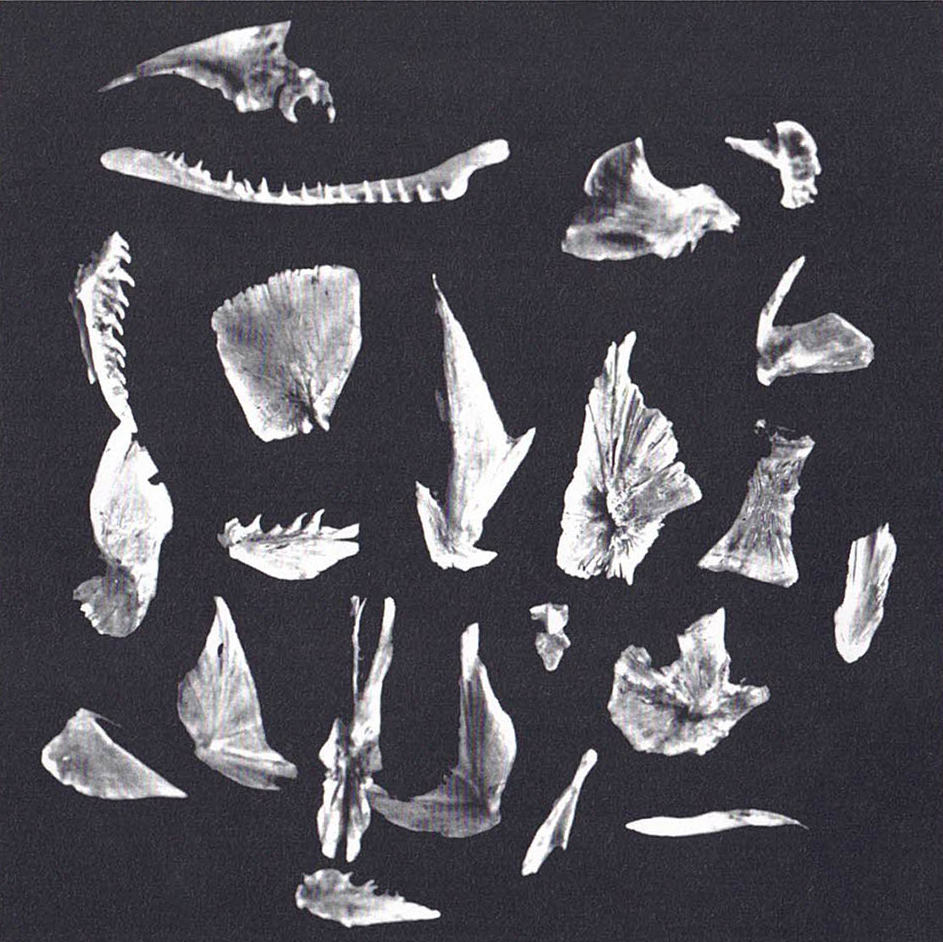
Story Bones game
About halfway through my stay I was brought a gift by an Inuk who spoke no English and who lived on the land most of the time. He was known as Scottie. In a little metal English breakfast tea box was a collection of bones from the head of a trout, each carefully cleaned, and a drawing where Scottie had traced each bone and written on each a name or description in syllabics script. Scottie simply gave them to me and said, “Look at the pictures.” He knew that he was giving me a very special gift. Everyone thought this was very amusing and they were amazed at Scottie’s gift because they hadn’t seen such a thing for a long time. Over the years I’ve asked the Inuit about the bones and discovered they are called ‘story bones’.
Recently, in conversation with Ruby Arngna-naaq about the story bones, I discovered how they were (and may still be) used. You could lay the bones out in such a sequence and in such a pattern as to tell a story. And the narrative would be based on traditional Inuit legends about such cultural heroes as Qiviuq and his wives; or Igutsaq, the bumble-bee woman, who stored the severed heads of her failed husbands in a little igloo adjoining her main living quarters; or the giant whom you must never approach from behind because, if you do you will discover that you can look through his ass and see a world beyond. If, for example, you put three of these bones together in a certain way, you will recognize an Inuit woman in the Baker Lake women’s atigi, with the enormous mutton-chop shoulders which accommodate manipulation of the baby on her back. If you put them in a different orientation, you see a man on a qamutik, a sled. Two particular bones become two ravens talking. These are the kind of legendary tales that the Inuit had been discouraged from remembering prior to the development of the print and drawing programs at the Snavik Co-op.
There is a purpose in ‘telling’ the story bones which is more compelling than the simple pleasure that attends a good story. Within the well-known tale you also give voice to your personal story. You gain license to speak of the unspeakable. If, for instance, there is someone that you loathe, someone who may have taken your spouse or who has one-upped you in some way, you may denigrate him/her by very wryly recounting the facts and giving expression, in the neutral narrative of the game, to confrontational or dangerous contents: what everyone knows but does not dare to say. So the bones provide an opportunity to lay out a social tale without identifying anyone in particular. This is beautiful, isn’t it?
Now when I look at these shapes, I see them as something else: as an exercise in visual thinking. I believe this traditional game functions also as an Inuit equivalent of a basic design course. I think these kinds of shapes, which were the bones from the head of a huge trout, this kind of aesthetic, this way of organizing the play between figure and ground lie behind the graphic forms that we see, for example, in Anguhadluq’s drawings.
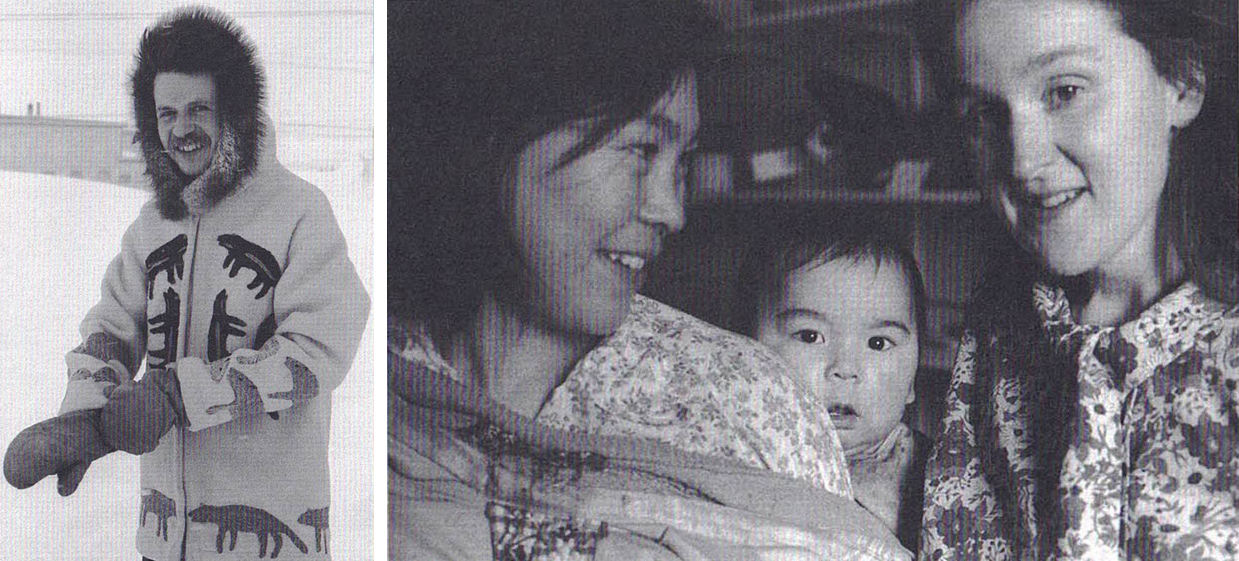
Jack Butler. Sheila Butler, Martha Noah and baby
Jack Butler, Sheila Butler and the Genesis of Art-making in Baker Lake.
Marie Bouchard
Enticed by their growing interest in non-western art, Jack Butler and Sheila Butler left the gritty industrial confined of their hometown of Pittsburgh, Pennsylvania in 1969, with their young daughter in tow, for a temporary hiatus in Canada’s “far North”. This would be their second sojourn in Canada; they had lived in Winnipeg briefly in 1962 when Jack Butler taught in the art department at the University of Manitoba. Glad to leave behind a nation obsessed with the Vietnam War, and the siege mentality of a city plagued by racial conflict, the Butlers’ dream was to settle in Vancouver and eventually become Canadian citizens. The latter they accomplished in 1975 but visions of living by the ocean never materialized. Instead, they found themselves jostling along in a Second World War vintage DC 3 airplane, crammed in amidst cargo, mailbags and oil drums headed not west, but due north. [1]
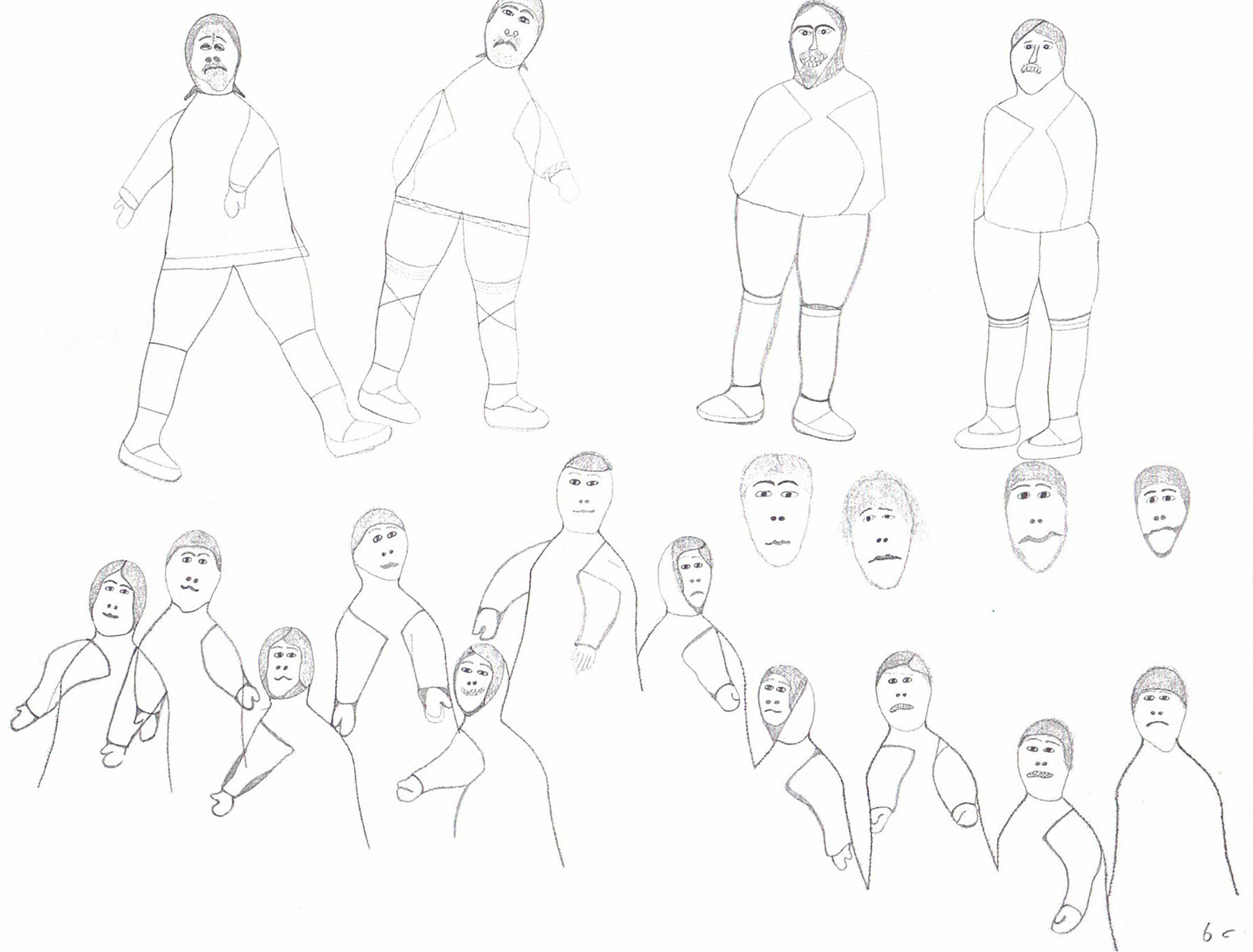
FAMILY GROUP, Harold Qarliksiaq, 1971, Graphite, 20 x 26 in.
“In this case, Qarliksaq is drawing portraits of particular families. He knew these children. As always, his line is very carefully modulated from light to dark grey and enriched with very delicate textural variations. The figures at the bottom are all woven into one continuous line – what a lovely metaphor for a family!”
Both professionally trained as painter and printmakers, the Butlers had accepted a short-term contract with the federal government’s Department of Indian Affairs and Northern Development (D.I.A.N.D.), to conduct a feasibility study on arts and crafts production in the fledgling Arctic settlement of Baker Lake. Similar economic development, already underway in the eastern Arctic settlement of Cape Dorset, had proved successful. The government was anxious to initiate comparable ventures, focusing on printmaking and carving, in other centres as a panacea for the burgeoning number of unemployed Inuit who, forced to abandon their traditional nomadic lifestyle due to a chronic shortage of land foods, now lived in the settlements year-round.
While the physical well-being of the Inuit was assured, the socio-cultural upheaval of recent years had taken its toll. The “make work” arts and crafts program provided needed income for the displaced Inuit now trying to survive in a wage economy, but, as noted by William Lamour, one of the first craft officers appointed to Baker Lake by the federal government, it also, unwittingly, filled an emotional void felt by many of the once self-sufficient caribou Inuit:
With some of the Eskimos the reaction (to carving) was immediate. With others it took longer, much longer, to drag themselves out of the morass of indifference created by the starvation years, breaking up of families, removed from the familiar places of childhood, experience the marks of which are to be seen on the faces of not a few of the men and women portrayed in the carvings. [2]
Other craft officers followed, each with her or his own vision of transforming these former hunters and seamstresses into artists. As William Noah noted in his address to the Baker Lake Art Symposium in 1994, it was a confusing time for Inuit. Art for art’s sake was not a known concept in Inuit culture. “Inuit made dolls and replicas of traditional tools and implements for their children, as toys to play with and learn from. It seemed strange and somewhat foolish to make them for grown-ups,” recalled Noah. To earn money for this and to be assigned the title of “artist” was equally foreign. “We never thought about money or being famous,” stated Noah. [3]
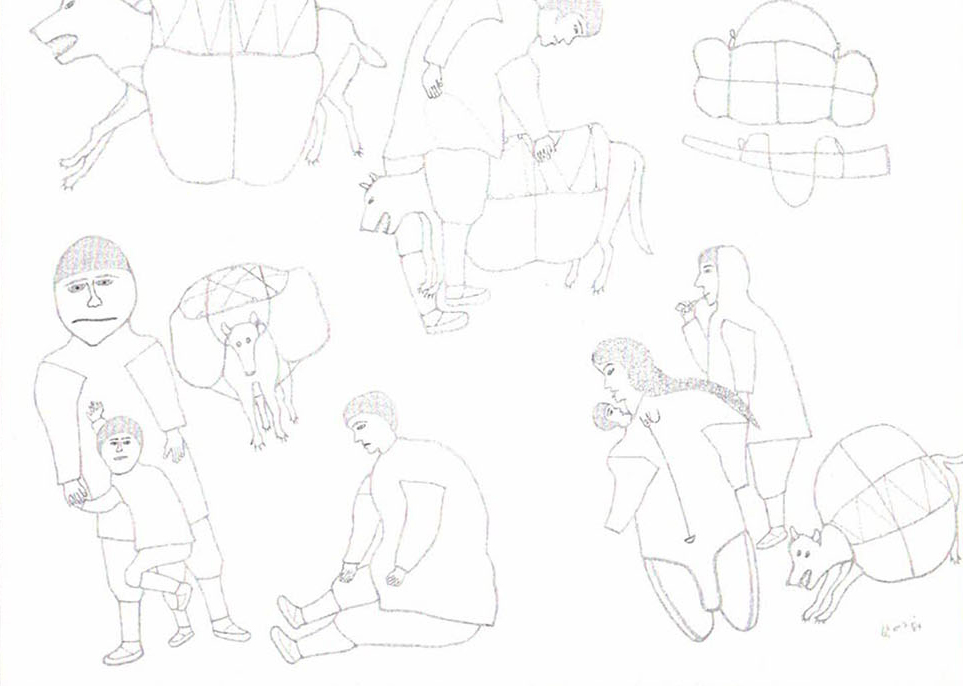
FAMILY AND DOGS WITH PACKS, Harold Qarliksaq, 1977, Graphite, 20 x 26 in.
“Qarliksaq was drawing very particular people in this group portrait: hunters, women and children, the big-faced frontal mother showing a poignant expression – surprise? dismay? perplexity? He was experimenting with how to represent figures, particularly in profile, spatially relative to each other. Note the ingenious use of the turn-of-the-nose-and mouth while the eyes are presented frontally. In this drawing, Qarliksaq also aimed to describe precisely complex physical maneuvers such as harnessing and packing the dogs. To demonstrate his intimate knowledge of his hunter’s business he deploys overlapping forms in a manner that demonstrates his awareness of contemporary western graphic conventions. If we compare Qarliksaq’s description of packing dogs to Anguhadluq’s many drawings of the same subject, I believe it is evident that Qarliksaq took a lesson from western art that was of no interest to the older artist.”
Many participated in the arts and crafts program in order to keep busy, to work once again with their hands and make something useful rather than rely on relief assistance. This was particularly true for the Utkuhikhalingmuit, like Noah and his family, who were among the last to leave their homeland of Back River and settle in Baker Lake. Considered socially backward, they found that settlement life held few opportunities for them. They forged a tentative place for themselves in the arts and crafts program, bringing to bear on this new endeavor their considerable manual skills, a strong visual aesthetic and a wealth of traditional knowledge, the cornerstones of their future success as accomplished, successful artists. While the carvings and prints produced showed promise, these early efforts were crippled by government inefficiencies, lack of proper funding and supplies, and bureaucratic meddling from outside the settlement that largely ignored Inuit values and beliefs. For example, the destruction of an entire collection of prints, deemed technically unacceptable by the then Eskimo Arts Council because the images had been printed in reverse, offended and baffled the Inuit involved in the printmaking program.
This was the milieu the Butlers stepped into when they arrived in Baker Lake in June of 1969, but mercifully preoccupied with getting settled – where was that trunk shipped from Pittsburgh a month ago, anyway? – they were oblivious to the current antagonism toward printmaking and blissfully unaware of just how complicated and frustrating government bureaucracy would become. They had also arrived at the worst possible time of the year to start assessment of the arts and crafts possibilities in the settlement as most Inuit were out on the land, spring fishing, and the qablunaat, non-Inuit, had already headed south for their summer holidays. Undaunted, they set about their task. Rummaging around the craft shop they discovered a small collection of Oonark drawings. “When I saw this,” states Jack Butler in an interview for this exhibition, “I knew we were in business. It was ideal for making prints.” [4]
The Butlers gave a positive recommendation for a sculpture and print-making program at Baker Lake and the rest, as they say, is history. Jack Butler’s three month contract was extended to seven months and included a modest salary for Sheila Butler who had worked as a volunteer on the project in the initial stages. People drifted in and out of the craft shop, duly observing the Butlers making prints before accepting their invitation to try it for themselves. Ever mindful of the Inuit psyche, about which they had studied, and somewhat hampered by the language barrier, they taught by example and slowly but surely nurtured the nascent talent around them. Once engaged, the Inuit brought an intellectual and emotional intensity to the task of interpreting and transforming the foreign materials into two-dimensional visual images and flourished under the Butlers’ guidance.
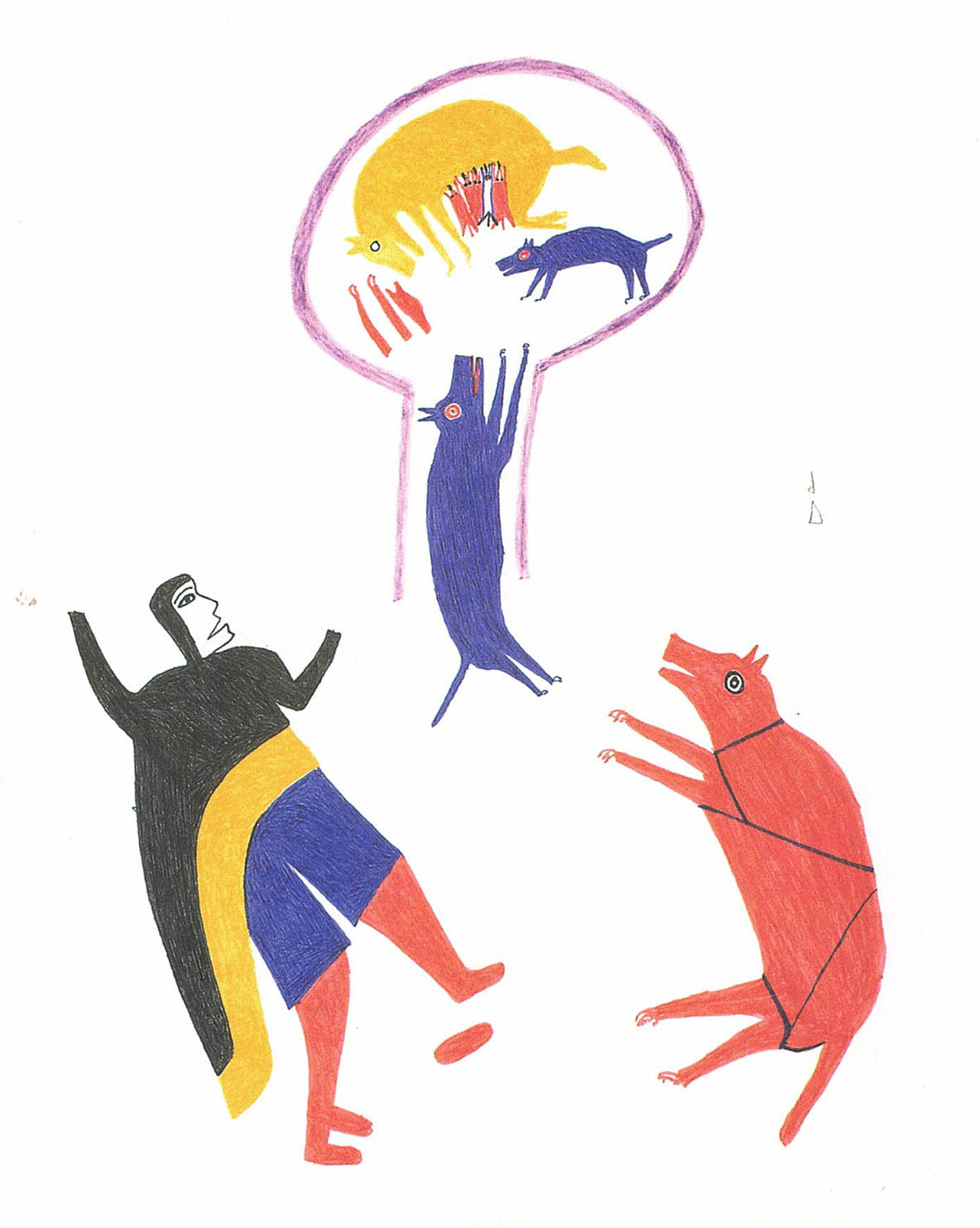
MAN AND DOGS, Jessie Oonark, 1968, Felt pen, 24 x 19 in.
“When we arrived in Baker Lake, there was a small collection of Oonark drawings already completed. When I saw them I knew we were in business; they were ideal for making prints. Oonark’s shapes are even, intensely coloured, and very dramatic. She reads the overall image primarily in terms of shape, not in terms of line. The round grouping at the top was excerpted and translated into a print in 1975.”
Equally important to the Butlers was the development of local leadership so that the arts and crafts program could eventually operate independently of government. Political activists at heart, the Butlers found a ripe milieu in which to blend their artistic practice with social concerns. To this end they were strong advocates for the local artists, helping them with the logistics of being artists: contacting galleries, soliciting grants, ordering supplies and managing their financial affairs. They also achieved some degree of autonomy for the arts and crafts program by successfully negotiating salaries for two Inuit managers and, in 1971, ultimately oversaw the incorporation of the artists under the legal title of the Sanavik Co-operative Association. Undaunted by the severe cold and isolation of the Arctic, the Butlers remained in Baker Lake for three years and continued to serve as art advisers, travelling from Winnipeg, for an additional year. Jack Butler remained in this role until Christmas of 1976, under contract to the artist-run co-operative.
Surviving repeated financial crises, at its peak the Sanavik Co-op provided employment in the production and marketing of local art for some two hundred adults and was the most successful economic enterprise in the settlement. Based on their direct experience with the Baker Lake artists, both Jack Butler and Sheila Butler have argued convincingly over the years against the popular notion that the Inuit are somehow genetically talented people. “The Inuit, like everyone else, work hard at what they have to do and therefore develop special abilities,” explains Jack Butler. He continues, “Perhaps there is a genetic predisposition but I think it is a cultural predisposition. One has to make everything by hand, or had to, with love, respect and hours and hours of incredible labour.” Their efforts bore fruit. Baker Lake became a major art centre known for its commanding sculptures, its large-scale textile art and its bold, vibrant prints released with much fanfare in annual print collections, a tradition that endured for twenty-five years.
The evolution of the drawings, integral to the success of the prints, happened more surreptitiously. “There was no market at that time for drawings,” recalls Jack Butler, “so they had no commercial value in their own right and the government was willing to pay only for drawings That were to be used for prints.” New drawings were urgently needed in order to produce a print collection, but other than Oonark, very few people had actually tried drawing and there were no funds to develop or encourage this medium or to other proper drawing materials. To access new sources, the Butlers launched an informal talent hunt. “I simply offered a kind of blank cheque,”: recalls Jack Butler, “I said that I would buy any drawings that came to the shop and that they could be done by anyone, children or adults; it didn’t matter.” The word spread quickly. The Butlers handed out 2B graphite pencils and sketchbook bond paper, left in the shop from previous projects, and the drawings poured in. Oonark was one of the first to encourage her children “to try drawing and not be lazy.” [5] A sliding pay-scale was used with more money paid for those drawings that showed promise and less for those that didn’t. According to Sheila Butler, the Inuit accepted their aesthetic judgements “…without rancour since drawing was a ‘white’ idea anyway.” [6]
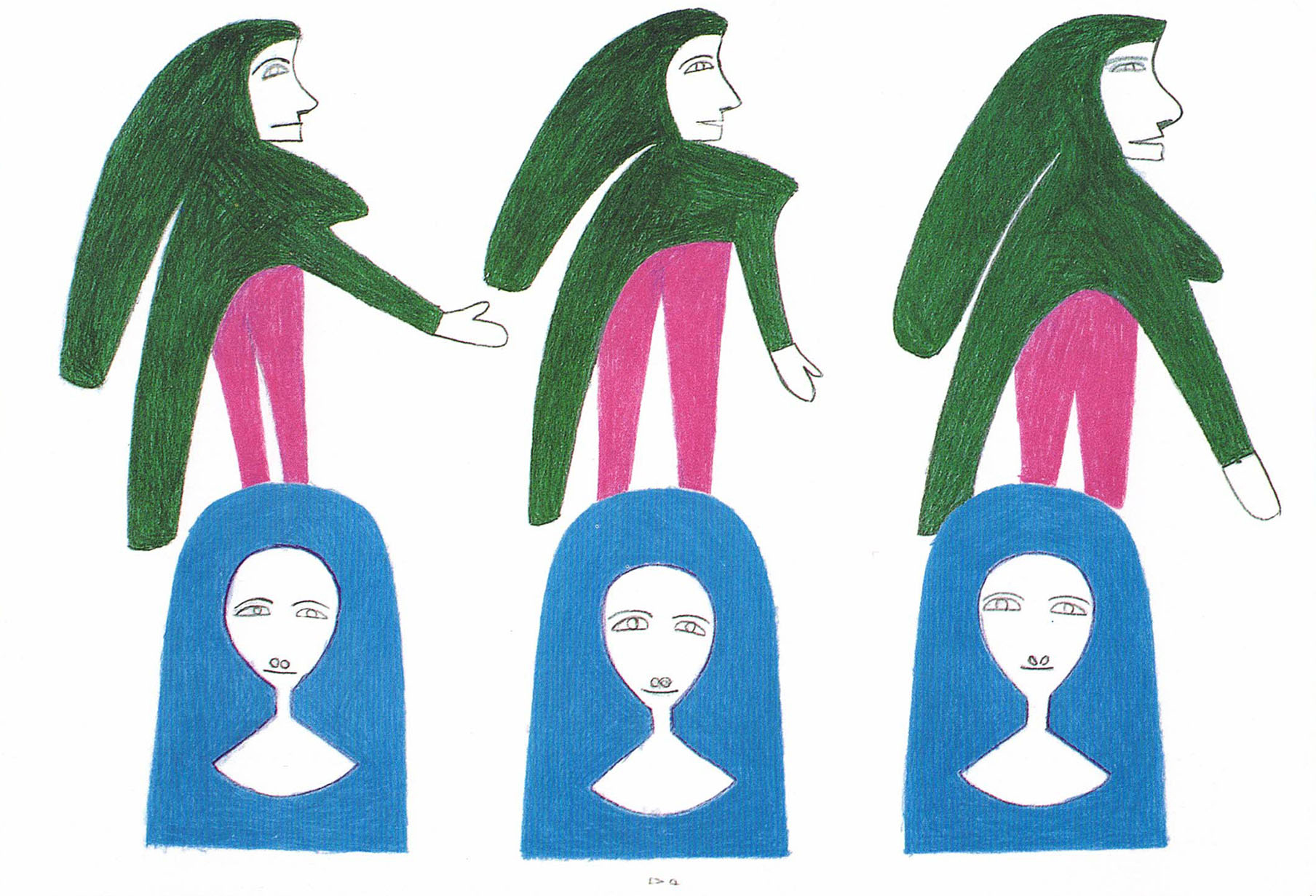
THREE WOMEN ABOVE ULU FACES, Jessie Oonark, 1978, Coloured pencil, 15 x 22 1/2 in.
“In this very graphic composition, Oonark repeats the three female figures to create long, white borders. Other elements in the drawing are constructed through an imaginative blending of rock forms, female faces, and the ulu, the woman’s knife. The poses of the figures suggest movement, yet the effect is static, creating a sense of timelessness. Oonark compresses these images into one multi-layered symbol of power.”
It was in this first accumulation of drawings that the Butlers discovered the talents of Luke Anguhadluq, Ruth Annaqtuusi, Marjorie Essa, Martha Ittuluka’naaq, Janet Kiguisuq, William Noah, Victoria Mamnguqsualuk and Harold Qarliksaq among others. For some of these people, it was their first attempt at drawing. In one of the sketchbooks, was a drawing that immediately caught the Butlers’ attention. Although tentatively drawn with scratchy, hesitant lines, the imagery was remarkably confident. “This was not a child’s drawing by any means,” recalls Jack Butler. He immediately sent a generous payment and a message that he would like to meet the person who had made this drawing. Two days later, Anguhadluq appeared, carrying a bag with a sketchbook full of drawings. As the acknowledged leader of a large family, the stately septuagenarian had come to check out the new qablunaat and the latest arts and crafts venture for himself.
Based on these early efforts, the Butlers ordered better quality paper and Prismacolour pencils, which they offered to the more promising artists. The Prismacolour pencils were intended to replace the popular felt-tipped pens, which were fugitive and would smear easily. According to Jack Butler, it was essential to use a permanent, dry and portable medium, particularly since people would often haul their art supplied back and forth to their camps or work at home in the midst of children and family’s coming and going. Once the new materials arrived, the drawings became more aggressive and authoritative and, when possible, were purchased as works of art in their own right. Unable to squeeze the necessary funds from the government to finance this venture, the Butlers sold the drawings locally to teachers, the school principal, to collectors and anyone else interested. The Butlers’ promise to buy everything meant that many times they had to reach into their own pockets.
“Do you eat seal or do you eat man?” The question still makes Jack Butler shudder. It is the opening line from the narrative of the legend of Igutsiaq. The content of the drawings proved to be a rallying point for the Inuit as the Butlers encouraged them, more and more, to illustrate the stories from the oral tradition that had been driven underground. The traditions and experiences of the Caribou Inuit fascinated the Butlers as well as the younger generation of Inuit who worked at the shop, many of whom were hearing the stories for the first time. “I was encouraging people to do drawings of the traditional tales which had been forbidden by the churches,” recalls Jack Butler. He continues, “People began to draw stories that they would never tell, and then set out to describe what they had drawn and everyone would get into it.” Endless hours were spent discussing the content of the drawings and at these sessions the Inuit became the teachers. The Butlers encouraged the revival of drum dancing, also forbidden. A drum was constructed at the craft shop. “:It was the first place that one was made and we used it for weddings, parties and things,” recalls Jack Butler. As a ceremonial instrument the once powerful drum again served a useful purpose.
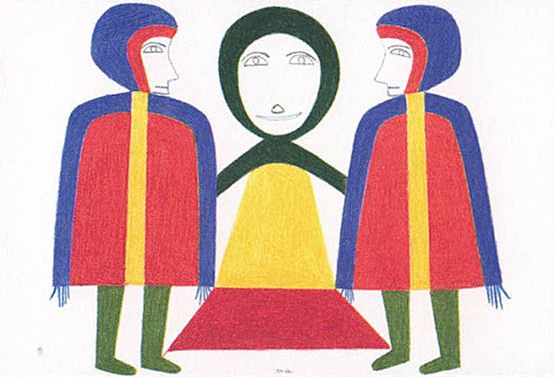
THREE FIGURES, Jessie Oonark, 1979, Coloured pencil, 15 x 22 1/2 in.
“Oonark often created a literal symmetry in her drawing by folding the paper in half or drawing a faint line down the middle of the page; she would then lay out her design with a figure on one side, visually mirrored on the other half of the page. This provided her with a discrete design element which she frequently repeated as a frieze or border pattern in her sewn pieces. The central figure in this drawing, created in this way, has the symmetry and abstract geometry of an alphabetical letterform. The figures on either side of the central fold of the page are almost mirror images, sharing scale, the slope of the shoulder, and their distinctive hoods. When asked about her imagery, Oonark was non-committal. She would often say, “This is not a real person,” or these are, “the people that are within each of us.” It took a long time and much discussion for translators and artists working together at the Co-op to be certain we understood her, and still, the subject of this drawing is ambiguous. It is a symbolic figure that seemed to have many meanings to Oonark.”
To facilitate the discourse on art, the Butlers collaborated with the bilingual artists and printmakers, such as Ruby Arngna’naaq, Michael Amarook and Armand Tagoona, among others, to collectively invent an Inuktitut vocabulary to talk about art. New terms were found to define art concepts, and names were given to art materials and synthetic colours, as well as to numbers above twenty, rarely surpassed in traditional transactions. [7] Communication thus flowed both ways and allowed the artists to actively engage in the art process and the mundane, but equally important, day-to-day operation of the arts and crafts program. Aesthetic criticism and technical quality control were also tailored to suit the cultural sensibilities of the artists who traditionally avoided face-to-face negative criticism. These issues and many others were discussed, at length, at the ‘Monday meetings’ where everyone was encouraged to speak freely.
From these discussions and from their own extensive observations and experience as artists, the Butlers developed several theories about the production of drawings in Baker Lake. In brief, these theories address the aesthetic, cultural and intellectual approaches taken by the various artists in their use of line, colour, and spatial relations to transform, images from the three-dimensional world to a two-dimensional graphic surface. Anguhadluq, for example, used a linear approach based on the idea of a scratched, incised and discursive line. “Even the lines that fill in the outlines of shapes like the contour of a caribou,” explains Jack Butler, “create the feeling of volume and fur because each line contains its visual integrity.” With Oonark, the shapes are dramatic evenly and intensely coloured. According to Jack butler, she was reading the image primarily in terms of shape not in terms of line, and the spaces between the subject matter (the ground) were considered as carefully as the shapes of the subject of the drawing (the figure). Qarliksaq, however, used a thick-thin, continuous fluid contour line. “Not just descriptive,” explains Jack butler, “the line itself has its explicit character.”
Traditional Inuit culture and language inform the way the older artists organize and conceptualize their images and the aesthetic behind their graphic forms [8]. On the other hand, drawings by younger Inuit artists, such as Oonark’s children, reflect the acculturation of visual art practice, rooted in the same ancient traditions but influenced by western pictorial imagery, found in mail order catalogues, Sunday school papers, record jackets, comic books and other visual representations that reflect their daily lives. The early Baker Lake drawings collected by the Butlers are a precious and important documentation of the search for graphic description among artists whose life experience spans the gamut from ancient to contemporary. Jack Butler commented during the preparation for this exhibition that it is a rare and breath-taking experience to see such divergent but related forms of graphic representation as that of Oonark and her daughter, Pukingrnak, two generations of artists working simultaneously, exhibited side-by-side.
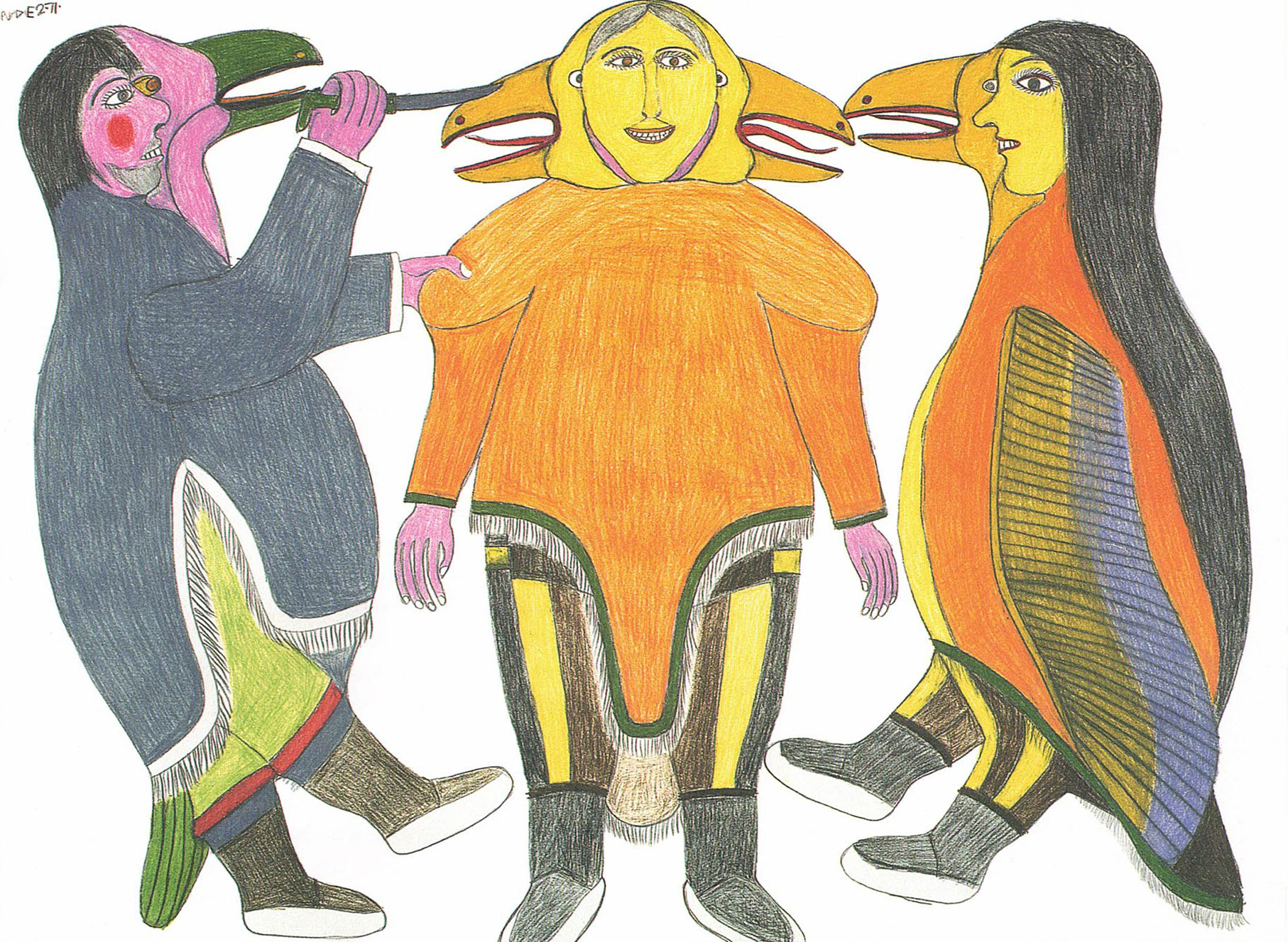
BIRD BEINGS, Janet Kigusiuq, 1974, Coloured pencil & graphite pencil, 22 1/2 x 30 in.
“Kigusiuq employs a unique graphic order with its own rules and regulations, which results in a mixture of a linear descriptive approach like that of Mamnguqsualuk and a highly formal, hieratic, presentation which is very much like that of Oonark. Increasingly, Kigusiuq moved in the direction of large, powerful, frontally deployed pictures which are, I think, her strongest work.”
One of the last tasks Jack Butler undertook in 1976, his final year as art adviser, was to move the entire inventory of drawings, prints and proof prints from the Sanavik Co-op to the Winnipeg Art Gallery. It was an expensive, difficult undertaking but he was anxious to store the works in a more permanent, climatically controlled, secure setting. As he stated, “I didn’t leave until they were shipped because I feared that this was the only legacy.” In December 1977, the Sanavik Co-op burned to the ground. His premonition had proven true. “It was the last thing I did,” states Jack Butler; “It was a stroke of luck or we would have none of this.”
Notes:
[1] For more complete account of the Butlers experience in Baker Lake see Sheila Butler, ‘The First Printmaking Year at Baker Lake,” The Beaver, Spring 1976, reprinted in Inuit Art: An Anthology, ed. Alma Houston, Winnipeg: Watson & Dwyer, 1988.[2] William Lamour, Eskimo Carvers of Keewatin, NWT, Winnipeg Art Gallery, July 1964, p.15.
[3] William Noah. Excerpt from address delivered to Baker Lake Art Symposium, August 1994.
[4] Jack Butler. Interview with Pat Feheley, Feheley Fine Arts, Toronto, December 1998. All quotes by Jack butler are from this interview unless otherwise noted.
[5] Marie Bouchard. “Kingusiuq & Mamnguqsualuk: Daughters of Oonark,” Print Retrospective 1978-1988, Canadian Arctic Producers, 1996.
[6] Sheila Butler, op. cit., p.106.
[7] Jack Butler, “My Visual Art Practice: Its Social Value,” Fate Maps, The art Gallery of Peterborough, January 8 – February 14, 1999, p.25.
[8] Sheila Butler, “Inuit Art, an Art of Acculturation,” The First Passionate Collector; The Ian Lindsay Collection of Inuit Art, The Winnipeg Art Gallery, 1990, pp. 38-39.
Inuit and Eskimos, Baker Lake Re-Visited.
Sheila Butler
An edited version of this essay was first published in “C” Magazine, Spring, 1995

MAN HARASSED BY BEARS AND BIRDS, Janet Kigusiuq, 1976, Coloured pencil & graphite, 22 1/2 x 30 1/2 in.
“In this drawing Kigusiuq is closest to her mother, Oonark. The drawing is visually full, a complex combination of the fantastic and the naturalistic which uses a heraldic, symmetrical design. It incorporates large fields of colour with simple lines. Yet look at the birds’ feet: they are anatomically current and precise, knowledgeably drawn, as are the feet of the owl in the middle. I think this is Janet Kigusiuq drawing at her very best.”
In the Canadian imaginary, the mysterious and powerful role of exotic Other has long been assigned to the Inuit, inhabitants of a frozen realm supposedly devoid of life, inexpressibly white and threatening. In the daydreams of inhabitants of southern Canada, the Inuit are the “true North strong and free”, living formations of fantasy, playing indigenous Man Friday to our shipwrecked Robinson Crusoe nation of immigrants. Cut off from us by blinding snowstorms and vast spaces, it is so much easier to imagine them as mythic, shamanic, the dark side of the moon, compared to southern Canada’s native inhabitants. The latter life in too close proximity to mirror so effectively the unspoken desired of our Euro-centric culture, and so the role of romantic Eskimo has come to be constructed for the Inuit. This constructed identity, in Gayatri Spivak’s words, may aptly be described as a reflection of “the desire to produce the other as well as to appropriate the other” (Spivak, 1988, 7).
I, myself, entered into this dialectic of production and appropriation in 1969, when my husband, Jack Butler, and I and our daughter Emily sold most of our household effects and other belongings and moved to Baker Lake, N.W.T. Although we were departing from Pittsburgh, Pennsylvania, this was a return to Canada for us; we had lived in Winnipeg for a few years beginning in 1962. Our return was precipitated by the grim experience of watching students and relatives snared by the draft for the war in Vietnam, and by race riots, fires, curfews and, in response, armed members of the National Guard in the streets of Pittsburgh. (Later, I compared it to my experience of colonialist appropriation of Difference as noble savage, another kind of violence, in the minus-thirty-degree darkness of Baker Lake winters.)
Ostensibly, we travelled to this small settlement, approximately one thousand miles north of Winnipeg, to do a short-term assessment of the feasibility of establishing a print-making project. We were under contract to the federal government, and our government contacts represented the printmaking project at Cape Dorset in the eastern Arctic as the ideal model. Art production in Cape Dorset existed then, and still exists, as one of the very few successful economic ventures for indigenous people in the Canadian Arctic. Preliminary planning directed toward a viable economic base for the Canadian Arctic settlements simply did not happen when these communities were founded by the federal government in the 1950s. Sothern Canadians, I have found, are largely unaware that the Inuit ceased to be nomads, and settled into village life (in historical perspective quite recently) in response to wide-spread starvation.
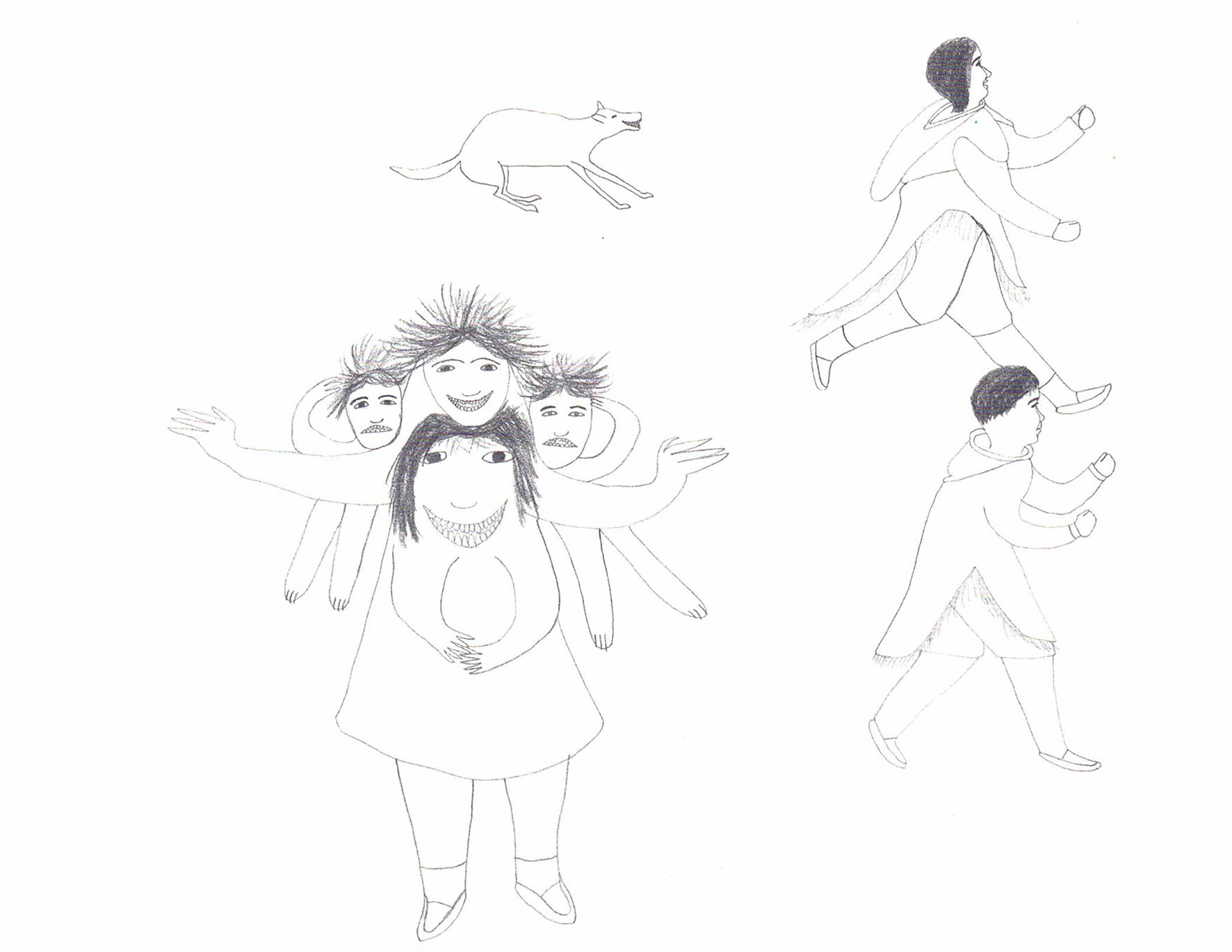
TERRYFING CREATURE, Victoria Mamnguqsualuk, 1969, Coloured pencil & graphite, 19 x 24 in.
“Mamnguqsualuk is one of Oonark’s daughters and, by comparing the drawings of mother and daughter, we can see generational changes in aesthetic expression. Whereas her mother’s work is hieratic (the importance of the subject, as opposed to its position in space, determines its size), symbolic and, I believe, derived from the processes involved in traditional clothing design, Mamnguqsualuk’s life and visual experience differ from those of her mother. Mamnguqsualuk’s drawings are narrative in structure. Her narratives appear within a pictorial space where distance is conventionally represented by overlapping forms, relative size, and position on the paper in relation to the top (distal) and bottom (proximal) of the sheet.
The subject matter of this drawing was problematic in the early days of the Sanavik Co-op. Drawn from traditional myths, it was considered taboo in the context of Paper Lake’s Christian community. Because of this clear form and candour I wanted, for years, to have this drawing made into a print, but none of the print-makers would undertake the subject.”
Writing about the people we knew in Baker Lake, anthropologist Nelson Graburn comments on the “Caribou Eskimos of the Barren Grounds, some half million square miles north of the tree line west of the Hudson Bay. These scattered populations depended mainly on the vast herds of migratory caribou and the fish resources of the Thelon, Kazan, Back and other rivers and lakes.” Since these people traditionally did not hunt sea mammals, their survival was more precarious than that of the Inuit groups whose material culture included the mead and skins from seals, whales and other sea mammals. Graburn continues, “With their limited resources, they [the Caribou Eskimos] had to be more constantly on the move, and were subject to drastic periods of starvation even in recent times” (Graburn and Strong 1973, 139). I knew a little of this history when I first arrived in Baker Lake, but it gradually became apparent that the lived reality of recent history for the Baker Lake Inuit exceeded my powers of imagination. The people I worked with had, in many cases, seen their spouses and children die from lack of food: this, in mid-twentieth century Canada.
In an introductory essay to the catalogue for the 1972 print collection, William Noah describes memories of his arrival in Baker Lake in the late fifties and his introduction to settlement life:
I remember my father very well when he was dying. It was a sad day for us, especially for my mother and me. For a few years after he died my uncle and his brother tried to look after us but there were too many of us. My father was a real hunter who knew how to take care of a big family. After his death we had hard times with no food and poor clothing. … A few years later all of my sisters except one were married, and my brother decided to move to his father-in-law’s camp near Baker Lake. I decided to go with him. We took off in the early morning, traveling all day in very cold weather and stopping to camp very late at night. The first night I was very lonely for my mother and sister, but that was my choice so it had to be that way. We traveled for five or six days until we finally reached the camp of Luke Angosaglo, who is today an artist. … After resting for a few days at Angosaglo’s camp, we traveled on. In two days we reached Baker Lake and I walked to the R.C.M.P. about my mother and sister because I knew they would soon be out of food. A few weeks later I heard that the R.C.M.P. had brought my mother and sister to Baker Lake by plane. So I went among the igloos to look for my mother’s igloo. I found it right away because my dog was standing in the doorway waiting for me (Noah in Sanavik 1972, 4).
Mo own arrival in Baker Lake, and the ensuing acceleration of art production in that settlement, thus coincided with abrupt cultural change, new cultural imperatives and new survival needs for the Inuit living there.
Art production in this contemporary Canadian community for a time withstood the shock of an incredible array of contradictory impulses, value systems and relations of power; it served as a site for temporary constructions of meaning. My perception is that works of art claimed for the Inuit artists a tentative, precarious position of stability in the midst of vast social change. In a catalogue essay published in 1991, I wrote:
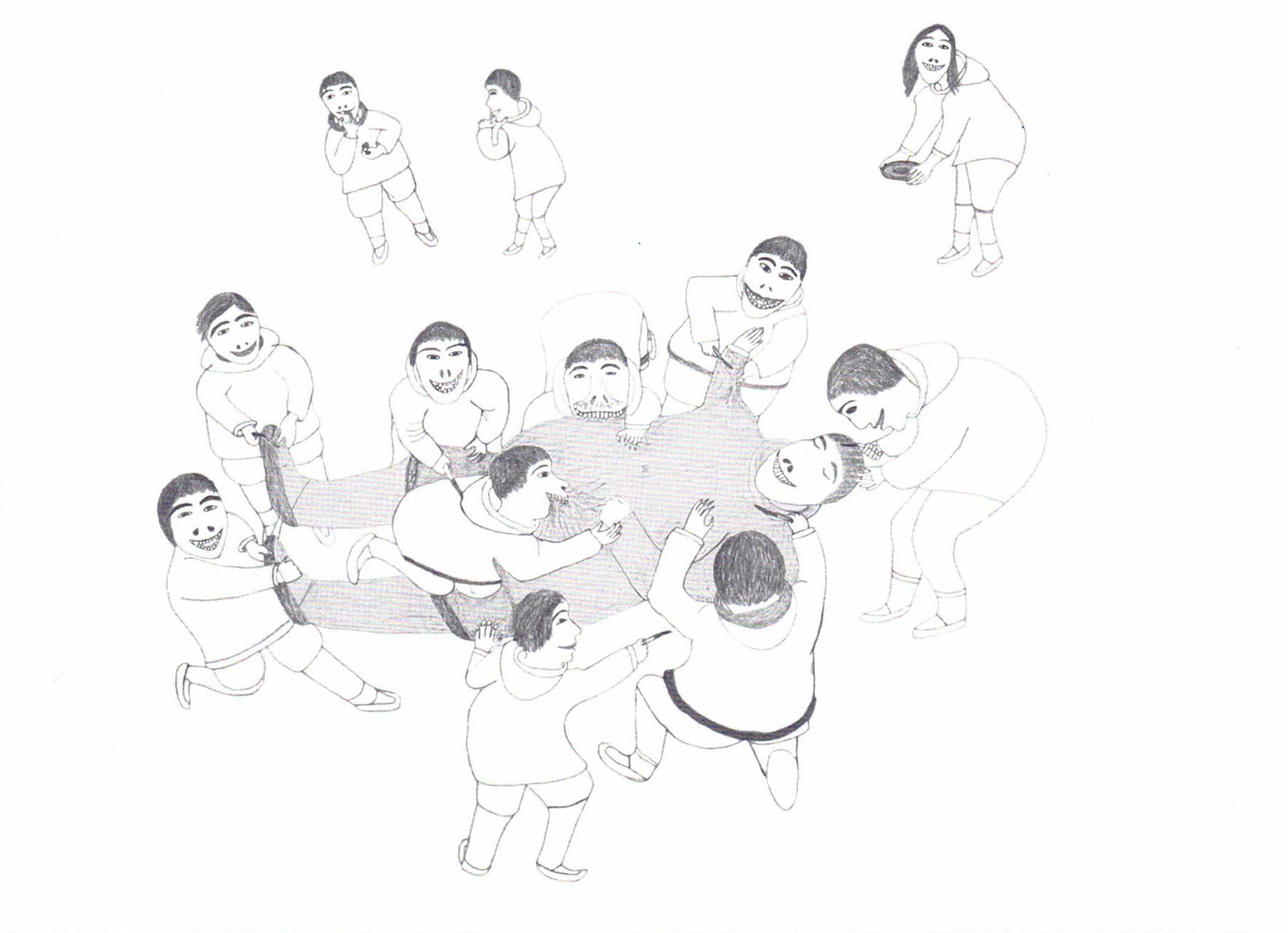
EATEN BY CANNIBALS, Victoria Mamnguqsualuk, 1973, Coloured pencil & graphite, 22 x 30 in.
Syllabics Translation: this one is said to be eating his father’s nose.
“Mamnguqsualuk had been drawing for quite a while before creating this work. Consistent with the Sanavik’s project to give the Baker Lake Inuit a cultural voice in Canada, we were supportive of drawings of the traditional tales that had formerly been suppressed by the Christian community. People began to make drawings of stories that they would never consider telling. Once the drawings became public in the Co-op, the artists set out to describe what they had drawn. Everyone would gather around at the ‘Monday meetings’ and discuss at great length what was going on in these drawings. We would try to come up with titles in English that captured the Inuktitut descriptions. Many drawings were about cannibalism, which was a deep and ancient fear among these people who had often faced starvation. The story behind this drawing by Mamnguqsualuk is taken from the Qiviuq legend. These would be the children of Igutsaq, who kept the severed heads of her victims in an adjoining igloo. The story, a beautiful narrative, starts always with these lines, ‘do you eat seal or do you eat man?’ Doesn’t that introduction make the hair stand up on the back of your neck?”
During the ‘early’ period presented by works in the Ian Lindsay Collection, some Inuit who began to rely on art-making as means for economic survival became aware that they were being designated as ‘artists’ by their white patrons, and that the designation was being taken up by members of their own community. Initially, the new awareness brought mixed reactions. The power vested in a person dubbed ‘artist’ by his/her ability to engage successfully in the money economy, and to participate in the power conferred by money, was a source of authority, pride and security. But at the outset very few Inuit had visited southern Canada, and the existence of white artists was gravely doubted. If art-making were an activity reserved only for natives in a new society dominated by white power and institutions, its prestige and value were suspect. Many Inuit ‘artists’ would have felt more secure with ‘white’ jobs, such as truck driving or airstrip maintenance. Now greater opportunities for travel and a more sophisticated understanding of southern Canadian society have changed these attitudes without completely eradicating them. It cannot be overlooked that for Inuit the identity of the artists exists, in some senses, as an assigned role (Butler in Wight 1991, 37).
Within the politically charged, conflicted space that adheres when art is defined as a commodity, government-funded production in Baker Lake guaranteed, from the start, an unbelievable amount of waste and confusion. This situation continues to the present. When they request financial assistance from territorial or federal funding agencies, artists and northern commercial agents alike are initiated into a nightmare of bureaucratic paranoia that I have often referred to as Franz Kafka at minus forty degree. The context is fleshed out in a tangle of competitive, interactive power systems represented by (in addition to federal and territorial governments) Christian churches, mostly Roman Catholic and Anglican, the Hudson’s Bay Company, the R.C.M.P., and the public school system. It is important to note, as well, that adult Inuit negotiating these layers impediments to economic survival, began their lives living in small groups of ten or twenty people. Settlement life itself has required that they learn new skills, new nervous connections, new sensibilities.
It is undeniable that the social reality I am describing is part of the reality of twentieth-century Canada, and that Inuit sculptures and prints are products of that historically specific milieu. The question, never-the-less, is often raised, can this work be considered contemporary Canadian art? The aesthetic value systems that have been brought to bear on the work of contemporary Canadian Inuit artists turn out to be, when examined, as cross-referenced, tangled and polysemic as the political context that I have described. As I see it, the question needs to be asked, to what extent is the Inuit artist constructing his/her own subjectivity in the space of colonization? As feminist theorists have pointed out, figuring the Other as Victim in critical discourse acts as its own form of definition, coercion, bracketing: or, in James Clifford’s words, “a specific story that excludes other stories” (Clifford 1988, 190).
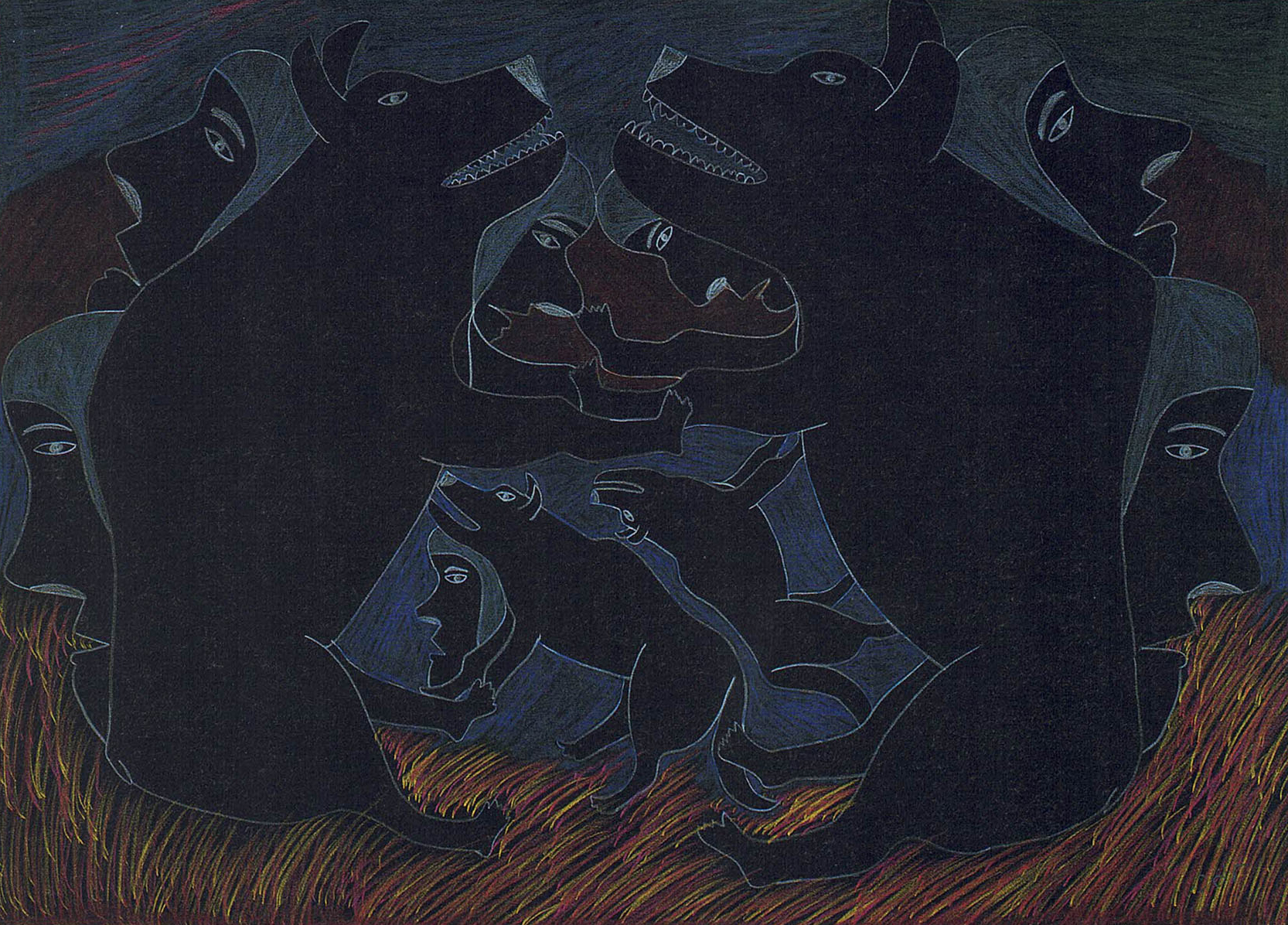
MUSKOX TRANSFORMATION, Simon Tookoome, 1982, Coloured pencil, 20 x 28 in.
“This drawing presents a shamanic subject, depicting a captured moment in the transformation between the shaman and the muskox. Tookoome is the only artist in this exhibition who was also a printmaker at the Sanavik Co-op. It was a policy of the Sanavik that whenever possible a graphic artist should produce her or his own prints. His work typifies what I have come to think of as ‘the’ Baker Lake graphic ethic: a confident, authoritative, aggressive line, lots of colour with strong colour contrasts, candid first-hand descriptions of both the most intimate personal experiences – dreams, fantasies, whishes – and unflinching depictions of both historic and legendary Inuit experiences of shamanic ecstasy, love, sex, family intimacy, hate, fear and death.”
In terms of aesthetic assessment of the contemporary production of Inuit artists, economic imperative as a factor in production seems to be the big stumbling block that relegates critical reviews of Inuit work to the pages of hoppy magazines directed to a readership of interested private collectors, and to the pages of exhibition catalogues published by Canadian institutions holding collections of Inuit art. The economic imperative, the fact that the majority of Canadian Inuit works, in both two-dimensional mediums, are sold to southern Canadians, Americans and Europeans is used to define this art as aesthetically suspect. Its exchange value is set forth as a totalizing explanation for the meaning of the works in the lives of the artists who produce it. This erases the subjective involvement of the artists in what is to me a shockingly simplistic reading of an immensely complex cross-cultural interaction.
Another “Catch 22”, both cause and effect of the reductive critical attitude to economic motivation, is based on the status of southern Canadians who have become the cultural middlemen entrusted with forming a critical context for the reception of Inuit art to southern Canada. Since Inuit work has historically been separated from contemporary collections in southern institutions, collectors, curators and critics who have focused their efforts on Inuit art have not made strong contributions to mainstream publications, to discourse or curatorial projects for contemporary Canadian art in general. They have not sought to insert critical examinations of Inuit work into southern Canadian art discourse. As a case in point, Kate Taylor commented in The Globe and Mail on Norman Zepp’s dismissal from the position of Inuit Curator at the Art Gallery of Ontario, “Sources outside the AGO say Zepp has fallen from favour because he was an advocate only for his specialized turf” (Taylor 1994, C18). In some cases, the writing published by critics of Inuit art indicates a lack of knowledge of the issues most relevant to contemporary art discourse. In other cases, the Inuit art that they represent has been judged as existing outside the domain of significant visual art in the late twentieth century, and so critical commentaries on this work have been rejected from prestigious journals and other forums for exchange and discussion. To compound the difficulties of cross-cultural communication, few southern Canadian experts of Inuit art have ever resided in an Arctic community.
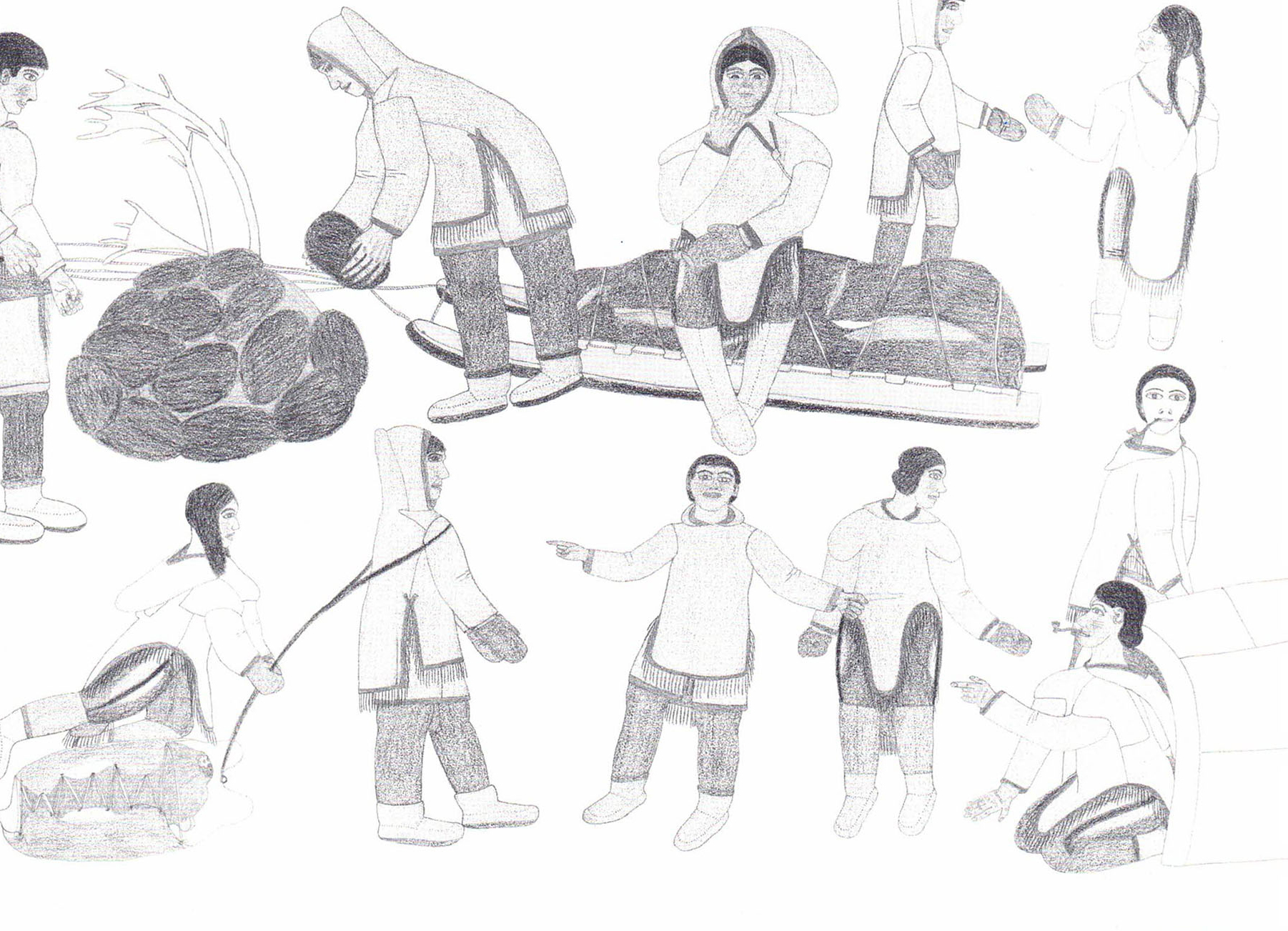
AFTER THE HUNT, Nancy Pukingmak, 1978, Graphite, coloured pencil, 22 x 30 in.
“:Like Hannah Kigusiuq, and even more than Mamnguqsualuk, Pukingmak tackled the description of three-dimensional overlapping forms from the moment she began to draw. But note how the figures are arranged: this is a narrative structure depicting a sequence of events in two tiers, like a comic strip. At the top, a caribou is brought in on the sled to be cached under rocks with the great antlers at the top marking the spot for the future. Note the carefully described caribou anatomy in the bundle at the lower left, with its cross-section of vertebrae and vessels. She has included in this drawing all the precise details that would indicate quality and success in this culture: beautifully made clothing, handsome people, food cached against the winter, and a well-constructed sled. There are many western conventions at work in this drawing, such as the cropped figure at the top left. Her mother, Oonark, would rarely, if ever, have cropped a figure by the edge of the page, because the space of the drawing was, for her, the space of the world: everything must be there. Here, the drawing reveals only a focused snapshot of the world, as though viewed through an open window. And it is a world visually informed by the influence of record covers, comic books and advertising art.”
Emphasis on economic forces as the primary determining factor for art production also introduces, as a subtext, a dated modernist template that is brought to bear on contemporary Inuit works of art. Unfortunately for the Inuit, the ghost of Immanuel Kant haunts their aesthetic marginalization. In the eighteenth century, Kant theorized that “Beauty” must be “disinterested”, that “if a thing is beautiful, we do not want to know whether anything depends or can depend on the existence of the thing… . Beauty is the form of the purposiveness of an object, so far as this is perceived in it without any representation of a purpose” (Kant in Ross 1987, 104, 118, emphasis original). As we know, in the twentieth century, Clement Greenberg expanded on this pronouncement to champion, “the autonomous value of the aesthetic” (Greenberg in Thompson 1990, 99, 107), thus collapsing Kant’s definition of art into his theory of beauty. In a post-modern re-thinking of these judgements, Donald Kuspit implied that Greenberg oversimplified Kant, and he pointed out that, “Greenberg importunately totalizes evaluation in the hopes of de-totalizing interpretation, but in so doing he falsifies the roles of both, and thereby the complex nature and spirit of the critical enterprise as such” (Kuspit in Thompson 1990, 108). The reductionist urge to read contemporary Inuit art as neatly and totally bracketed by the demands of the southern Canadian economy appears to me to be a similarly unsatisfactory simplification, grounded in modernist values that defined art as disinterested, non-functional, transcendent, universal. This frame of reference constructs living Inuit as romantic Eskimos, marginalizes contemporary Inuit artists and relegates their work to gift-shop status.
Questions of purity and authenticity purportedly banished from the post-modern lexicon, often seem to me to overdetermine questions of economic imperative in critical evaluations of Inuit art. It is dismissed, again in a reductivist judgement, as having been introduced by white Canadians and as having no authentic roots in traditional Inuit culture. It is hard to imagine how so complex a cross-cultural practice could be so reduced. Again, in Inuit are constructed as passive receivers, their own agency erased. James Clifford’s comments in The Predicament of Culture are relevant here, “The relations of power whereby one portion of humanity can select, value and collect the pure products of others need to be criticized and transformed.” Clifford calls for “radically heterogenous … impure productions” (Clifford 1988, 213) to expand the boundaries of art.
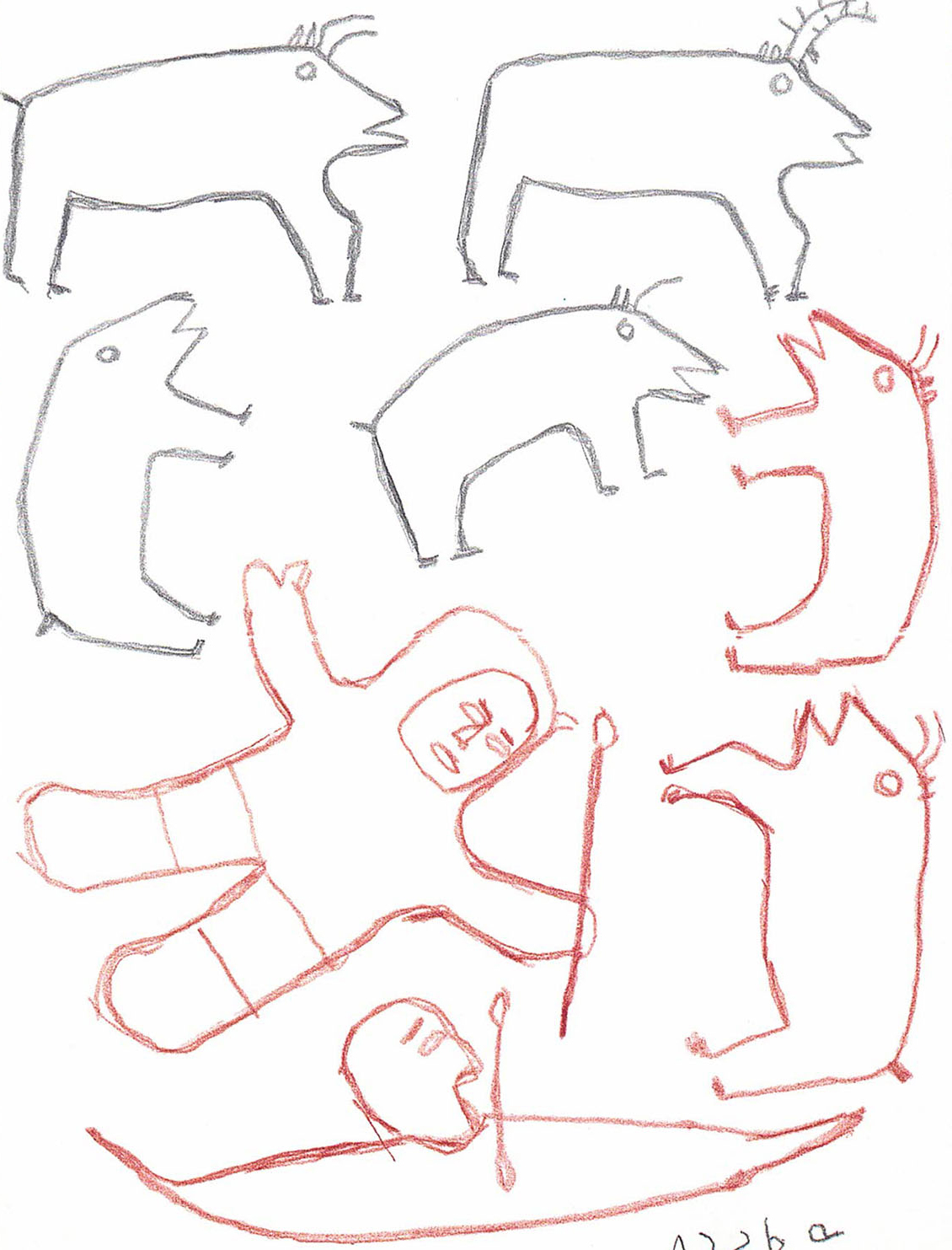
HUNTER, KAYAK AND CARIBOU, Martha Ittuluka’naaq, 1972, Coloured pencil & graphite, 8 1/2 x 6 1/2 in.
“She was using greeting card paper that I gave to the artists because it was very good quality paper, which, at the outset of the print and drawing project, was so hard for us to get. I must admit that I thought people would draw on the separate folded halves, but that is not what happened! The fold down the middle did not seem to deter the artists at all. Most drew over the whole card as if the fold did not exist.”
Contemporary Inuit art is an art of acculturation, and as such it reflects the lived reality of its creators. Materials such as paper, ink and pencils as well as printmaking techniques were introduced to the Arctic by southern Canadians. The notion of autonomous works of art, separate from function, was an introduced concept. The introduction was heightened in intensity by economic need. Nevertheless, the Inuit brought a great deal, intellectually and emotionally, to the engagement and they still do. They did not passively receive; they actively engaged, based on lifetimes of training in manual dexterity through the experience of meticulous manufacture by hand of utensils, clothing and tools, worked from an exceedingly narrow inventory of raw materials. The labour devoted to the aesthetic elaboration of these items consistently went far beyond what was required by function. Indeed, utilitarian objects, especially weapons for hunting, were seen as more efficacious if they were aesthetic as well as functional. Aesthetic values were acknowledged and appreciated, but they were crucially allied to physical and emotional survival.
Another extremely important operative principle in the production context for contemporary Inuit art is the highly refined Inuit sensitivity to spatial relationships and to the experience of three-dimensional volumes. This is firmly rooted in Inuktitut, the Inuit language. This language ignores time as an organizing structure, but includes a variety of forms for each noun. The choice of the noun form which is spoken is determined by the relation in space of the speaker to the object that is being spoken about. The noun form also indicates if the object is still or moving. The Inuit sensitivity to the subtleties of spatial relationships as reflected in their language has been described as among the most sophisticated in human cultural experience. The introduction of foreign materials and art theories did not operate outside this experience.
On a personal level, I don’t live within that linguistic reality, since I am not a speaker of Inuktitut, but I do experience my own subjectivity as interactive with the position of difference defined for the Inuit (defined since the beginning of colonial contact). Three years of daily life in the Arctic played an extremely formative part in my personal history. Jack and I reviewed that time of our lives in a taped conversation that formed part of our recent collaborative exhibition titled We Need a New History. In this examination of a shared history, I stated:
The reason we were in the Arctic and were able to see those people and meet them was because we were empowered by our society to be there. And so we were placed in that position. All of our experience was mediated through power. Even though we like to think of ourselves as being benevolent, still, I don’t think we can disassociate that (power) from the real experience of having lived and worked there.
Their events conjoined, without our knowledge or efforts, to bring about the return visit. First, the staff of the Canada Council Art Bank conceived a plan to purchase work directly from Inuit artists in their Arctic communities, rather than purchasing from commercial agents in southern Canada, as they had done on previous occasions. Jack was invited to participate in the jury that would travel to Baker Lake. Second, Judith Nasby, Director of the MacDonald Stewart Art Gallery in Guelph, Ontario planned to hold the opening for a major exhibition of Baker Lake drawings in Baker Lake, before touring the show to southern institutions. Third, Marie Bouchard, an art historian who, at that time, had been living and working in Baker Lake for nine years as an independent art adviser and gallery owner, organized a conference in Baker Lake with invited professionals and visiting participants, to coincide with the Art Bank jury and the opening of the drawing exhibition. I was invited by Marie Bouchard to travel with conference funding, but without any formal commitment, to contribute to the conference.
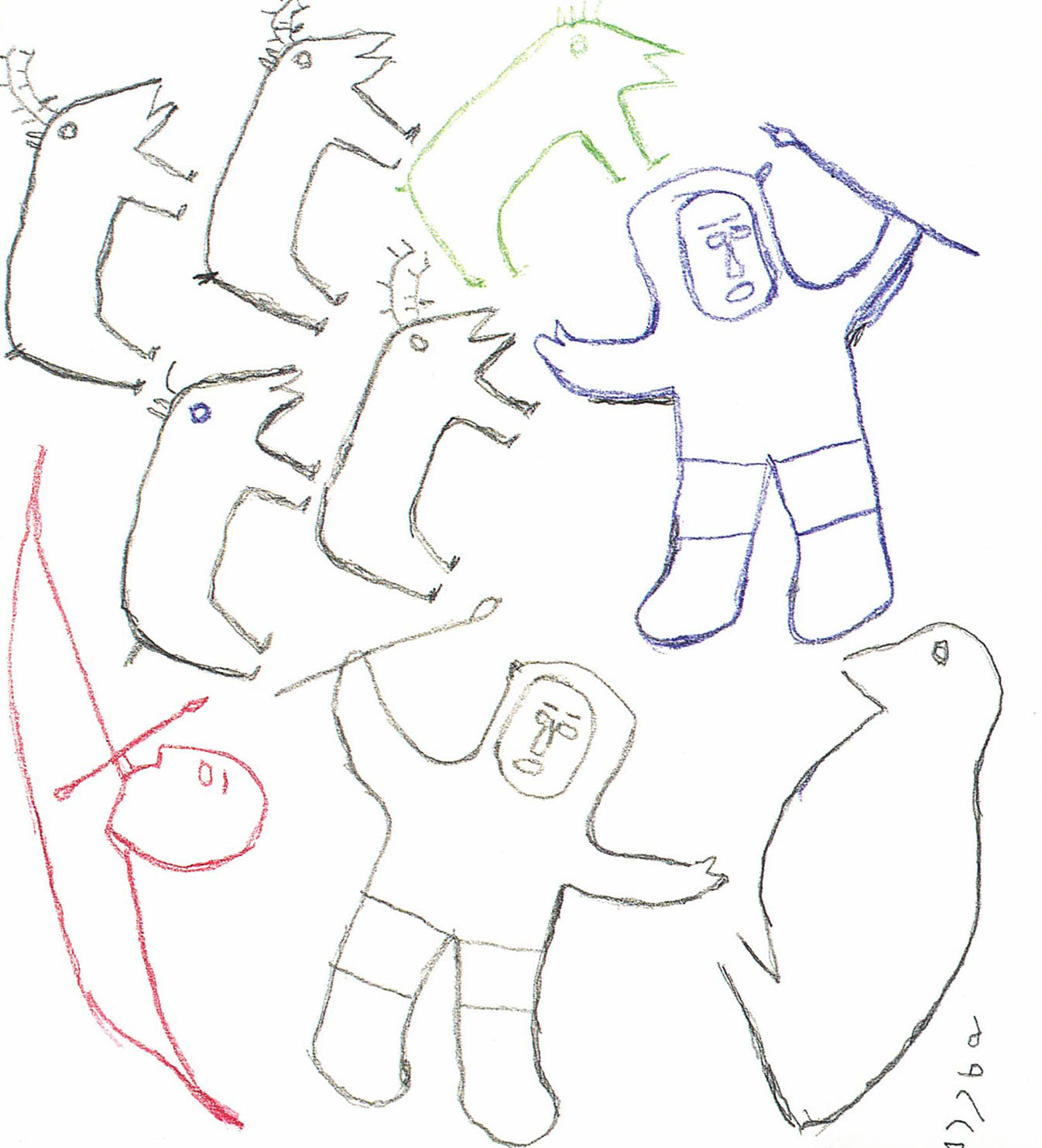
HUNTERS, KAYAK, CARIBOU AND BIRD, Martha Ittuluka’naaq, 1972, Coloured pencil & graphite, 9 x 8 in.
“These are the sort of drawings that Ittuluka’naaq made, beginning the drawing by tracing her own stencil-like forms. The incomplete contours or open spaces at the bottom of the caribou feet are surprising. The caribou have obviously not just been traced around like cookie cutters. She is conscious that the profile only shows two feet, yet at the same time she wants to show that the caribou actually has four feet. By leaving the open spaces at the bottom of the animal’s silhouetted shape she satisfies both conditions: a clearly recognizable animal profile and a true-to-nature number of parts – a very personal and distinctive solution.”
When Jack and I worked in Baker Lake, and for the four years afterward, during which we remained involved with the project by commuting from Winnipeg, the production of prints and sculpture was by far the most important economic resource in the community of Inuit adults. During the time that we commuted, production and shipping were managed effectively by the Inuit themselves. Thomas Iksiraq, Ruby Arngna’naaq, Michael Amarook and William Noah were among the principal manager/producers. However, in August of 1994 we were ware that no annual portfolio of prints had been produced in Baker Lake since 1989, and we assumed that our connection to the Inuit artists had faded with time. Stepping out of the plane onto the windy gravel airstrip, we were completely unprepared for the emotional intensity of the welcome that the community accorded us, and also naively unprepared for our own emotional response. The sewing shop, where we administered the production of appliqued wall-hangings and decorative clothing, and the Sanavik Co-op craft shop, where we worked with sculptors and print-makers, for which the Hudson’s Bay Company Manager co-operated as our banker, flying in cash to meet the payroll every month, have succumbed to the contradictory impulses, value systems and power trajectories of increasingly complex social structures exaggerated by a growth in population. In a tangle of government marketing agents, Northwest Territories administrators, and oppositional Inuit factions at the local level, the artists never received their portion from the sale of the last portfolio of prints, a portfolio that is estimated to represent a total value of approximately $50,000.
The Sanavik Co-op, which ironically means “open workshop’ in translation, is now a grocery store with a manager from southern Canada. At great expense, the territorial government has erected a large building for the printing of silk-screened Baker Lake images on t-shirts, canvas bags and jackets. Computer equipment has been installed to do the colour separations for the screens. A few Inuit people working there use the equipment to design and print their own work on the off-hours when they are not working at assigned tasks. As with the Sanavik Co-op, the manager is a southern Canadian. The building is immensely expensive to heat, given northern conditions., and the shipping costs to southern markets are not realistically competitive with those of southern and Asian manufacturers, so it is very unlikely that this technologically advanced operation will ever bring into the settlement the amount of money once earned by means of the production of prints, drawings, sculpture and fabric works. The name of this factory is also sadly ironic: The Jessie Oonark Centre, named for one of the community’s most distinguished and productive artist, now deceased.
For the two groups of printmakers in the community who would like to continue to produce prints, the most pressing problem is the lack of a place to work. Heated interior spaces are not plentiful in any community in the Canadian Arctic, and Baker Lake is no exception. One group approached the management of the Jessie Oonark Centre, asking for space to make prints but they were refused. We were asked by members of both groups for assistance in starting print production again, particularly by Thomas Iksiraq who is determined to begin printmaking again on a modest scale. It was clear that drawing was still actively practiced, as evidenced by the numerous fine drawings brought forward for the inspection of the Art Bank jury, since these can be made at home, even under crowded domestic conditions.
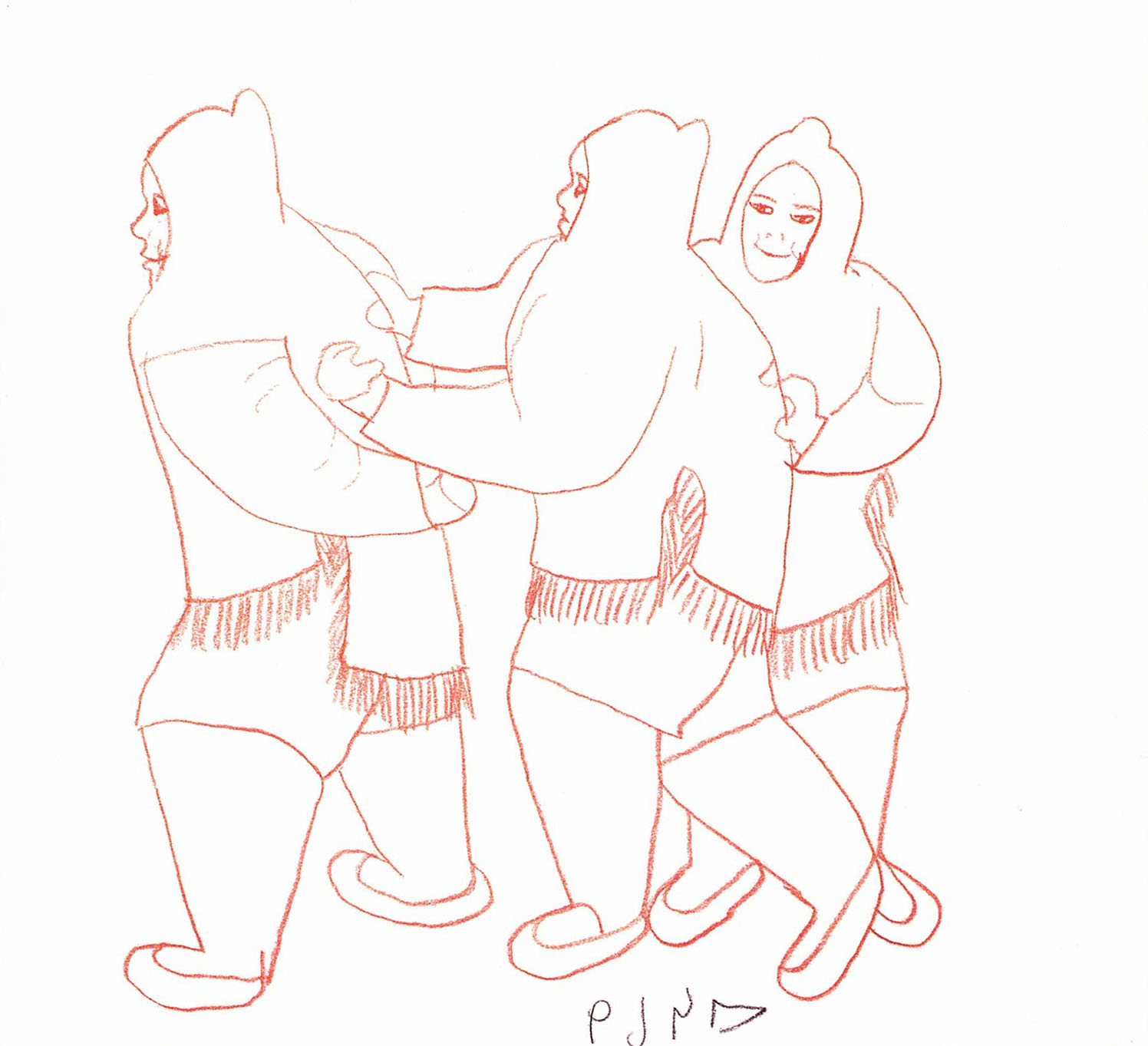
THREE FIGURES, Hannah Kigusiuq, 1971, Coloured pencil 7 1/2 x 8 in.
“Hannah Kigusiuq was one of the first Inuit artists in Baker Lake to work with the western graphic convention of overlapping lines and shapes to create an illusion of three dimensions. She had no formal art training, yet her drawings were like this from the very beginning. Hannah Kigusiuq was a very cool, authoritative draftsman. It is especially noteworthy that there are no erasures; they were just drawn straight out.”
When Jack and I left Baker Lake that summer to return “down south,” we carried with us three works of Inuit art. We did not intentionally collect these works; rather, they became attached to us. The three works differ radically in material and processes and presentation, for me, the gap of twenty years between the intensely creative daily reality of the Sanavik Co-op in the early seventies and the politically precarious existence of the inhabitants of Baker Lake in 1994. One of the pieces, a small sculpture of a goose in flight by Martha Noah, brought out for my inspection and pleasure over lunch of caribou meat and Bannock, harks back to an earlier time. The materials from which it is made, a piece of antler culled from an individual member of the immense Kamanuriak herd of caribou, connects directly to the material-culture context of Martha Noah’s life as a young woman. Now middle-aged and the mother of teenage children, Martha made the goose in conditions very different from the tent and igloo environment where she first learned to make wonderful objects from a limited repertory of available materials. This small sculpture of a goose in flight was made as piece-work at the new Baker Lake factory, the Jessie Oonark Centre. The labour-intensive process, the meticulous crafting demanded by this form of manufacture, was judged to be too expensive, not commercially viable as a product of the t-shirt factory: this, despite the fact that the viability of the t-shirts is also questionable.
We also brought back a print of a ptarmigan made by William Noah, Martha’s husband. William made the print using the equipment at the factory that is named in memory of his mother, Oonark. During his off-hours he worked in a drawing program on a Macintosh computer, using a photograph of one of his earlier drawings as a reference. He made use of a computerized colour-separation process and then output to a silkscreen set-up. Mediated by twentieth-century technology, the ptarmigan stands on a rock on the ageless Arctic tundra. The high-tech imaging process intensifies the pop-art aura that I always considered to be the great strength of William Noah’s work.
The third work is a monoprint with drawing by Philippa Anirniq, wife of Thomas Iksiraq, a former print manager of the Sanavik Co-op. Working in good weather in a small tent behind her house, Philippa responded to being turned away as an employee of the t-shirt factory by making her own jewellery from antler, hoof and ivory. She makes stamps by cutting various designs onto erasers (one on each eraser). She stamps her design onto a sheet of paper and on the same sheet makes a linear contour drawing in ball-point pen, traced from paper templates designed to show the size of the finished piece of jewellery. Her signature in syllabics is accompanied by a commercial stamp that bears the name, address and telephone number of her business. She sends the resulting monoprints by mail to potential clients. These works are exemplary of the tradition of circulars, posters and political broadsheets in the history of printmaking. The tradition marries aesthetic demands with practical intent.
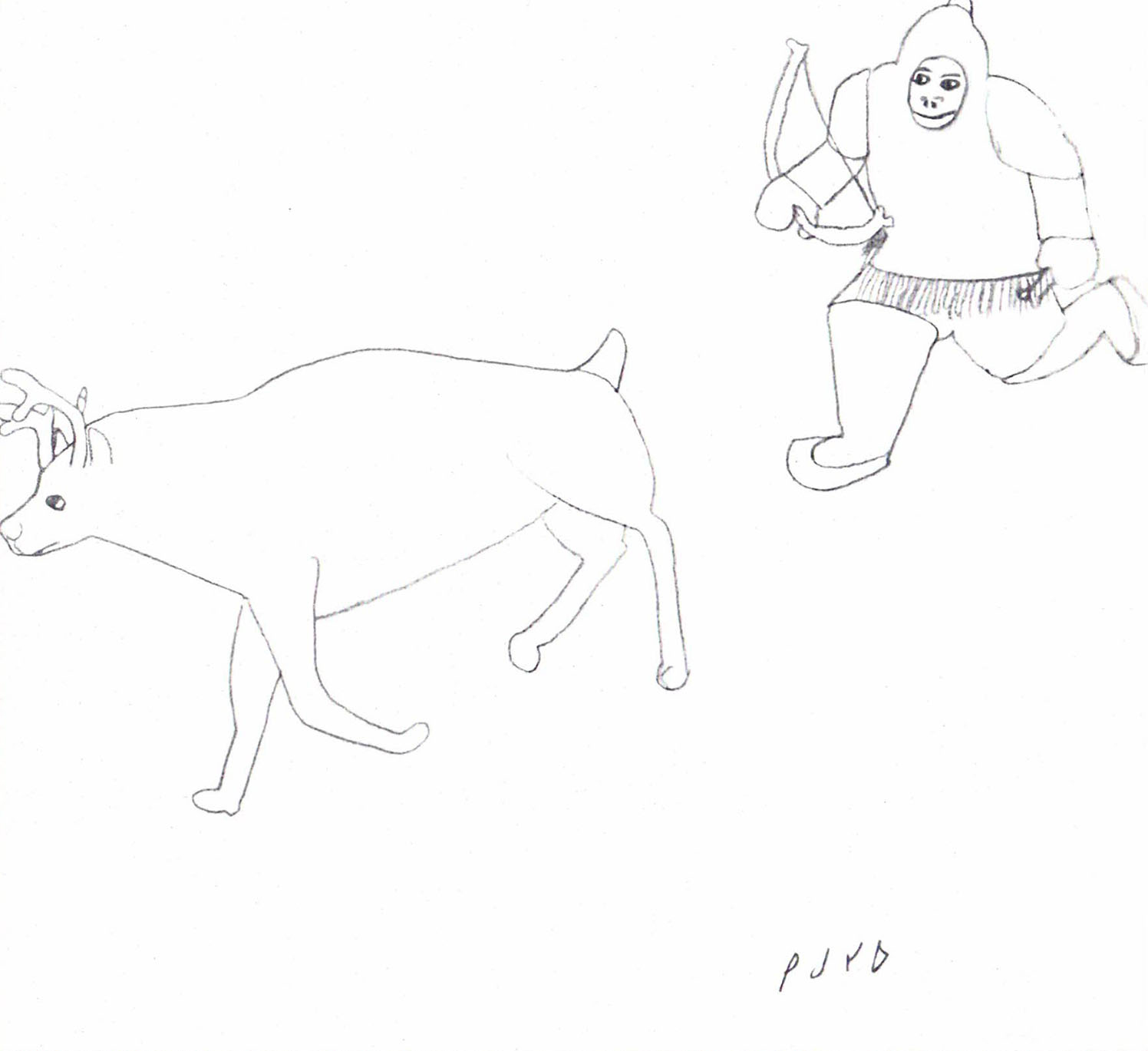
HUNTER CHASING CARIBOU, Hannah Kigusiuq, 1971, Coloured pencil, 7 1/2 x 8 in.
“Her drawings present a long series of images of everyday life. They are remarkably informative narrative illustrations, as well as being confident, imaginative drawings. In this drawing, the posture for carrying the bow is accurate, but the caribou head seems out of scale. She has made the neck very broad, probably to indicate the rich fat content of the animal. I think it is a very ‘food like’ description of a caribou.”
The Inuit drawings in our personal collection, like these three works of art which became attached to us on our return visit to Baker Lake in 1994, were not systematically collected, but became a part of our lives between 1969 and 1983, in response to our love and respect for the drawings themselves. Economic imperative played a part in the creation of all these works, but only a part. The works grow directly from pre-contact roots in Inuit culture, but they also reflect the undeniably cross-cultural reality that forms the quotidian life of the contemporary Canadians who made them. The work of these artists and their compatriots does not seem to me to exist outside the interests of contemporary visual arts discourse. Inuit work has been theorized and exhibited in such a way as to allow it to be dismissed without the intelligent and sensuous viewing that it deserves. Inuit art deserves a more informed examination, and in my experience, those who engage in such critical scrutiny will be well rewarded.
Notes:
Butler, Sheila. “Inuit Art, an Art of Acculturation”, in Write, Darlene, The First Passionate Collector, The Ian Lindsay Collection of Inuit Art, The Winnipeg Art Gallery, 1994.
Butler, K.J. and Butler, Sheila. We Need a New History, exhibition text published by the artists for Open Space, Victoria, B.C., 1994.
Clifford, James. The Predicament of Culture, Harvard University Press, Cambridge, Massachusetts, 1988.
Conlogue, Ray. “A curatorial square-off”, The Glove and Mail, Toronto, Ontario, October 22, 1994.
Graburn, Nelson and Strong, B. Stephen. Circumpolar Peoples: An Anthropological Perspective, Goodyear Publishing Company Inc., Pacific Palisades, California, 1973.
Greenberg, Clement in Thompson, James M., Twentieth Century Theories of Art, “Modernist Painting”, “State of Art Criticism”, Carleton University Press, Ottawa, Ontario, 1990.
Kant, Immanuel in Ross, Stephen David. An Anthology of Aesthetic Theory, “Critique of Judgement”, State University of New York Press, Albany, New York, 1987.
Kuspit, Donald In Greenberg, Clement, op. cit.
Mulvey, Laura in Pollock, Griselda. Framing Feminism, “‘Post-Partum Document’ by Mary Kelly”, Routledge and Kegan Paul, Ltd., London, 1987.
Noah, William. Baker Lake 1972, “Part of My Life”, Sanavik Co-operative, Baker Lake, N.W.T., 1972.
Spivak, Gayatri Chakravorty. In Other Worlds, Essays in Cultural Politics, Routledge, New York and London, 1988.
Taylor, Kate. “For better of worse, ‘it’s a revolution’ at the AGO”, The Globe and Mail, Toronto, Ontario, October 8, 1994.
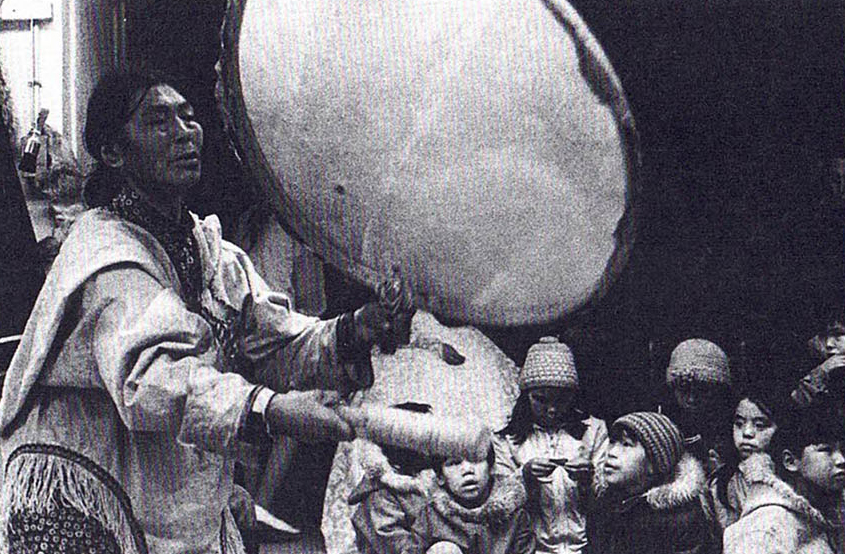
Mummuk performing with the drum at Iksiraq and Anirniq’s wedding party at the Sanavik Co-op.
Artists Biographies
Annotated with comments by Jack Butler
 Harold Qarliksaq (1928 – 1980)
Qarliksaq’s career as an artist was cut short when he died prematurely in 1980 at the age of fifty-two from a heart attack, perhaps the aftershock of severe starvation as a child. Born and raised in the Back River/Garry Lake area, Qarliksaq belongs to the sub-group of Utkuhikhalingmuit known as the Haningayuqmuit, a group that was only too familiar with hardship. No longer able to support his family through hunting and trapping, Qarliksaq moved to Baker Lake in the early 1960s with his wife, Martha Apsaq, his children, and his younger brother.
Encouraged by Jack Butler, Qarliksaq first tried drawing in 1969. Working with ordinary 2B pencils on sketch-book paper, he produced delicate distinctive drawings based on his intimate knowledge of the land and his life as a hunter. One of these early efforts was selected for a print and based on this initial success, Qarliksaq continued to make drawings. He was given good quality paper and did many drawings over the next eleven years. The character of the drawn line, its contour, fluidity and weight became the focus of Qarliksaq’s drawings and, ultimately, his trademark. His extraordinary detailed narratives translated well into prints, which were featured in every Baker Lake Annual Print Collection throughout the 1970s, earning him well-deserved recognition as a graphic artists. His works have been featured in two solo exhibitions and more than twenty group exhibitions.
In his early drawings Qarliksaq is literally finding his way graphically. He had never tried to draw before and had no Inuit cultural practice equivalent to drawing to follow as a model beyond the examples being set by other, also new, artists in Baker Lake. He looked for instruction in pictorial models from the South, such as Sunday School pamphlets and mail order catalogues, as did many of his peers, but seemed to rely equally for visual form on older cultural conventions more closely allied to those used by Anguhadluq. However, in the quality of line, Qarliksaq’s drawings are distinctly different from those of Anguhadluq and other artists of his community.
Qarliksaq uses a double contour line that I can best describe as a synthesis of naturalistic-descriptive and ornamental-decorative impulses. The closest equivalent to Qarliksaq’s line that I know of is to be found in Laplander decorative incised patterns on reindeer antler implements such as knife handles and pewter wire applique designs on skin clothing. Qarliksaq shapes the line; he did not draw it discursively lie Anguhadluq did. Qarliksaq’s line had an explicit character, variably thick and thin, delicately modulated from dark to light throughout. And yet his contour lines seem to have been executed in one continuous, fluid motion. I don’t know anyone else who has ever drawn like this. It is an extremely sophisticated visual technique and it is his entirely.
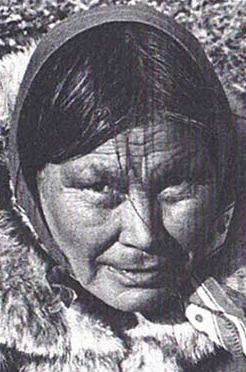 Jessie Oonark (1906 – 1985)
Jessie Oonark is widely recognized as one of Canada’s most important artists. She was a prolific artist and a major force in the development of the arts and crafts program in Baker Lake where she had settled in 1958, a widow, with the last of her thirteen children still in her care. Oonark knew that returning to the land was not feasible for her and her relatives were already struggling to survive. She began drawing shortly after her arrival in the settlement at the invitation of Canadian wildlife biologist, Dr. Andrew MacPherson, and was the first adult Inuk in Baker Lake to be asked to make drawings for sale. In her enthusiasm, she filled both sides of the paper!
Born and raised in the Back River area, Oonark was intimately familiar with the culture and traditions of the Utkuhikhalingmiut, as taught to her by her grandmother. The stories and legends of old, and the long-ingrained habits and skills of survival, were an integral part of her upbringing. Most importantly, she learned how to cut and sew caribou skins into warm, functional clothing: an essential task and test of womanhood. In the new settlement, she translated the skills used in making clothing onto paper and fabric, in her characteristically bold style which emphasized form, colour and design. Her early drawings, simply singed ‘Una’, appeared in the 1960 and 1961 Cape Dorset graphics collections; when printmaking began in Baker Lake, Oonark’s work was included in each annual collection from 1970 to 1985. Her drawings and textile art quickly attracted the attention of southern galleries and collectors and have been featured in more than 100 national and international exhibitions and 15 solo exhibitions, the last mounted by the Winnipeg Art Gallery in 1986 as a major retrospective and tribute to the artist.
Oonark has received many awards. She was elected a Member of the Royal Canadian Academy of Arts in 1975 and named an Officer of the Order of Canada in 1984. Her legacy lives on in her children: Janet Kigusiuq, Josiah Nuilaalik, Victoria Mamnguqsualuk, Miriam Nanerluk, Mary Yuusipik, Nancy Pukingrnak and William Noah, all of whom became, at their mother’s instigation, accomplished artists.
If Anguhadluq drew primarily with a discursive line, referred to by the term titiraut, the incised line, then Oonark drew primarily with coloured shapes. The root word which best describes her approach to drawing is mingaut, which means spread or smeared, as with printer’s ink. At the Sanavik Co-op, the stencil and stonecut print process was designated minuanguagarq in Inuktitut, because the ink was spread by roller onto the stone. I believe that Oonark’s distinctive visual thinking, her way of knowledge, ability, and experience as an Inuit mother in making clothing for her family. She could cut a flat piece of stretched caribou skin into two-dimensional shapes, which, when sewn together, would fit the bodies of her family perfectly. When it comes to making skin clothing to survive in a Baker Lake winter, a design error could be deadly. When you take a skin and cut it with an ulu, you don’t get a second try. This is a highly visually-skilled process. It is a life and death issue.
IF I play backward Oonark’s process for constructing a skin atigi or amautik, and imagine the abstract pattern of shapes that make up the garment, I think the resulting design can serve as a model of Oonark’s method of working. The quality of her drawn lines on paper is more like the contour of a cut piece of skin or cloth than like the textured and tactile drawn lines of other artists in Baker Lake. Her preference for bilateral symmetry, the symmetry of the human body, I suggest, is the organizing scheme that most often gives coherence to her drawings.
Oonark employs the play between figure and ground in her drawings to create visual symbols, as opposed to narratives. This is especially evident in her later work. Recall the Gestalt phycologist’s textbook example of figure-ground equivalence: is it a woman’s profile or is it a vase? Depending on the viewer’s attention, the same image can be both a face and a vase. This preoccupation with figure-ground ambivalence in Oonark’s pictures also relates to clothing design, in particular, to the insets of fur where a decorative shape in caribou skin is traced onto the back of a fur garment, cut out, and a fur of contrasting colour is set into the space. In one cut, the ground becomes the new figure on the garment, and the cut-out becomes a figure appliqued elsewhere on the same garment.
Graphically unambiguous, the subject matter of Oonark’s pictures is characteristically ambiguous and her images can rarely be given concise descriptive titles. Frequently referencing women’s things, such as facial tattoos, ulus, beaded decorative patterns, clothing shapes, babies, birds, etc., it seems poetic titles suit her work best, such as “The People Within” or “Dream of the Bird Woman”.
Oonark did literally hundreds of small drawings. They gave her the chance to let her ideas leap visually from one thing to another. Oonark’s graphic drawings and appliques are, I believe, a significant contribution to the history of visual art. Her work resonates with the hieratic form of ancient Egyptian art, shares common concerns with the figure-ground play in contemporary oriental calligraphy and is designed with as much graphic clarity and authority as are the letters of the alphabet. At the same time, Oonark’s imagery and form are distinctively both Inuit and unique to herself.
If we follow Oonark’s artist-children from the eldest to the youngest, from Janet Kigusiuq to William Noah, you can see the acculturation of Baker Lake Inuit visual art practice. Oonark’s drawings are spatially absolutely flat and hieratic. They are symbolic images in form and content, whereas Noah’s drawings look more like comic-book pictures and are informed by the visual form and information carried by the images he experiences in his settlement life, that is, contemporary popular visual conventions.
When the drawings of Oonark and her children, Janet Kigusiuq and Nancy Pukingrnaq, are placed side-by-side in this exhibition, the works evince a recognizable pattern indicative of the acculturation of visual art practice. These drawings indicate that mother and daughters, different generations from the same community and even the same family, were working within visual cultures that both relate and differ. Although Oonark and her daughters each began at a different point in history, with a different ethnic, a different aesthetic, a different intention, these artists have expressed in their drawings many of the same qualities and traditions of Inuit culture. Where will we ever see this again?
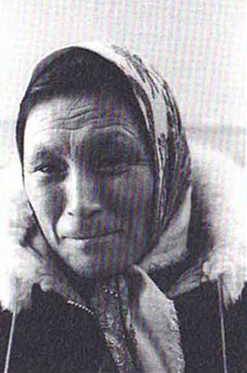
Janet Kigusiuq (1926 – )
Kigusiuq is the daughter of Jessie Oonark, and sister of artists Josiah Nuilaalik, Victoria Mamnguqsualuk, Miriam Nanerluk, Mary Yuusipik, Nancy Pukingrnak and William Noah. Together with her siblings, Kigusiuq was encouraged by her mother to participate in the arts and crafts program as a means of supplementing her family’s meagre income. She made tentative efforts at drawing as early as 1967. In 1970, two of her drawings were selected for the inaugural Baker Lake Print Collection. Since then, she has contributed some thirty drawings to the annual print collection. Her works have been featured in more than eighty national and international group exhibitions. She had her first solo exhibition in 1995 at the Norman Mackenzie Art Gallery in Regina.
Kiguisuq is a prolific artist thoroughly engaged in presenting depictions of the gritty reality of quotidian camp life as well as the myths and legends told to her by her grandmother. Over the years her style has evolved from a strong linear descriptiveness with colour as a decorative accent to a more painterly style with vibrant colours applied in thick overlays that completely obscure the white ground of the paper. Her drawings always bear her disc number, E2-71, inscribed next to her signature in syllabics.
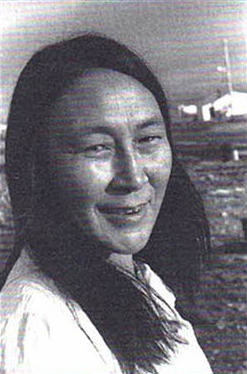
Victoria Mamnguqsualuk (1930 – )
Mamnguqsualuk derives inspiration for her drawings from memories of her life in the land and the myths and legends she heard as a young girl from her grandmother. She is Utkuhikhalingmuit, born and raised in the Back River area. She is the daughter of Jessie Oonark, and sister of artists Janet Kigusiuq, Josiah Nuilaalik, Miriam Nanerluk, Mary Yuusipik, Nancy Pukingrnak and William Noah. Mamnguqsualuk moved to Baker Lake in 1963 and soon became involved, like other members of her family, in the fledging arts and crafts program. Her artistic abilities were first recognized by the Butlers in the summer of 1969; she started drawings and creating textiles art shortly thereafter.
Mamnguqsualuk has achieved significant recognition for her work. Her drawings have been made into prints for several of the Baker Lake Annual Print Collections; her drawings, prints and textile art have appeared in over thirty-five national and international group exhibitions. She has had three solo exhibitions, most recently in 1986 at the Ring House Gallery in Edmonton. Mamnguqsualuk continues to make drawings which she now prints herself in a departure from the traditional print-making process in Baker Lake. At the age of sixty-nine, Mamnguqsualuk is still defining herself as an artist.
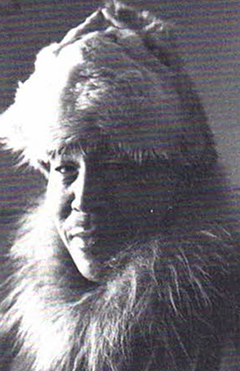 Simon Tookoome (1934 – )
Simon Tookoome is Utkuhikhalingmuit, born in the Chantrey Inlet area of the Back River delta. He also lived in Gjoa Haven before settling in Baker Lake in 1965. He began drawing in 1970, shortly after the Butlers’ arrival. A prolific artist, Tookoome carves, draws and often prints his own images using stone-cut and stencil techniques. A strong advocate of traditional culture and the arts, Tookoome was a founding member of the Baker Lake print shop and active in the Sanavik Co-op for many years.
Working as an artist over the past thirty years, Tookoome has achieved national and international recognition for his art and is the recipient of several awards and honours. His drawings were included continuously in the Baker Lake Annual Print Collections from 1971 to 1988. He has contributed work to over 100 group exhibitions and has had solo exhibitions in Vancouver, Kleinburg, New York, San Francisco, and Mannheim, Germany. Tookoome’s print, “The World of Man and the World of Animals come Together in the Shaman,” was produced on a thirty-five-cent stamp in 1980. One of his drawings was chosen as the poster image of the 1988 Winter Olympics held in Calgary. IN 1993, Tookoome received a grant to attend a drawing workshop in Cape Dorset. In 1997, a second grant enabled him to apprentice with Regina artist, Joe Fafard, who taught him how to transform his images into laser cut steel sculptures.
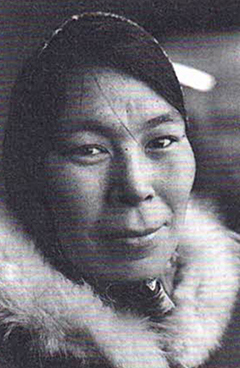 Nancy Pukingrnak (1940 – )
Nancy Pukingrnak is Utkuhikhalingmiut. As a young child, she led a traditional nomadic existence along the banks of the Back River, living in igloos in winter and tents in the summer and subsisting on a diet of caribou and fish. She was brought to the nearby settlement of Baker Lake in the spring of 1958 following a difficult winter marked by a severe shortage of land foods. In a dramatic rescue by the Canadian Armed Forces, a starting Pukingrnak and her mother, Jessie Oonark, were airlifted to the settlement.
Pukingrnak’s childhood experiences and her grandmother’s stories by bygone days and Inuit mythology remained impressed in her memory, and became an endless source of inspiration for her art. Her work is characterized by a detailed, narrative style. Influenced by the flood of western pictorial imagery in the settlement, Pukingrnak incorporates many western conventions that make her work distinct from that of the older generation of artists, and even from that of her sisters, Kigusiuq and Mamnguqsualuk. In addition to producing drawings and sculptures, Pukingrnak has made prints and served on the Sanavik Co-op Board of Directors. In 1976, the Upstairs Gallery mounted a solo exhibition of her work. She has also been featured in more than twenty group exhibitions.
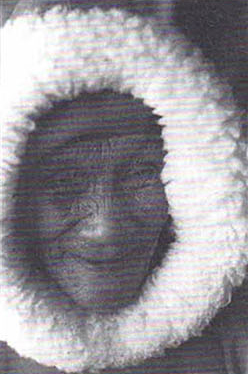 Martha Ittuluka’naaq (1912 – 1981)
Martha Ittuluka’naaq was born near the Kazan River, southwest of Baker Lake, and is a part of the Inuit group known as Harvaqtuuqmiut. She came to the Baker Lake settlement in 1961 and began drawing in 1969. Her imagery is rooted in the ancient traditions of the Caribou Inuit and reflects her knowledge of, and familiarity with, hunting techniques, the animals relied upon for survival, and the making of clothing from caribou skin.
Ittuluka’naaq’s repetitive images of human and animal figures are highly reductive and very distinct. Working from stencil forms, she individualized her drawings with gestural lines and decorative details. Her drawings have been featured in more than twenty group exhibitions, and her prints were included in several Baker Lake Annual Print Collections throughout the 1970s. Her son, Mathew Aqigaaq, is a well-established carver.
I was astonished when I first saw Ittuluka’naaq’s earth-oriented, direct and powerful drawings. Perhaps they require an artist’s sensibilities to enjoy them; they are so stripped down to basic formal elements while expressively subtle and often very humorous. She, like Anguhadluq, was one of the few people who had lived long enough to have travelled in a kayak. They were the only artists I knew who ever drew kayaks. Despite other similarities, she does not share Anguhadluq’s preference for tiny delicate feet; the figures in Ittuluka’naaq’s drawings have huge feet. Having lived most of her adult life on the land, she was also intimately familiar with clothing designs and women’s tattoos which she incorporated regularly into her drawings.
To the best of my knowledge Ittuluka’naaq had never made drawings before we arrived in Baker Lake in 1969. The subjects of her drawings were first drawn by hand and then cut out of heavy paper or cardboard. In this way she produced simple stencil-like shapes and then traced these bold shapes of figures and animals and kayaks onto the drawing paper from the hand-cut stencils.
Ittuluka’naaq’s drawing technique is almost exactly the same as the traditional sewing technique for producing inset decorations on skin clothing. A decorative shape was cut out of the garment and into its contours was sewn an identical shape of fur of a contrasting colour. Once Ittuluka’naaq had traced the main lines that described the silhouette of an object, she would then go back and add important details in very delicate lines. Her method was an interesting combination of extremely intricate drawing done freely together with traced stencil imagery. It always seemed to me to be an extremely indirect and labour-intensive way to make a drawing. But the product is distinctly Ittuluka’naaq’s and unquestionably Inuit.
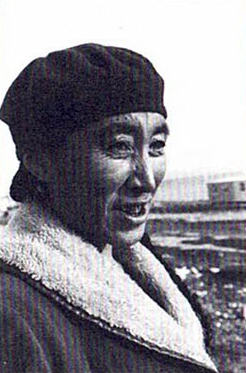
Hannah Kigusiuq (1931 – 1995)
Hannah Kigusiuq was born near Garry Lake, in the northwest region of the Back River delta. She is Haningayuqmiut, a sub-group of the Utkuhikhalingmiut. She married at a young age and raised five adopted children. In 1956, her parents were sent to hospital in the south because of the tuberculosis outbreak in their camp; a year later Hanna’s family moved to the settlement at Baker Lake. In the 1960s, she was encouraged to draw by the craft officer, Boris Kotelewetz, and then continued, in earnest, under the Butlers’ nurturing guidance.
Hannah’s drawings illustrate experiences and stories remembered from childhood. She has made numerous contributions to the Baker Lake Annual Print Collection and her drawings have been featured in several group exhibitions.
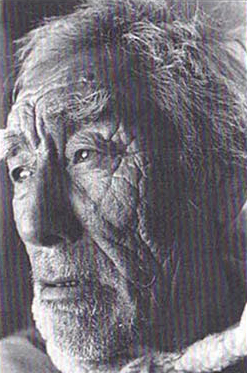 Luke Anguhadluq (1895 – 1982)
“Tall and broad shouldered, a head higher than all the others” and acting with “the dignity of a chieftain” is how Knud Rasmussen described Anguhadluq, when he made his legendary visit to the Utkuhikhalingmiut in the Back River area in 1923. The young man Rasmussen had met grew into a respected hunter and the camp leader of a large extended family. He retained an imposing posture throughout his lifetime. Anguhadluq reluctantly moved his family from their beloved Back River region to the settlement of Baker Lake in 1961 due to a chronic shortage of land foods that threatened their survival, but he continued to spend extended periods of time on the land he knew so well. He chose to be buried, not in the Anglican cemetery, but on his favourite viewing hill, east of the settlement, where he had often searched the horizon for caribou.
Inspired, perhaps, by the early artistic efforts of his cousin, Jesie Oonark, Anguhadluq made his first drawings in 1960/61, for the Northern Service Officer, Tom Butters. He also tried his hand at carving but the graphic medium is what held his interest. It earned him renewed respect and attention in the new social milieu of settlement life. Anguhadluq was a prolific artist and his distinctive images of hunters and animals on the land were an integral part of each Baker Lake Annual Print Collection from 1970 to 1982. His drawings have also been featured in more than seventy national and international exhibitions including a shared exhibition with his wife, Marion Tuu’luq, which was mounted in 1976 b the Winnipeg Art Gallery. There have been six solo exhibitions of his work, most recently in 1993, at the Art Gallery of Ontario.
I knew that Anguhadluq existed because I had seen his drawing but I didn’t know exactly who he was. I didn’t know that when people spoke about ‘Anguhadluq’ it was the same artist whose name was spelled ‘Angosaglo’ on the RCMP disc list. As I struggled to hear and speak names in Inuktitut, I thought ‘Angosaglo’ and ‘Anguhadluq’ were different people. Eventually I realized that it was one name pronounced differently by different groups of Inuit. Most people coming from his area, the Back River, would pronounce it ‘Anguhadluq’ but more formally it would be ‘Angushadluq’ or ‘Angusadluq’ and the result was all these different spellings.
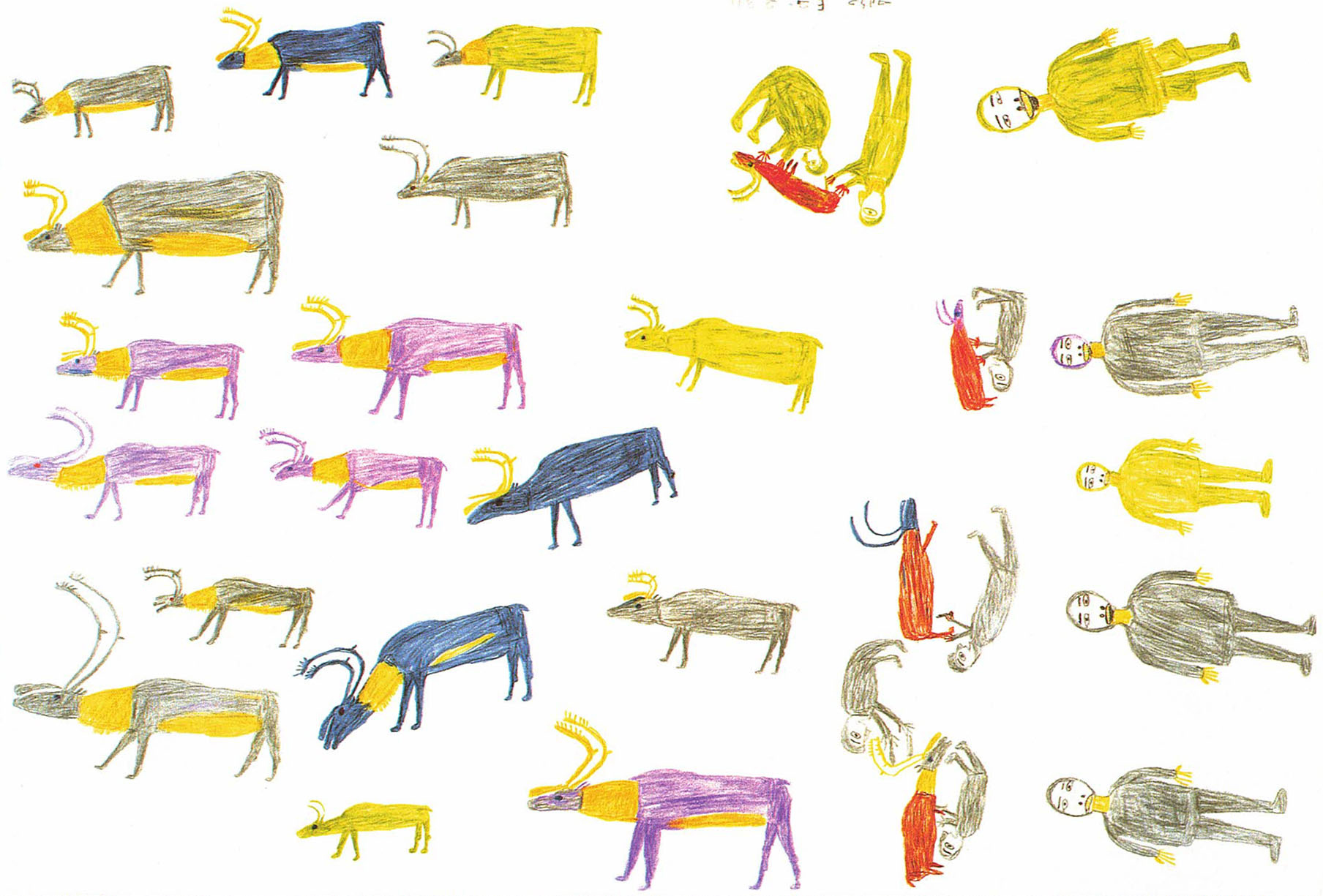
CARIBOU HUNTING SCENE, Luke Anguhadluq, 1970, Coloured pencil, 30 x 42 in.
“The orientation of the figures in different directions on the page is significant. It is as if Anguhadluq was somehow above the scene, looking down on the middle, with distance moving outward in all directions toward the edges of the page. The animals are then oriented graphically in their most representational form as they relate to the figures of the hunters.”
The early Anguhadluqs are not signed. Either I would have written his disc number (E2-294) on the back of the drawing when it came in or the number would have been written on the note-book itself. For a long time there was no way I could get Anguhadluq to sign the drawings nor had I the Inuktitut to ask him to do so. I suspect he might not have known how to write his name in syllabics to begin with. It’s quite possible. What use would she have had for writing in syllabics at seventy-plus years of age? Later, he developed a signature which became big and clear. I don’t think any of his drawings were signed prior to 1970. Once we were producing editions of prints we asked him to come to the shop to sign the prints and sign his early drawings as well.
In the beginning Anguhadluq used regular 2B pencils and sketchbooks of bond paper, as those were all that we had available. Later, I ordered good quality paper for him, Rives BFK, and provided him with Prismacolour pencils. He liked to work at his camp and needed a medium that was dry and portable. Sheila describes Anguhadluq’s drawings as having the “tactile, textural quality of shaggy, broken and flickering lines.” One of the aesthetic, cultural, and intellectual approaches Inuit artists take to the production of drawings can be found, it seems to me, in the root word ‘titiraut’ which the artists use to designate drawing. ‘Titiraut’ is based on the idea of an incised and discursive line, like the kind of line used to make a map: you may end up with the two-dimensional field of the map but the drawing process is linear in its approach. That seems to be the process, for instance, that Anguhadluq follows; his pencil lines have the quality of incised marks. Even the lines that he uses to mark the outlines of a shape, line that of the caribou, create the feeling of volume and the texture of fur because each line is an independent mark and contains its own visual integrity. Later on, Anguhadluq became equally preoccupied with shapes, his figures became larger, and he really enjoyed using colour in a very decorative way.
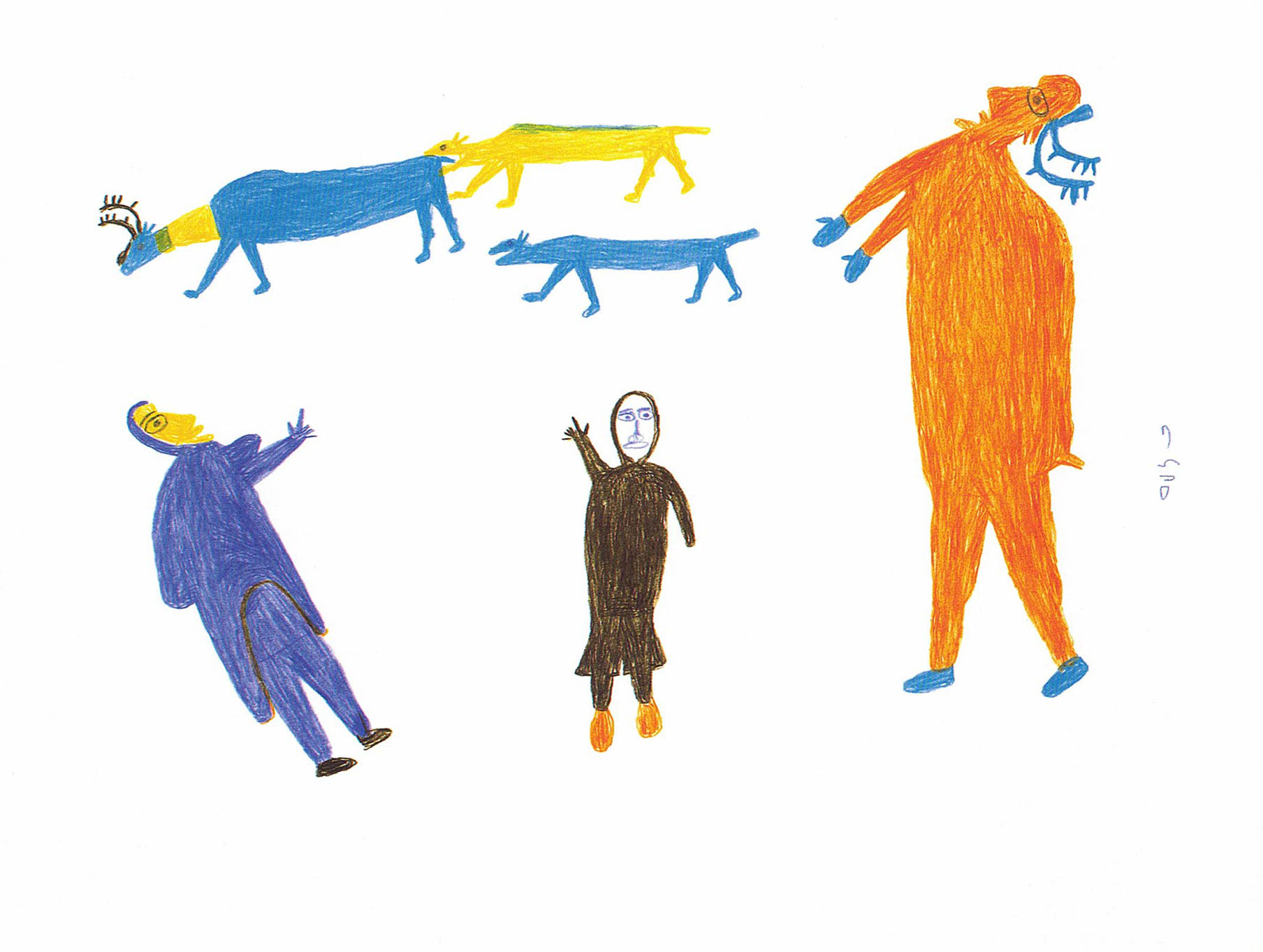
CARIBOU, TWO FIGURES AND SHAMAN, Luke Anguhadluq, 1978, Coloured pencil, 23 x 30 in.
“This is a later drawing. Anguhadluq moved very slowly toward using figures this large and so much colour. He used yellow to indicate white on the neck of the caribou and on the wolf; the brown on the child’s garment would suggest that it is caribou fur. I cannot explain the orange figure at the right nor can I recall another Anguhadluq drawing of a person with caribou antlers like this one. It could be a shaman, but this was one of the subjects that the artists were reluctant to discuss. Anguhadluq certainly did drawings of the drum dance which was originally an ecstatic, shamanic experience. My only experiences with drum dancing in Baker Lake were in the context of parties or wedding ceremonies, where the drum was used for entertainment and the telling of stories.”
The particular placement of the figures on the sketch-book page or sheet of paper is significant in Anguhadluq’s work. He sat on the floor with the drawing between his outstretched legs and turned the paper as he drew. Working in this way, Anguhadluq located himself, imagined his point of view on the world, at the centre of the paper, and the edges of the paper can be understood to represent the horizon. In the visual conventions applicable to western art, including the science of linear perspective, objects located at the bottom of the page signify proximity in space and objects at the top of the page signify distance from the viewer, like a landscape format. Anguhadluq approached the two-dimensional surface of the paper from above, looking down on the middle and moving out from the centre. Distance thus became the edges of the paper on all four sides, essentially creating four horizons. This was his organizing format for space.
Animals and figures are oriented on the visual field consistent with this spatial plan. Inuit and caribou are described graphically in their most recognizable form, that is, as they would be viewed by the hunter. Also, when Anguhadluq drew on the page, he was sensitive about the size of his subjects relative to the expanse of the white paper, the ground. His decision to draw tiny figures on a huge piece of paper represents an essential aspect of his unique world view. Whether this was accomplished consciously or intuitively is unimportant; it was his decision and that’s all that matters.
The young bilingual Inuit who were responsible for translating in the Co-op would just dread it when Anguhadluq showed up because often no sense could be made of what he was saying. Many times, I did not get any clear explanation. Furthermore, Anuguhadluq was reluctant to discuss his images. Like Picasso, he used to say it was enough that he had made the drawings and that what was in them was obvious to everyone. I suppose, to Anguhadluq, the fact that we often did not know what his drawings were about was simply unfortunate for us!
To view available artworks for sale from Baker Lake, click here.