
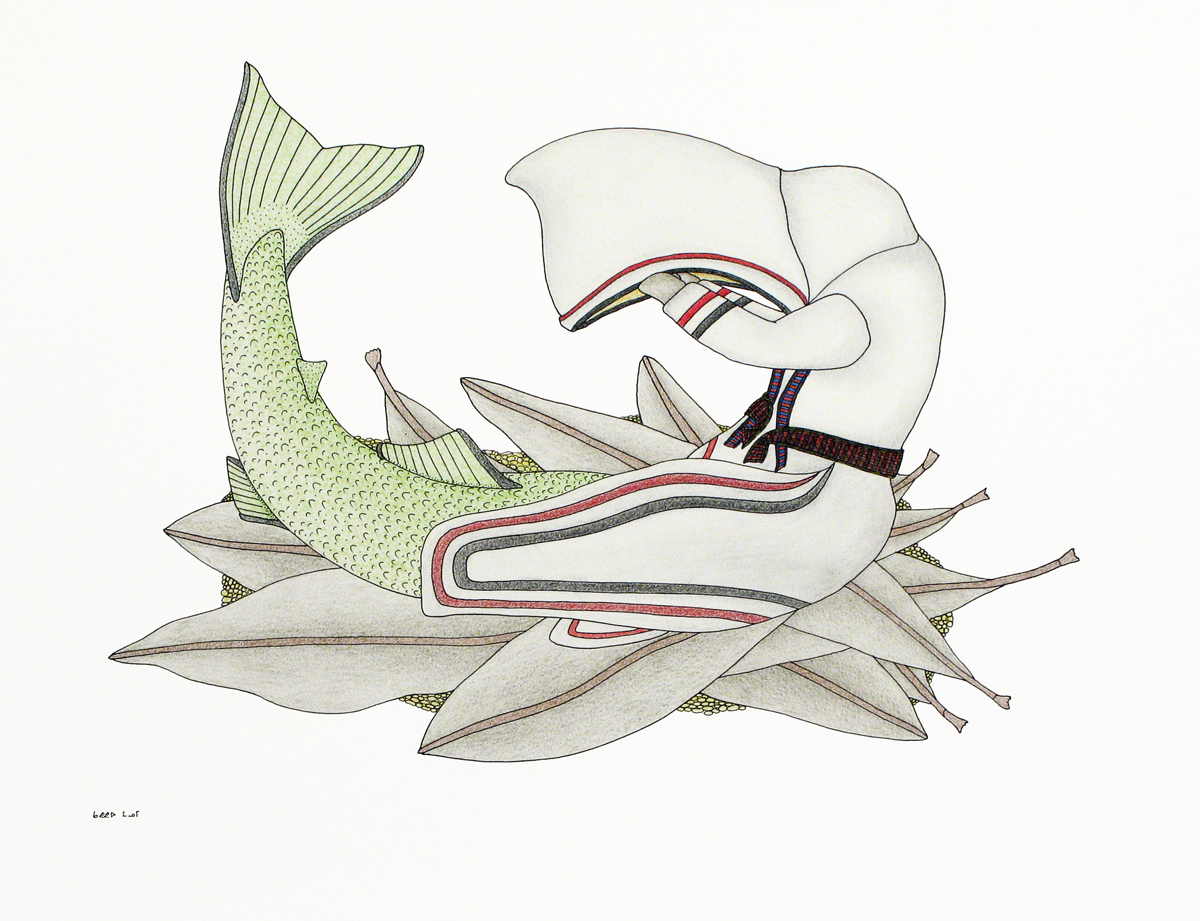
Qavavau Manumie, RECLINING SEDNA, Kinngait (Cape Dorset), 2006, coloured pencil & ink, 20 x 26 in.
I first encountered the work of Cape Dorset artist, Qavavau Manumie, in the early 1990s when I saw a remarkable image entitled, NASA Graveyard. This drawing, done in 1989, was the first truly contemporary Inuit work I had seen in that it depicted the televised launch (and subsequent crash) of the Challenger at Kennedy Space Center. The concept of an Inuit artist watching this event on television came as a revelation to me. Of course there was no reason why significant world events would not be depicted in an Inuit drawing. It was my own assumptions of what Inuit art could, or should, be that needed to be readjusted. Since that viewing of NASA Graveyard, I have been intrigued by the dichotomy present in the work of this contemporary generation of Inuit artists. I have followed Qavavau’s work and subsequently that of his contemporaries Annie Pootoogook, Shuvinai Ashoona, and Siassie Kenneally trying to track the history of this innovative group of Inuit artists, the first generation to be raised in a culture of television, global current events and now the internet.
Contemporary Inuit artists are gradually establishing a distinct style different from the art of their ancestors. This new style has been slow to emerge while the artistic connection to their ancestors remains significant and traditional images still predominate in the commercial market. Qavavau Manumie’s work is particularly reflective of this divide between past and present.
Qavavau’s art is idiosyncratic, combining traditional stories, realistic images of birds and sea life, as well as references to world events all depicted in shifting styles. In reviewing his massive production (he draws daily when not working at his job as a printer at the West Baffin Eskimo Co-op in Cape Dorset), one becomes aware not only of his ability as a draftsperson, but also as a teller of tales. His images are emblematic, typically centered on the page, which is perhaps a result of his practice as a printer of Inuit graphics. An example of his type of composition is the beautiful Reclining Sedna, 2006, which illustrates a Sedna figure seated on kelp trying on an amauti for the first time. Similarly, Smoking Raven, 2006 shows a central image of a delicately rendered bird smoking. The cigarette jolts the viewer into the less idealized present-day world of the Arctic North.
The influence of television is seen in much of Qavavau’s work. Christmas Tree, 2006 shows a hunter hooking a Christmas tree “after seeing a tree for the first time.” (It is important to remember here that Cape Dorset is above the tree line). We also see the Disney icon Donald Duck (Bird and Duck, 2006). The powerful image entitled Global Warming: Birds Rescuing Flooded Houses, 2005, shows gulls spitting out the swallowed buildings that were swept away by the Tsunami of 2004 and returning them to the land. Similarly, a large drawing, Men at Work, 2007, shows two groups of men making traditional Inuit tools. The central image is our planet, rotating on its axis. According to the artist, the tools are being made to repair the earth. Here Qavavau offers commentary on global issues, such as sustainability.
In the work of Qavavau Manumie the nuances are especially compelling. At its best his work is both fanciful and pointed, combining traditional Inuit imagery with references to the realities of his contemporary world. With the exception of his drawings of nature, he does not record scenes from everyday life as many Inuit artists do. Instead he creates vignettes from his life, myths and imagination and imparts them with cultural meaning. It is this meeting of influences that is provocative. We see a survey of traditional Inuit subjects: birds, Sednas, hunting scenes, and sea life often infused with images from the South: a Disney character, a spaceship, a cigarette, a tree. Like his contemporaries, Qavavau challenges our conceptions of a sublime pristine North and subtly teases us through his blended imagery to revise our expectations of Inuit drawing.
Essay by: Nancy Campbell
Nancy Campbell is an independent curator of contemporary and Inuit art.
She lives and works in Toronto.
Artist statements taken from an interview with Feheley Fine Arts, May 2008.
To view available artworks for sale by Qavavau Manumie, click here.