
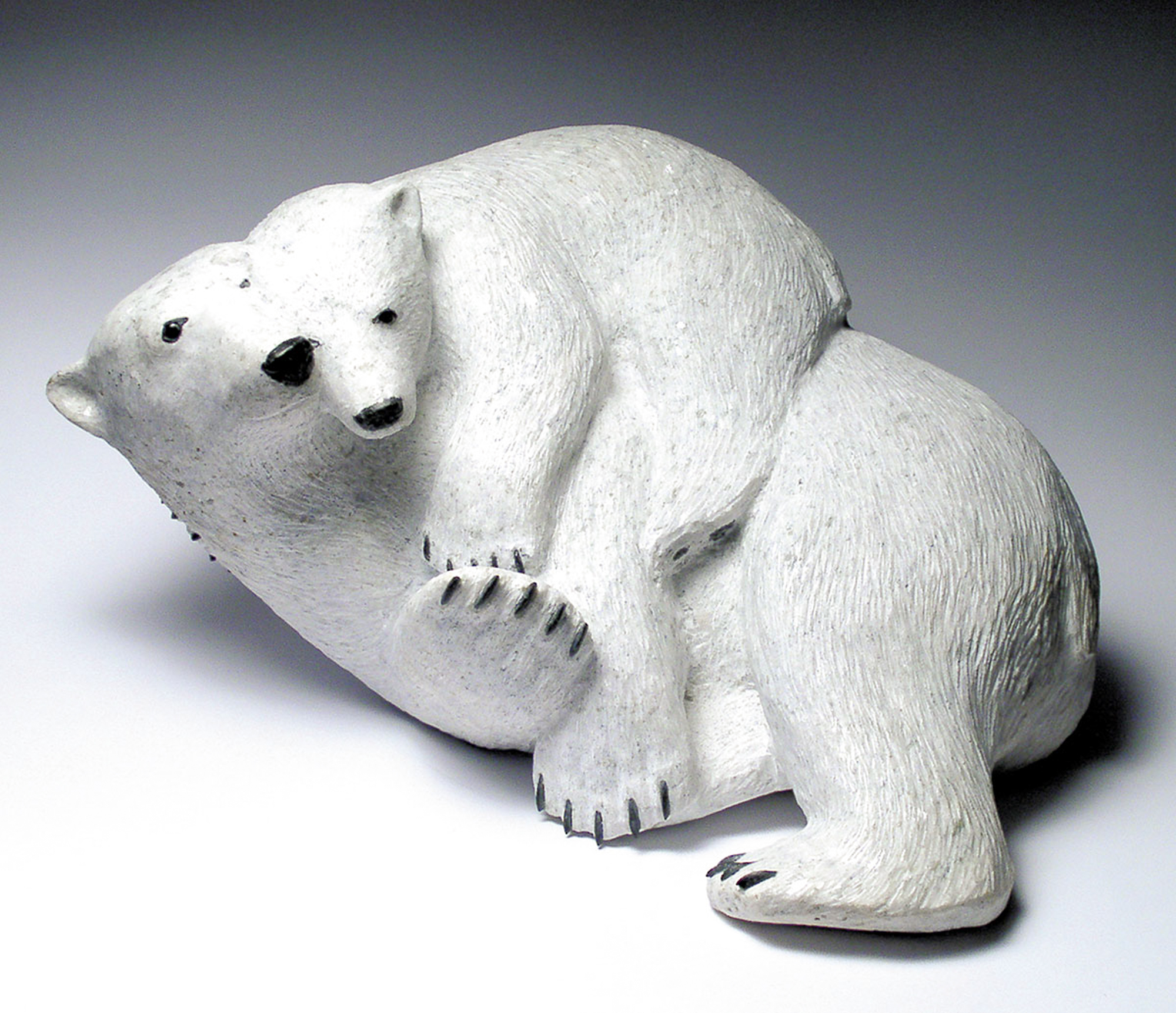
Paul Malliki, BEAR WITH CUB, 2004, Stone & inlay, 10 1/2 x 21 1/4 x 15 in.
The small hamlet of Repulse Bay holds the distinction of being the only Inuit community located directly along the Arctic Circle. Named “Repulse Bay’ in the 1740s by Captain Christopher Middleton during his fruitless quest for the North West Passage, the area is also called “Naujat” by the Inuit, a reference to nearby cliffs where seagulls nest each year. Remote and close-knit, this small community of seven or eight hunder people retains many connections to traditional Inuit culture. Hunting and fishing are still essential parts of the seasonal calendar in an area rich with wildlife, including beluga whale, caribou, seal, and a rare narwhal calving ground that has inspired several local sculptors.
Repulse Bay art has been celebrated for the delicate naturalism of historic period trade sculpture such as small static birds, animals or human figures pegged into intricate groupings. The most renowned artist to emerge from this community was undoubtedly Mark Tungilik, master of miniature and truly magnificent ivories. These influences filter softly through sculpture produced in antler, bone and ivory by contemporary artists such as Matthew Shimout and Tungilik’s grandson, Alex Kringuk. In addition to the indigenous grey stone, sculptures are made from locally quarried white marble and red granite. Carving skills are passed down through families, and the sale of work by senior artists ensure that the Naujat Co-op continues to support young sculptors in their earliest artistic endeavours.
Today, Paul Malliki is the most established and widely exhibited Repulse Bay artist, and one of few local sculptors to make his living entirely from his art. His spirited animals are dramatically posed and finely finished. Paul is an avid hunter with intimate knowledge of the physiology of the animals he sculpts in stone. “My carvings are all to do with the animals,” he acknowledges. “It’s the beauty of the animals that I’m trying to show, all the time.”
Paul has taken a fatherly role in promoting the development of carving among local artists, through his role as teacher of the Arctic College sculpture course. His tutelage has fostered several artistic careers in the settlement, including those of his brother, Lazarus, and Jackie Milortok. Paul’s influence can be felt throughout contemporary Repulse Bay sculpture, in the attention paid to inlaid detail on bears’ paws or the careful inter-carving of legs on a hunter or animal, made possible through the skilled use of modern power tools. When asked if he has a favourite subject, Paul responds, “as long as it has something to do with carving, it’s my favourite.”
Lazarus Malliki’s figurative work provides a pleasing counterpoint to the dazzling bravura of animals created by his brother, Paul. Soft-spoken and immensely talented, Lazarus accentuates his dark stone compositions with contrasting marble dust inlay, and he creates meticulous relief footings for his figures on separate stone bases. These works exhibit a careful balance and dynamism and solidity. The drum dancer is his current favourite theme. “Drum dancing is for enjoying,” he explains. “in the old days, when they had food for many months, when they were happy, they drummed. When I am very happy, when we’ve got everything in our community, its like old times. I don’t really drum, but I’m very happy when people buy my carvings. It’s how I show my happiness to people.”
To view available artwork from Repulse Bay, click here.