
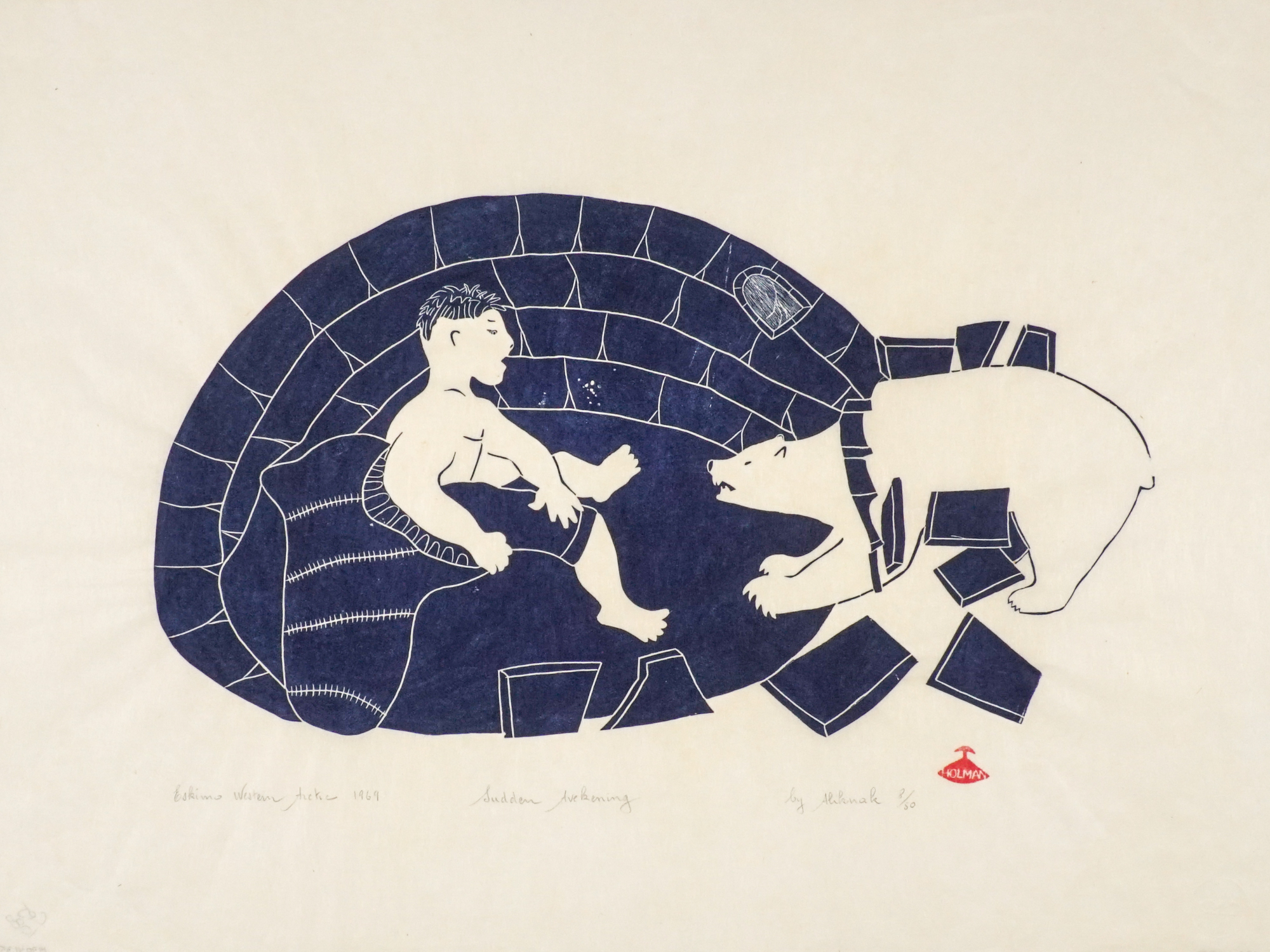
Peter Aliknak (1928 – 1998), SUDDEN AWAKENING, 1969, Stonecut, 18 x 24 in.
Ulukhaktok (Holman Island) is a small settlement located on Victoria Island in the Inuvialuit region of the Northwest Territories, Canada. Renamed from Holman to Ulukhaktok in 2006, the name was changed back to the original Inuit name which means ‘area from which the materials for making ulu knives comes’. The community overlooks the Amundsen Gulf and is renowned for its traditional culture, including drumming and dancing. Printmaking in the region began in the mid-1960’s in the Ulukhaktok Co-operative, with the first collection being officially released in 1965. Up until 2000, annual print collections were released and documented in catalogues. Beginning with stonecut and stencil, the co-op eventually introduced woodcut, lithography, etching, and even sometimes combining two techniques, lithography and etching, into one print.
Primarily monochromatic, the mid to late 1960’s minimal compositions feature magic and shamans, dancing and play, mythology, traditional stories and day-to-day life. There are also images depicting darker themes involving murder, vengeance, and kidnapping, as well as animals, birds and hunting. Sometimes, they show the realities of the dangers of life in the Arctic, where a polar bear can break in, as underlined in Peter Aliknak’s Sudden Awakening (1969). The compositions are simple but powerful, with large blocks of ink defining the figures. While they do capture Inuit traditional culture, they also capture the distinctive clothing and regalia of the Copper Inuit (Kitlinermiut), Inuit from the Northwest Territories, who were known for their use of local copper and iron deposits for tools and implements. Their distinctive clothing and dancing caps with ermine skins are shown in Mark Emerak’s Women’s Clothes (1968) or Helen Kalvak’s posthumous print The Power of Amulets (1987). These two artists, both born in 1901 lived on the land for most of their lives and could easily portray ‘the old ways’. Kalvak in particular was a well-respected storyteller.
The strong stonecut prints of the 1960s were eventually tempered by the addition of etching and lithography, making later works more textured and finished as seen in Emerak’s posthumous print Winter and Summer Hunt (1987) or the bright colour found in Kalvak’s Dream from 1977. The stonecut method, which was a staple of the program, was largely phased out by 1987 in favor of stencils and lithography due to health concerns regarding dust.
Unfortunately, Ulukhaktok’s final collection was released in 2000. Despite attempts to revive the printing shop, it remains unused today. In the community however, the graphic tradition is carried on with beautiful embroidery found in clothing.
This collection of prints, created between 1968-1987, highlights the most active and prolific time of the Ulukhaktok Co-operative.
To view available prints for sale from Ulukhaktok (Holman Island), click here.