
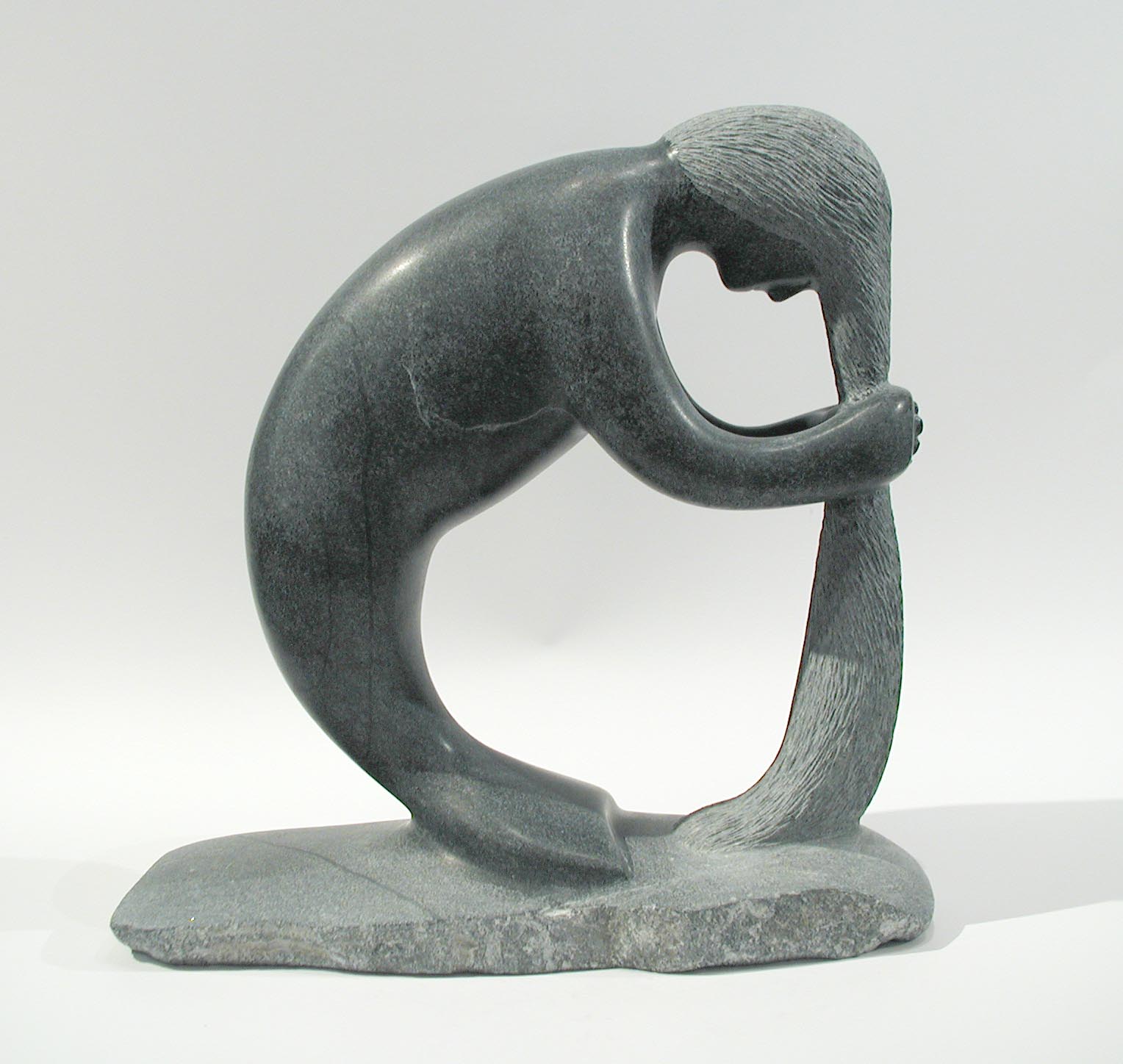
Johnny Kataluk, NARWHAL TRANSFORMATION, Stone, 12 x 13 x 4 1/4 in.
Coral Harbour, or Salliq, is located on Southampton Island in northwest Hudson’s Bay. In 1902, all of the original population of the area, the Sallirmuit, died from disease brought by European whalers. Since that time, the Coral Harbour area has gradually been settled by Inuit from Baffin Island, Arctic Quebec and mainland Keewatin. This migration created a community whose fabric was woven from diverse background and artistic styles.
Today, the people of this modern, thriving community of about 700 continue to blend the traditional with contemporary lifestyle. This, combined with the successful assimilation and evolution of their broad heritage, has yielded several generations of talented artists whose work is astonishing in its diversity and imagination. This is what makes a study of the art and artists of Coral Harbour so fascinating.
Typically, studies of Inuit art focus on the individual artist, and so it might seem anachronistic to feature a ‘community exhibition’, particularly when the work of several of the community’s artists has the maturity and depth to warrant solo exhibitions. However, like many Arctic communities, it is the common thread that provide the base from which individuals emerge.
In this community, the use of traditional materials for sculpture such as bone, ivory, antler and baleen is common. Stone supply can be problematic and often needs to be imported. Recently, local limestone has been supplemented by a newfound quarry of ‘pipestone’, rusty red in colour and beautifully veined. From these materials, works of art are made which are most often representational, depicting traditional subject matter; animals and birds, hunting and fishing, singing and dancing and the world of shaman and transformation figures.
It is the senior generation of Coral Harbour artists who typify the tradition of blending different backgrounds and artistic styles. Johnny Kataluk moved to Coral Harbour from Arctic Quebec as a child. Leo Angotingoar, although born locally, grew up in Repulse Bay, learning his skills from his uncle, the well-known sculptor Mark Tungilik. George Noah also left for many years to live in Churchhill before returning home. Artists from Cape Dorset, such as Kavavaow Pee and Otoochie Peter have taken up residence, either temporarily or permanently. This mix of influences, from the exquisite small ivories of Tungilik to the lyrical and inter-carved works typical of Cape Dorset, have been both assimilated and adapted into the work of contemporary Coral Harbour artists.
While we mourn the recent loss of Kimmy Nakoolak, his contribution to art is carried on through the younger generation. Henry, Tommy and Lucassie Nakoolak, Leo and Charlie Napayuk, Daniel Shimout, Clifford Natakok, Simeon Dion, and Bobby Eetuk are members of this group. All are enthusiastic artists who are aggressively pursuing their talen and taking every opportunity to expand their horizons. Many have participated in the sculpture and jewelry courses run by Arctic College. Henry Kudluk, who now lives in Ottawa, has been able to hone skills learned in Coral Harbour by studying the styles and techniques used by artists in the south.
It is the enthusiasm, strong sense of community and sheer talent of this group of artists which will lead the way for future generations. They have assimilated the diverse styles available to them, absorbed the fabric of the community and the benefits of mutual support, and reached out for new ideas and materials. In doing so, they have created a unique dynamic and creative artistic community.
To view available artwork from Coral Harbour, click here.