
By Edd J. Guarino
In Inuktitut, the language of the Inuit, the word for polar bear is nanook, or nanuq. Its Latin name is ursus maritimus. These huge animals are a fact of life in the Arctic. Their huge size and power make them very impressive creatures. The Inuit have been hunting polar bears for millennia, along with other Arctic animals. For generations, Inuit culture has been based on subsistence hunting, which today remains important as a source of food for the Inuit who have relied on polar bears, along with seals, whales, walruses, and caribou for their meat, which provides essential nutrients such protein, iron, niacin, riboflavin, and vitamin A, all of which are essential for survival in the harsh Arctic environment. In addition, polar bear skins are used for clothes, footwear, blankets, and rugs. In the past, the bones would be fashioned into tools and weapons and the fat was rendered to be used as oil for lamps. Today, a full hide can be sold on the international market for as much as $10,000.00. As with all of the animals the Inuit hunt, polar bears are important both culturally and economically and they are the most prized. To this day, the Inuit continue to have extensive knowledge about polar bear behavior and the Arctic environment. Although an integral part of Inuit identity, polar bear hunting is regulated by a governmental quota system to ensure the continued survival of this iconic Arctic animal. That polar bears appear frequently in Inuit art is testament to their cultural importance.
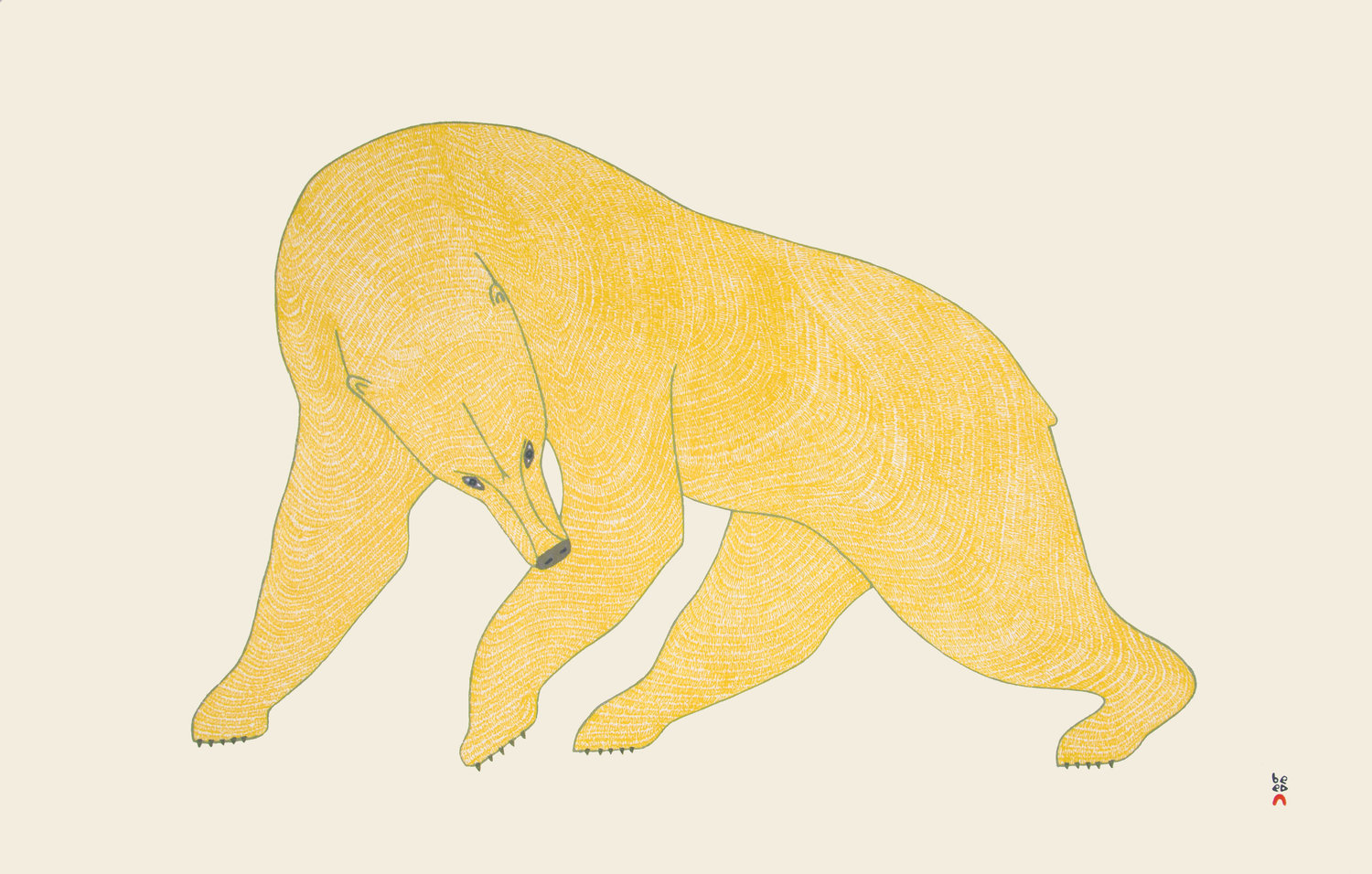
Mighty Bear by Quvianaqtuk Pudlat, Kinngait (Cape Dorset), Stonecut, 13/50; Paper: Kizuki Kozo Natural; Printer: Qavavau Manumie, 24“ x 37“ (2018). Collection of E. J. Guarino.
As with many Inuit prints dealing with animals, in Mighty Bear the image of the polar bear dominates the page. The creature’s sheer visual presence suggests its importance. Whether or not Quvianaqtuk Pudlat created an accurate or fanciful representation of a bear is open to interpretation. However, there are other Inuit works that depict yellowish polar bears. This color is the result of environmental pollution, causing the animal’s fur to become discolored. On the other hand, the bear may simply be pure fantasy on the part of the artist. Over the years, other Cape Dorset artists have created prints in which the color of the animals they depicted had no relationship to reality.
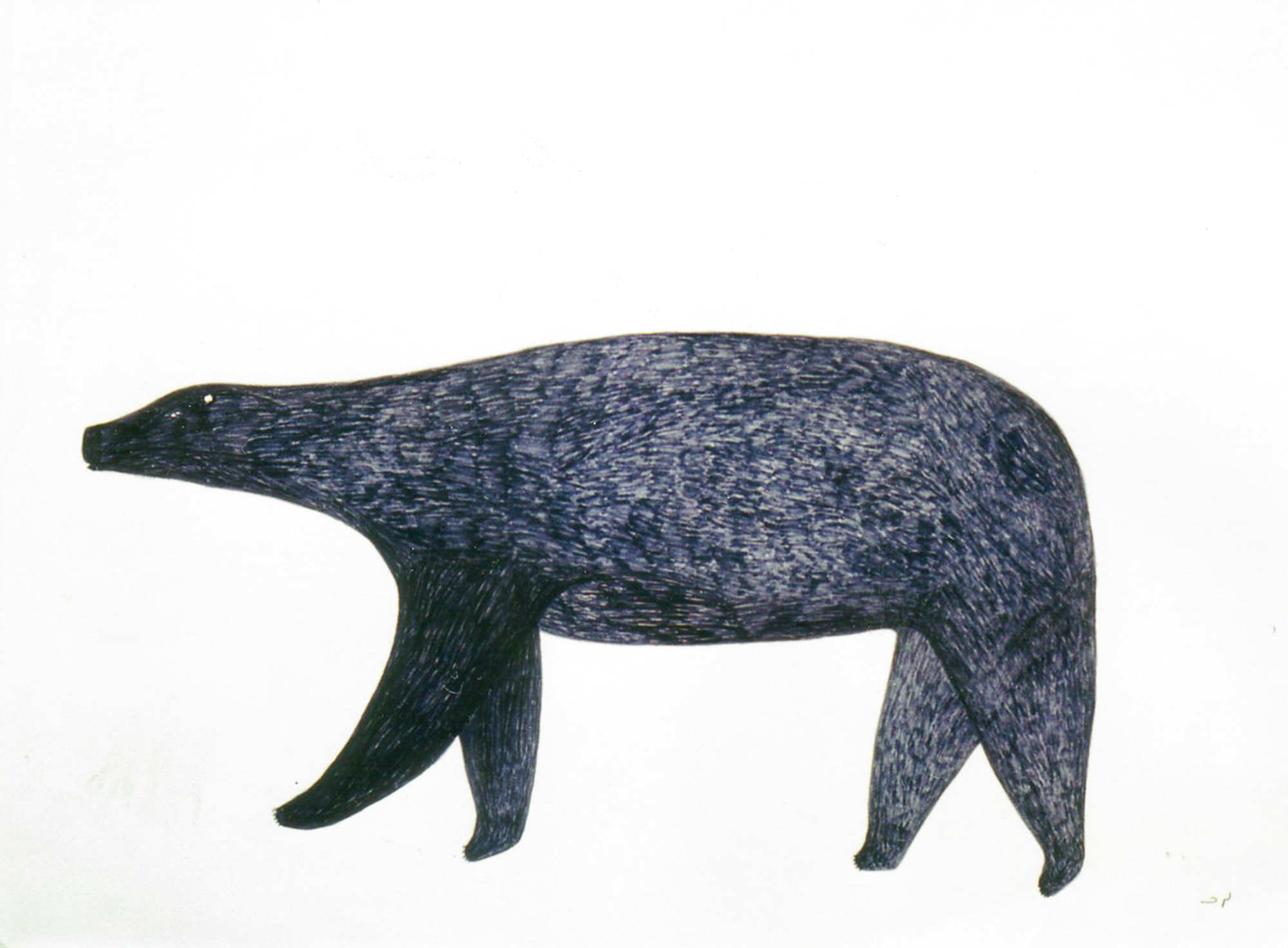
Walking Bear by Lucy Qinnuayuak, Pentel drawing, Kinngait (Cape Dorset), 20” x 26” (1976/77). Colledtion of E. J. Guarino.
Best known for her images of bird life, Lucy Qinnuayuak’s drawing of a polar bear is a rare work. The bear is charming because the animal’s fur is clearly delineated and because the artist chose to give it a purplish-blue color. The fugitive nature of Pentel, the tool the artist used to create this piece, is somewhat problematic. Basically, Pentel is another word for Magic Marker and works using this technique can fade over time. However, more importantly, if stored with other works on paper they could “bleed up” and “bleed down,” thus damaging or destroying other prints and drawings. As it turned out, the Pentel used in the Qinnuayak piece is of a more stable nature but, nonetheless, a thick barrier must be kept between Walking Bear and other graphics stored together. Rather than create a fierce looking polar bear Lucy Qinnuayuak chose to produce one that is delightful. Anyone viewing this work can’t help but smile.
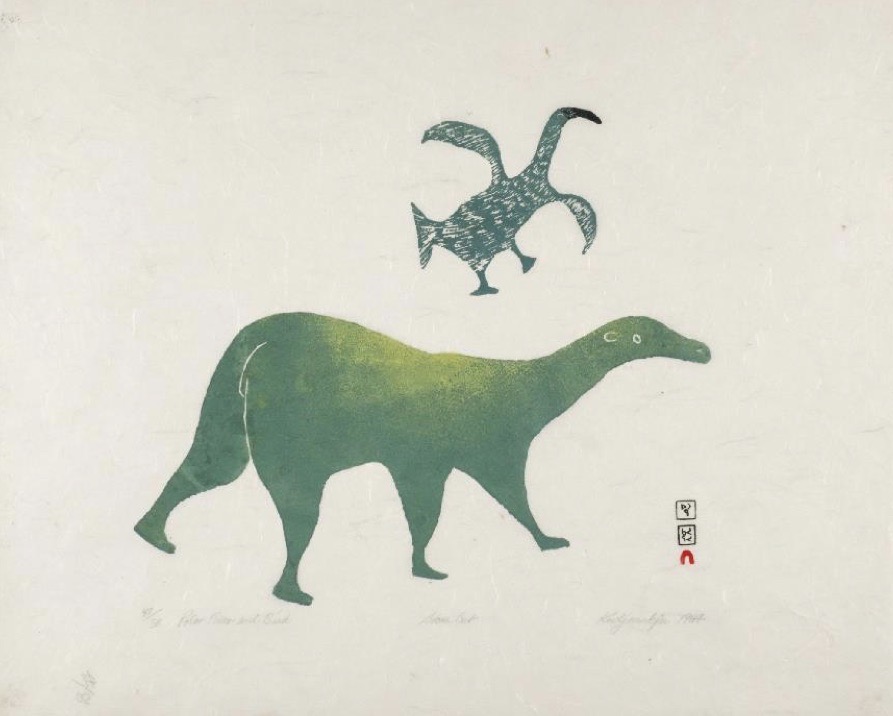
Polar Bear and Bird by Mary Qayuaryuk, Kinngait (Cape Dorset), stonecut, Ed. 41/50, 19 1/2” x 24” (1964). Collection of E. J. Guarino.
The imagery of Polar Bear and Bird is at once curious and humorous, but it does reflect a reality of Arctic life: When a polar bear makes a kill, other creatures feed off of it as well. In addition to the oddly nonrealistic greenish color of the bear, which also has touches of yellow, what appears to be the creature’s ungainly walk gives Polar Bear and Bird its somewhat humorous quality as does the rather clumsy looking bird positioned above it.
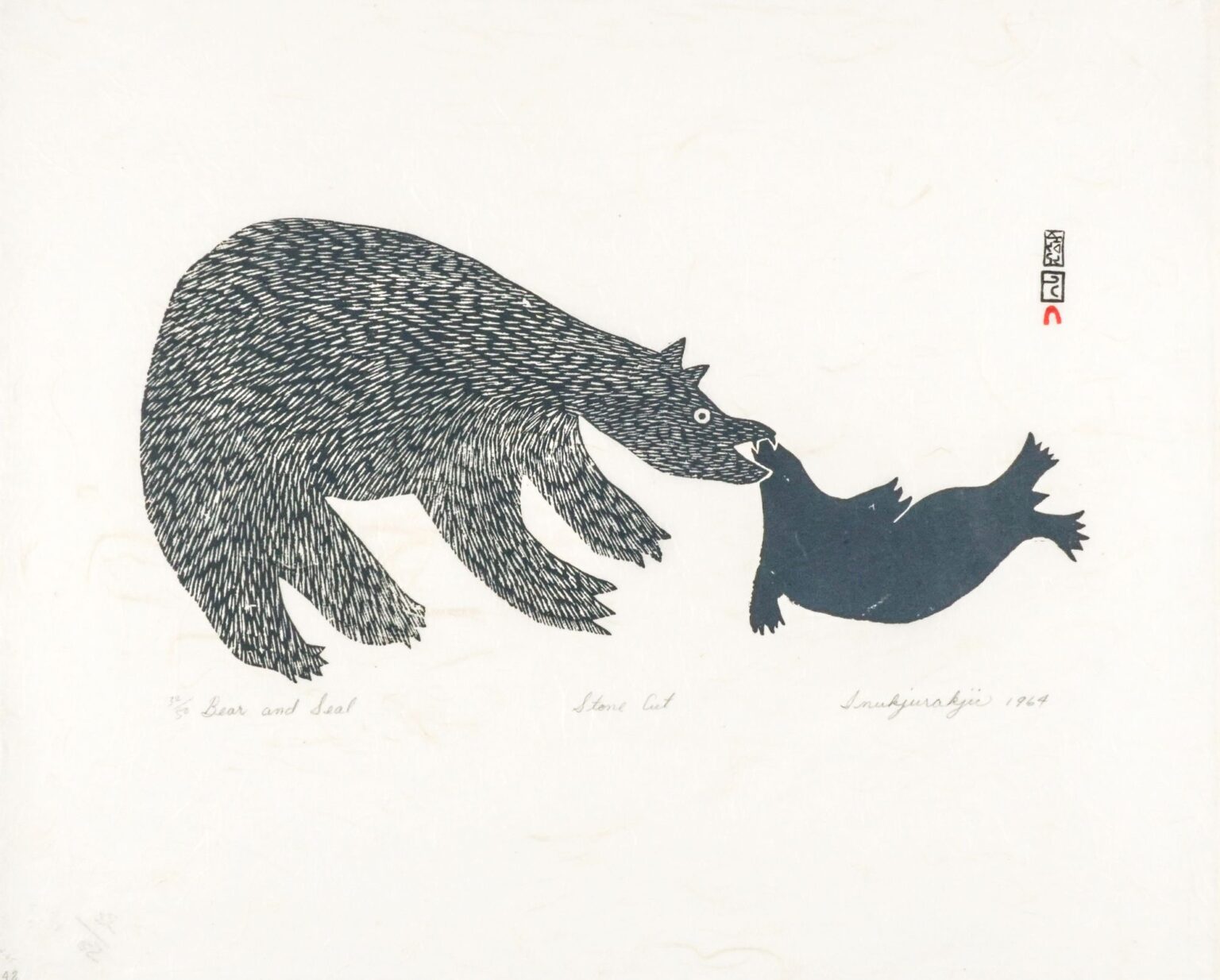
Bear and Seal by Innukjuakju Pudlat, Kinngait (Cape Dorset), stonecut, 19 3/4” x 24 1/4” (1964). Collection of E. J. Guarino.
There are many fascinating aspects to Bear and Seal by Innukjuakju Pudlat. Some are technical while others are visual. The printmaker’s decision to employ the use the stonecut technique to create the print yielded unique results – subtle textures, sharp details, and bold outlines. The end result is that the viewer visually “feels” the fur of the polar bear and the coat of the seal. In addition, the print is quite realistic, revealing the fierceness and brutality of the bear’s attack. Its claws are depicted suggesting the fact that polar bears frequently seize seals by the neck in order to hold and kill them. Unlike Mighty Bear and Walking Bear, the images in this work are neither humorous, nor simply portray the polar bear as a beautiful creature.
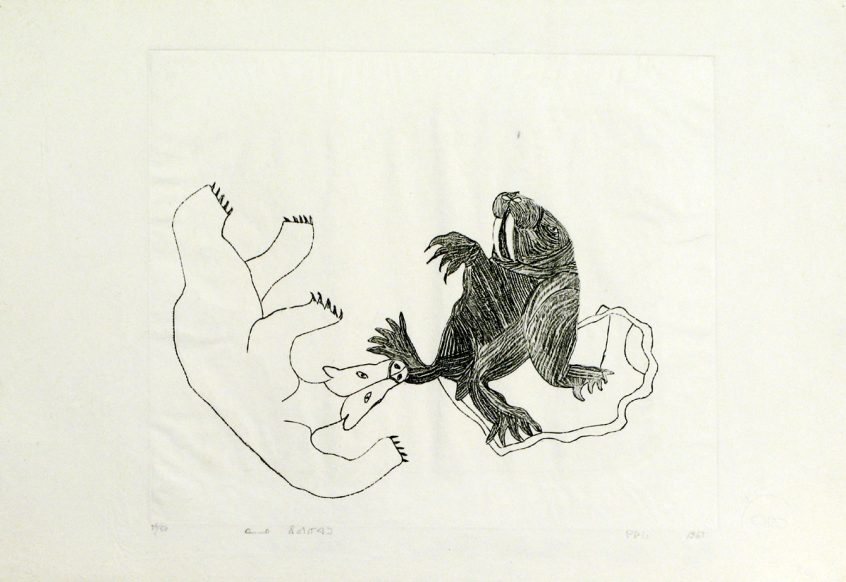
Bear Attacking Walrus by Kiawak Ashoona, Kinngait (Cape Dorset), engraving,12 1/2” x 17 3/4 (1963). Collection of E. J. Guarino.
Life and death struggles are common in the Arctic whether between man and beast, or between two animals. Looking at Bear Attacking Walrus by Kiawak Ashoona one intuitively senses that while the walrus is fighting for its life, the polar bear needs to eat it to survive. The battle between these two great Arctic animals is emphasized by the position in which they are placed on the paper. Their bodies seem awkward, the image suggesting that the walrus is being pulled off an ice floe by the bear as is often the case. Stealth hunting allows the polar bear to sneak up on its prey unnoticed until the few seconds before it strikes.
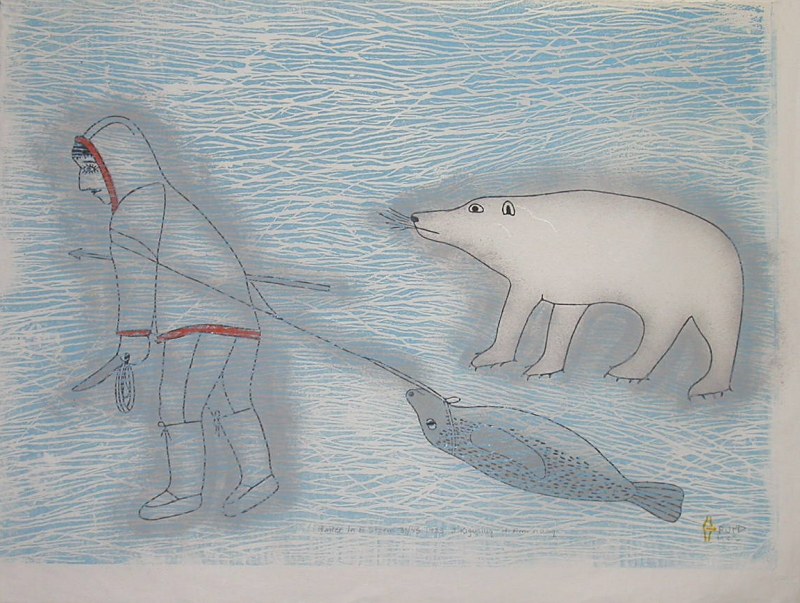
Hunter in a Storm by Janet Kigusiuq, Baker Lake, artist proof ii/iv, stonecut & stencil, edition 45, 18¾” x 25” (1983/84). Collection of E. J. Guarino.
Depicting snow on a white page is a challenge, but in Hunter in a Storm Janet Kigusiuq suggests the ferocity of the storm through which the hunter must trudge by employing light blue ink in which irregular lines have been left without color. The hunter dramatically slouches forward, allowing the viewer to feel the effort necessary to haul the seal back to camp. The polar bear is also an important character in the narrative and adds humor to the work. Since the bear is in pursuit of the man and his catch, one is left to wonder if man and seal will be eaten, but the bear is so charmingly drawn that it doesn’t appear particularly threatening. The fact that the polar bear is following the scent of the hunter and seal is indicated by black lines near the tip of the creature’s nose.
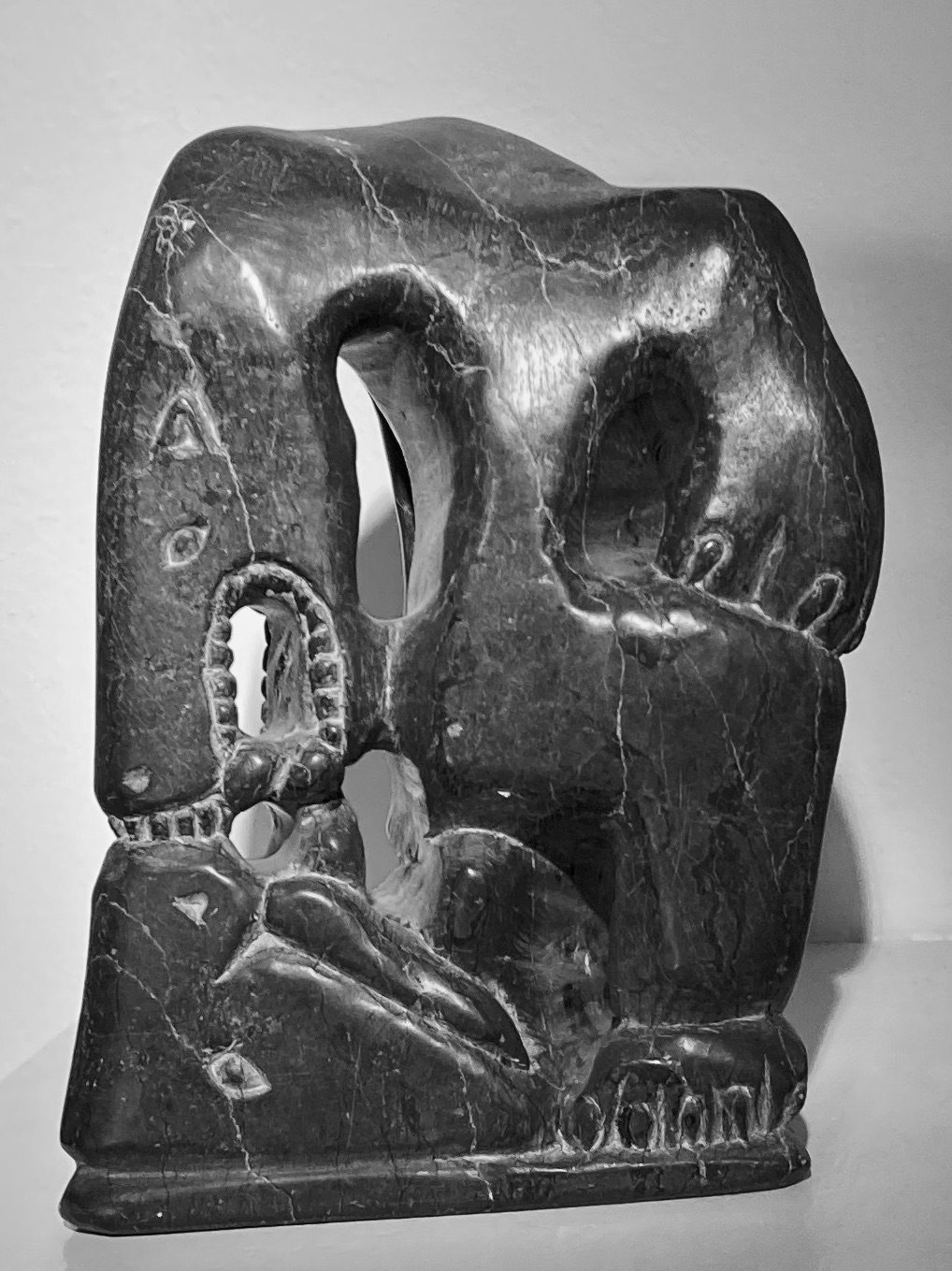
Bear and Walrus by Charles Inukpuk, Inukjuak, soapstone7” x 5” x 3¾” (1998). Collection of E. J. Guarino.
In addition to producing images of polar bears in works on paper, Inuit artists have carved sculptures of the animals. Like Kiawak Ashoona’s print Bear Attacking Walrus, Charles Inukpuk’s sculpture Bear and Walrus shows the two animals, each in its own way, struggling for survival. In Inukpuk’s work, the figure of the polar bear dominates the piece. Its ferociousness is evident as it looms over its prey, which can only be partially seen, suggesting that it might be in the water. The artist focused on the polar bear’s teeth and claws as it attacks its prey, revealing its incredible power.
Many collectors, as well as the public, may be familiar with Inuit images of polar bears through sculptures that have come to be known as “dancing bears.” However, these carvings, which can be termed as ‘“cute,” do not reflect the breath and scope of Inuit artistic output with regard to this quintessential Arctic animal. Unfortunately, the art market often drives the output of artists and this is partly true of Inuit art. However, many Inuit artists, while making works that will appeal to a wide audience also produce works that will satisfy their creative instincts as well as being of interest to a more discerning group of collectors.
This essay was reproduced courtesy of King Galleries, Santa Fe and with the permission of the author.
To view available artworks for sale on the theme of the bear, click here.