
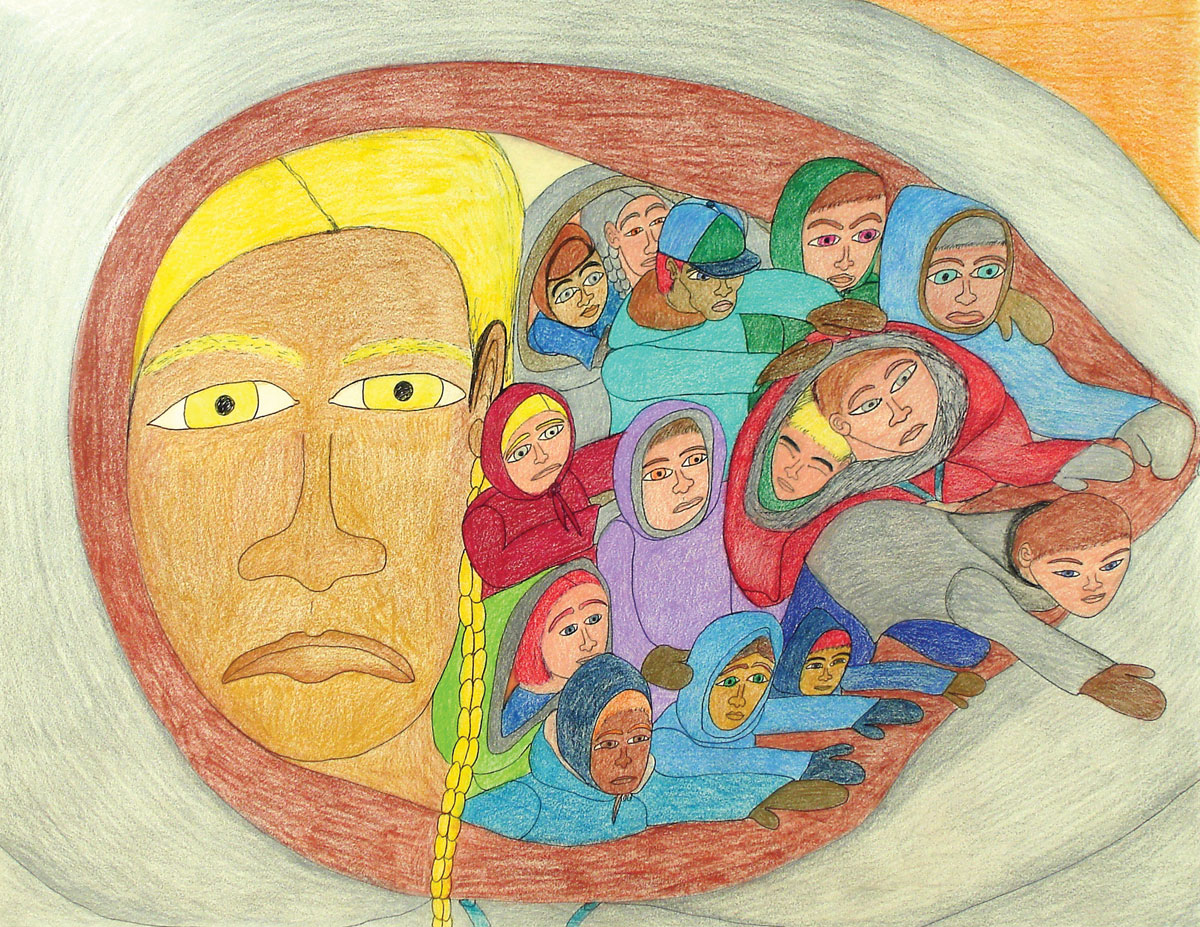
Shuvinai Ashoona, COMPOSITION (THE PEOPLE OF CAPE DORSET IN AN AMOUTI), coloured pencil & ink, 20 x 26 in.
(Digitized catalogue below)
Shuvinai Ashoona is not an emerging artist; her detailed ink drawings of dense landscapes have intrigued viewers for many years. In earlier works, domestic items and interwoven topographical elements lived side by side in a relationship of rich detail made possible through ink stippling and cross-hatching. Today, Shuvinai continues to work with an intense attention to detail, stunning colour and fascinating perspective, creating compsotions that embrace past and present. Her work is now filled with images of human figures – relatives, artists, imaginary figures from the past and even self-portraits. It may be said that Shuvinai Ashoona has truly broken out of her shell; her monochrome landscapes are now only one facet of a highly personal and accomplished oeuvre.
This exhibition is the first solo exhibition featuring the works of Shuvinai Ashoona. It celebrates the emergence of her evolving mature style with over sixty new drawings that confirm the artist’s bold new palette and increasingly confident hand.
Undeniably, an in-depth interaction is required to take in all of the elements of this large repertoire of new works. Similar to a camera’s lens, the artist encourages the viewer’s eye to approach and recede from her images. She makes a path through her drawings, depicting the figures and scenery around her, including the imagery seen in the mind’s eye. This women journey through time is like a personal tour by the artist, visiting people, places and spaces that leave one to wonder where reality ends and imagination begins.
These drawings chronicle the past and present simultaneously as Shuvinai processes and interprets the stories of others and combines them with her own. They are then presented within the context of her idiosyncratic view of the topography and landscape in and around Cape Dorset.
The Single Object
Shuvinai dedicates much attention in her artwork to the process of creating things. The making of art or tools, the building of shelters or homes, and the collection and preparation of food all receive equal importance. The abundance of these representations suggests an overt connection between people and their surroundings. These distinct relationships reveal the way people are linked to their environments and the way continued existence is based on their interdependence.

Shuvinai Ashoona, COMPOSITION (EGGS IN LANDSCAPE), ink, 20 x 26 in.
One way that Shuvinai explores the links between people and nature is through studies of objects, such as the egg, the kudlik, or the ulu. These drawings denote a shift in Shuvinai’s focus as she dedicates her attention to single objects rather than her previous more encyclopedic compositions.
The egg is a known symbol for beginnings and birth. As subject matter, it appears in Shuvinai’s work as a representation for continuity and as proof that this imagery signifies the possibility of starting anew. Similarly, Shuvinai depicts the kudlik (the stone oil lamp) and the ulu (the round women’s knife). These items are not just objects to draw, they are also traditional tools which nurture, preserve and endure the continuity of life.
The them of renewal is ongoing in Shuvinai’s drawings, which have become a place of rebirth for her memories, and she has commented on this aspect of her artwork: “Every day each coloured pencil seems like a new baby.”
Creating Art and Self Reflection
The process of making something is often considered as important as the product. In some of her work, Shuvinai breaks things down to their essential elements, revealing the individual parts that make things function. For instance, she carefully illustrates, in great detail, the way in which a kudlik functions when used to cook food, or all of the tools necessary to survive camp life. It is therefore logical that she transfers this focus to herself and studies her role as an artist in her own community.
Shuvinai is aware of her role not only as a chronicler, like her aunt Napachie Pootoogook and her grandmother Pitseolak Ashoona, but also as an intermediary between time and space. She uses her ability to communicate through artistic compositions as a means of bringing together memories of the past with the present. She has said that these images are often transmitted through her pen onto the paper so that it seems as if she is releasing the drawing from the paper, reminiscent of the notion that sculptors are simply releasing a hidden form from the surrounding material. She is well aware of the function of an artist; her recent works reveal an interest in depicting artists and the role of art making in Cape Dorset.
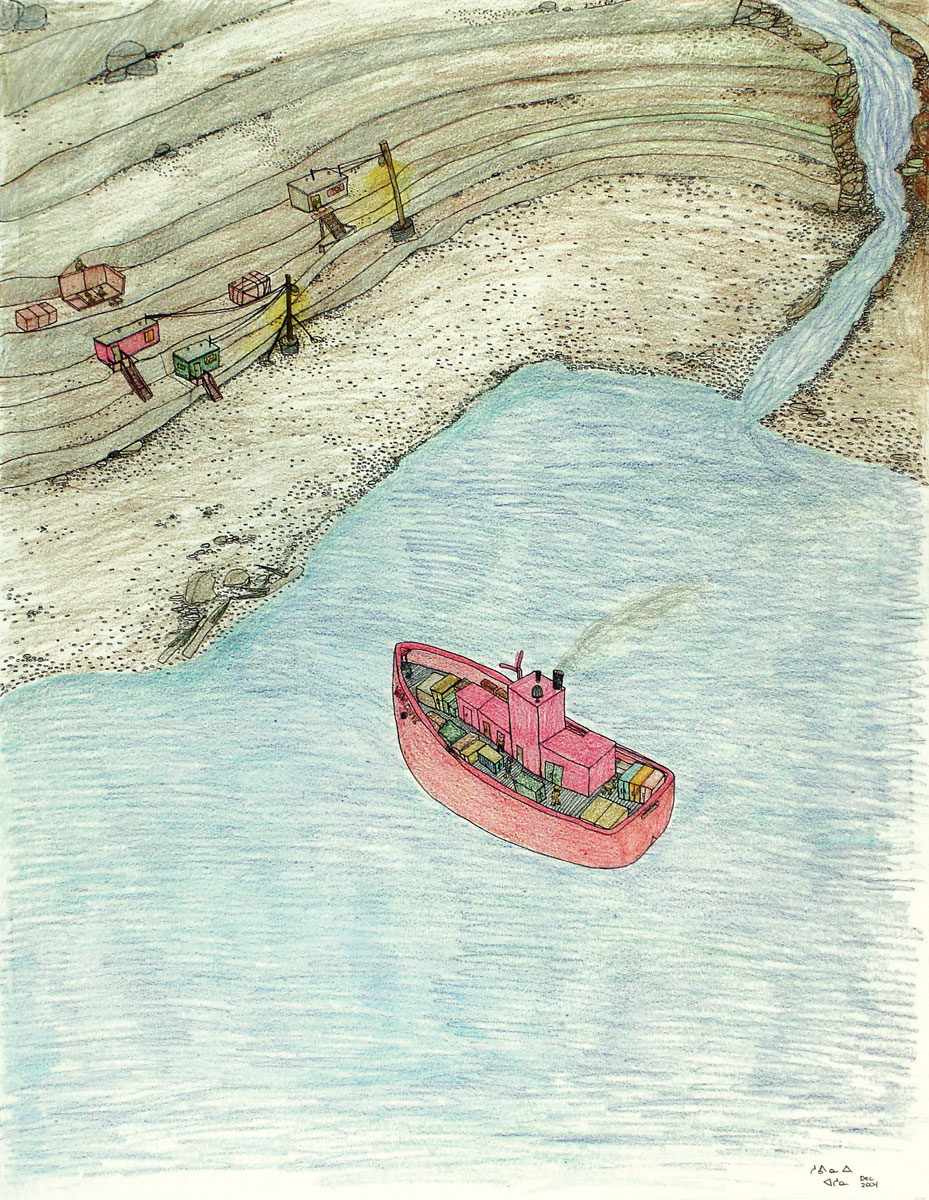
Shuvinai Ashoona, COMPOSITION (NASCOPIE APPROACHING CAPE DORSET), coloured pencil & ink, 26 x 20 in.
In Time Interrupted many of these elements are combined. The concept of being interrupted, as well as the comfortable way in which diverse imagery is combined successfully, summarizes Shuvinai’s talent for capturing different places, different activities and different moments in time within one drawing.
Metamorphosis
The theory of transformation, of one object changing into another, is not foreign to Inuit art or to Shuvinai’s work. Her imagination and innovative mind’s eye often combines shapes so that forms blend and emerge simultaneously. Many of Shuvinai’s drawings explore this idea and these images provide a sort of challenge to the viewer to deduce how many hidden objects may be found.
Remembering the Past – The Nascopie
For many years, the Nascopie, a supply ship that travelled to the Arctic every summer, was fundamental to life in Cape Dorset, marking the coming and going of time. This vessel was the principal means for transporting goods and people to and from Cape Dorset; its visits provided the community with a connection to the outside world.
In 1947, the Nascopie met her demise when she collided with a rock just outside Cape Dorset harbour. She remained stuck for two months before sinking, during which time the residents of the community availed themselves of salvageable cargo and fittings. To this day, pieces of the Nascopie are scattered throughout Cape Dorset, having found new life in the homes of Cape Dorset residents.
Shuvinai was born long after this event took place, but it seems fitting that she would represent this narrative in her work. She often recalls her father’s stories about “the old days.” Many of the elders mark the sinking of the Nascopie as the time when the old ways began to give way to the new. In some ways, the Nascopie’s story is an appropriate analogy for Shuvinai’s drawings as it too brings the past and present together in unique ways.
The Land
Landscape and topographical views remain an important part of Shuvinai’s work. However, these drawings have also changed; colour is widely used throughout them and there is an increased presence of human figures. The works featured in this exhibition testify to the evolution of Shuvinai’s artistic expression over the last few years. It is in these compositions that she tests her precision for details, complex structures and mind-bending perspectives. Through the tip of her pen, she leads us through her artistic creations telling a story that unites her community’s past with her own visions. Even in her mature style, Shuvinai’s landscapes continue to provide the stage on which past and present, real and imagined, human and animal exist.

Shuvinai Ashoona, COMPOSITION (SUMMER CAMP), coloured pencil & ink, 26 x 40 in.
The fond way she shares these memories indicates the great extent to which they are a part of her person. By including images of the past in her work, Shuvinai conveys a sense of pride in her identity, once again linking the past with the present.
Now and Then – People and Places
Shuvinai’s images are first and foremost highly imaginative and innovative works of art. These characteristics, paired with a unique sense of composition and colour, allow the artist to depict unlikely situations and present them as stunning graphic creations.
In these compositions, the artist draws on stories and memories of the past to inform the content of her work. She combines this knowledge with her own perceptions and interpretations, which give her work an anachronistic aspect, a sense of being out of step. In this respect, Shuvinai interrupts time, or pauses it, to take snippets from different eras and assembles them together to create a new dialogue – one that meshes past and present in a framework of reality, memory and imagination.
To view available artwork for sale by Shuvinai Ashoona, click here.