
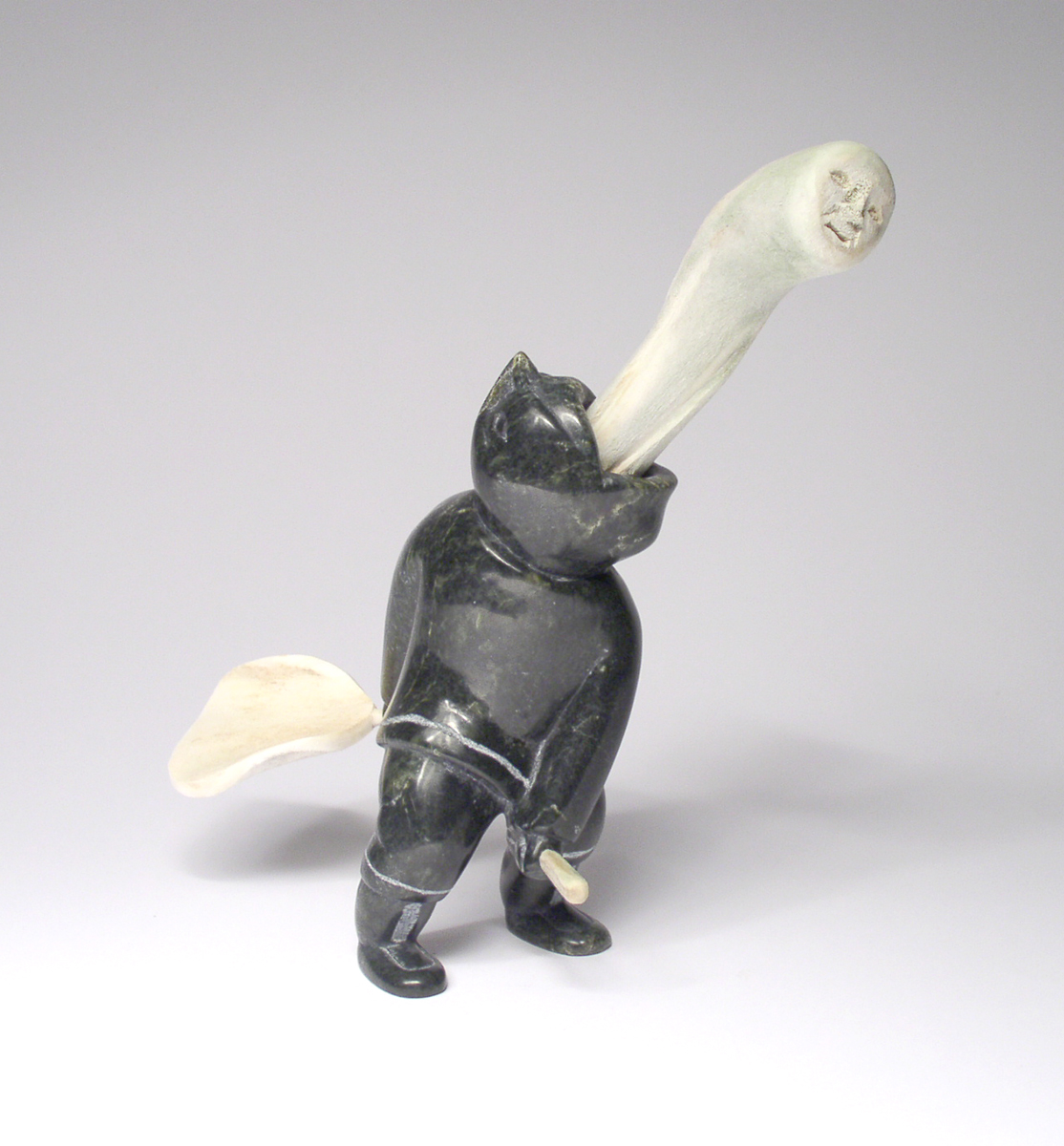
Isaci Etidloie, DRUM DANCING SONG, 2002, Stone & antler, 10 x 8 x 2 1/2 in.
My Father told me when I started carving that I should make things very unique – make things that catch the eye. I’m going to try to keep on doing traditional things in my carving because some kids are forgetting about the traditions and the carvings would probably help them. Our traditions are still important; we need to keep our traditions going.
Isaci Etidloie is a young artist on the rise. Now barely thirty years old, he began carving as early as age seven after watching his father Etutu Etidlui create animals in stone. His grandparents were artists Kingmeata and Etidlooie Etidlooie, and Equma and Quvianatuliak – of the famed Parr. In recent years, Isaci has emerged as an artistic force among Cape Dorset sculptors.
Although Isaci is aware that certain subjects are perennial Inuit art market favourites, his work is driven by more personal concerns. Isaci’s father, Etutu, si now well known across the Arctic as a singer of traditional Inuit folk music or, as Isaci calls it, ‘story-telling music’. Isaci’s recent artistic exploration of drum dancing and singing themes springs naturally from familial pride and the influence of countless stories and songs heard at Eutu’s side. Isaci has lived all his life in the settlement of Cape Dorset – never on the land in the traditional Inut manner, except for short visits to his uncles’ outpost camps. Nevertheless, his early sculptures are filled with figures engaged in the daily practices of nomadic Inuit life: hunting or fishing, cooking or sewing. This traditional subject matter is augmented by the artist’s recent fascination with ancient shaman stories and elaborate spirit transformations.
Technically Isaci is brilliant, stretching the limits of his material in ways attempted by few of his peers. Isaci’s current creations are mature, multilayered constructions such as heads that open at the mouth or brow to reveal hollowed-out chambers which could be used to hold secret enclosures. He has also become intrigued by issues of reflection – both physically and symbolic – using mirrors in his sculptures to suggest pathways to spiritual discovery. These new interests merge with his penchant for linking varied materials by means of subtle pegs and hinges to create intricate balancing compositions enlivend by colour and texture contrasts. In the past year, Isci has begun creating large-scale sculpture after a decade of small works in stone and bone. His distinctive subject matter flows seamlessly into the new larger works, although the artist admits that bing sculpture requires an exponential increase in patience and effort on his part.
Isaci’s artworks have been included in international exhibitions since the early 1990’s, and his artistic self-confidence continues to grow. Despite his young age, he is rapidly developing into one of the most exciting sculptors on the Inuit art scene today. Feheley Fine Arts is proud to present this first solo exhibition of sculpture by Isaci Etidloie.
I Like the artists who do real Inuit carvings: Quvianatuliak Takpaungai, Tivi (Davie) Atchealak, Aqjangajuk Shaa. That’s mostly how I learned to carve, by watching them. I would go to my uncle Quvianatuliak’s camp and watch him work on a spirit animal, or watch Aqjangajuk make carvings of people – that’s why I do so many people in my sculptures today.
To view available artworks for sale by Isaci Etidloie, click here.